


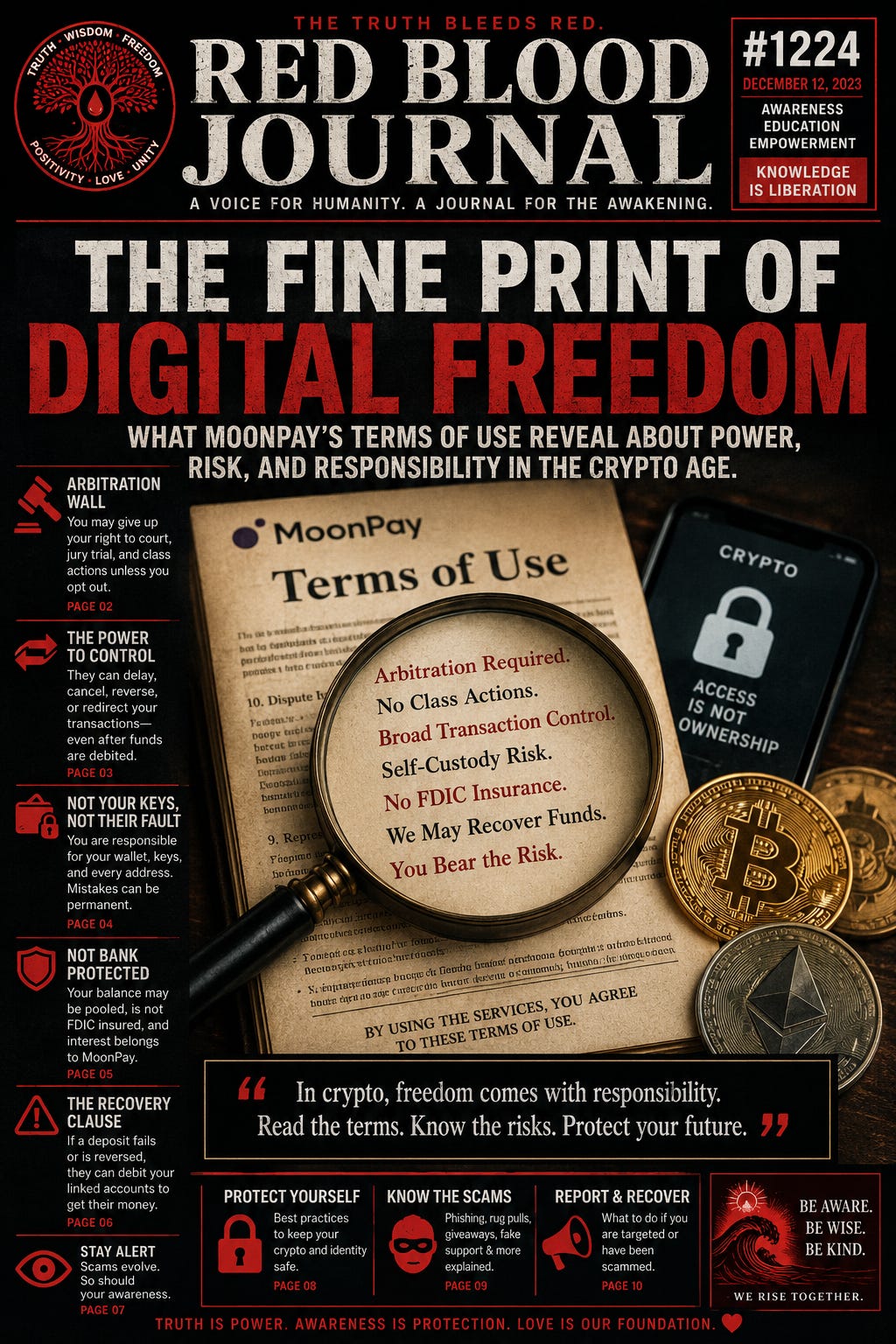
🩸 #1224 — THE FINE PRINT OF DIGITAL FREEDOM
Red Blood Journal Transmission
Introduction
The cryptocurrency movement was born from a promise: freedom from gatekeepers, decentralization of power, and direct ownership of wealth. Millions entered the digital asset world believing they were stepping outside the traditional financial structure and into a new era of financial sovereignty.
Yet every bridge between fiat currency and digital assets requires an intermediary. Those intermediaries often operate under lengthy agreements that few users ever read.
The recently updated MoonPay Terms of Use provide a window into the realities of the modern crypto ecosystem. While the platform offers access, convenience, and liquidity, the fine print reveals where responsibility ultimately rests and where power remains centralized.
The Arbitration Wall
One of the most significant provisions is the requirement that most disputes be resolved through arbitration rather than traditional court proceedings.
Users may waive their ability to participate in class-action lawsuits and may lose access to a jury trial unless they actively opt out of the arbitration provisions.
Supporters argue that arbitration reduces costs and speeds dispute resolution.
Critics view it differently.
To them, arbitration creates a barrier between individual users and large corporations, limiting the ability of groups of affected customers to pursue collective legal action.
The lesson is simple:
Every agreement signed without reading transfers a portion of decision-making authority to someone else.
Control of Transactions
Perhaps the most revealing language is MoonPay’s broad authority to suspend, delay, redirect, reverse, or cancel transactions under numerous circumstances.
In practice, this means that even within the cryptocurrency ecosystem, transactions involving fiat gateways remain subject to compliance reviews, fraud monitoring, risk assessments, and regulatory obligations.
For some users this is reassuring.
For others it highlights an uncomfortable reality:
The decentralized world often still depends on centralized checkpoints.
Ownership Means Responsibility
A recurring theme throughout the agreement is self-custody.
MoonPay explicitly states that it does not provide custodial wallet services and that users are responsible for protecting wallet addresses, private keys, recovery phrases, and transaction accuracy.
If funds are sent to the wrong address, recovery may be impossible.
If private keys are lost, access to assets may disappear permanently.
Unlike traditional banking, there is often no help desk capable of reversing blockchain transactions.
Freedom and responsibility arrive together.
The Illusion of a Bank Account
The platform’s stored-value and virtual-account features resemble traditional financial accounts, yet important distinctions exist.
Funds may be pooled with those of other users and are not eligible for FDIC pass-through insurance. Interest earned on those funds belongs to MoonPay rather than the customer.
Virtual accounts are not traditional bank accounts in the user’s name and certain funds moving through those systems may not receive conventional banking protections.
The appearance of familiar banking infrastructure can sometimes create assumptions that do not match the legal reality.
Recovery Rights
The agreement also grants the company significant authority to recover funds.
If a deposit is reversed, disputed, or fails after credit has been provided, MoonPay may recover the equivalent amount and may debit linked payment methods to satisfy obligations.
This reflects the collision between irreversible blockchain transfers and reversible traditional banking systems.
One world operates on final settlement.
The other operates on reversals and dispute procedures.
Bridging those worlds requires rules that many users never realize exist.
The Larger Lesson
The broader lesson extends beyond MoonPay itself.
Nearly every major financial platform—whether traditional banking, fintech, or cryptocurrency—contains similar themes:
Broad compliance powers.
Extensive identity verification.
Transaction monitoring.
Liability limitations.
User responsibility for account security.
Arbitration requirements.
The technology may evolve rapidly, but the underlying structure often remains recognizable.
Final Reflection
Digital assets were never a guarantee of absolute freedom.
They were an opportunity to assume greater responsibility for financial sovereignty.
The promise of self-custody is powerful, but it comes with obligations that cannot be outsourced.
The careful reader discovers that every convenience carries conditions, every service carries limitations, and every signature transfers some degree of authority.
The true lesson is not fear.
The true lesson is awareness.
When agreements are understood rather than ignored, knowledge replaces surprise, responsibility replaces assumption, and confidence replaces uncertainty.
And from that awareness emerges something far more valuable than convenience:
The ability to navigate the financial world consciously, with open eyes, while remembering that beyond every contract, policy, and platform remains the vast Ocean of Positivity, Wisdom, and Love that no terms of service can ever control. 🌊❤️
📜 The Fine Print of Digital Freedom
Jun 4, 2026
The provided text analyzes the legal and operational realities of the cryptocurrency industry by examining the fine print found in MoonPay’s Terms of Use.
While digital assets promise financial sovereignty, the source argues that centralized intermediaries often retain significant power through mandatory arbitration clauses and the authority to cancel or reverse transactions.
Users are cautioned that self-custody requires immense personal responsibility, as there are no traditional banking protections or safety nets for lost private keys or incorrect transfers.
Furthermore, the document highlights that virtual accounts lack typical insurance and serve to bridge the gap between irreversible blockchain actions and reversible legacy banking.
Ultimately, the text serves as a call for informed awareness, suggesting that true digital freedom is only possible when individuals understand the contractual trade-offs and risks inherent in modern financial platforms.


