


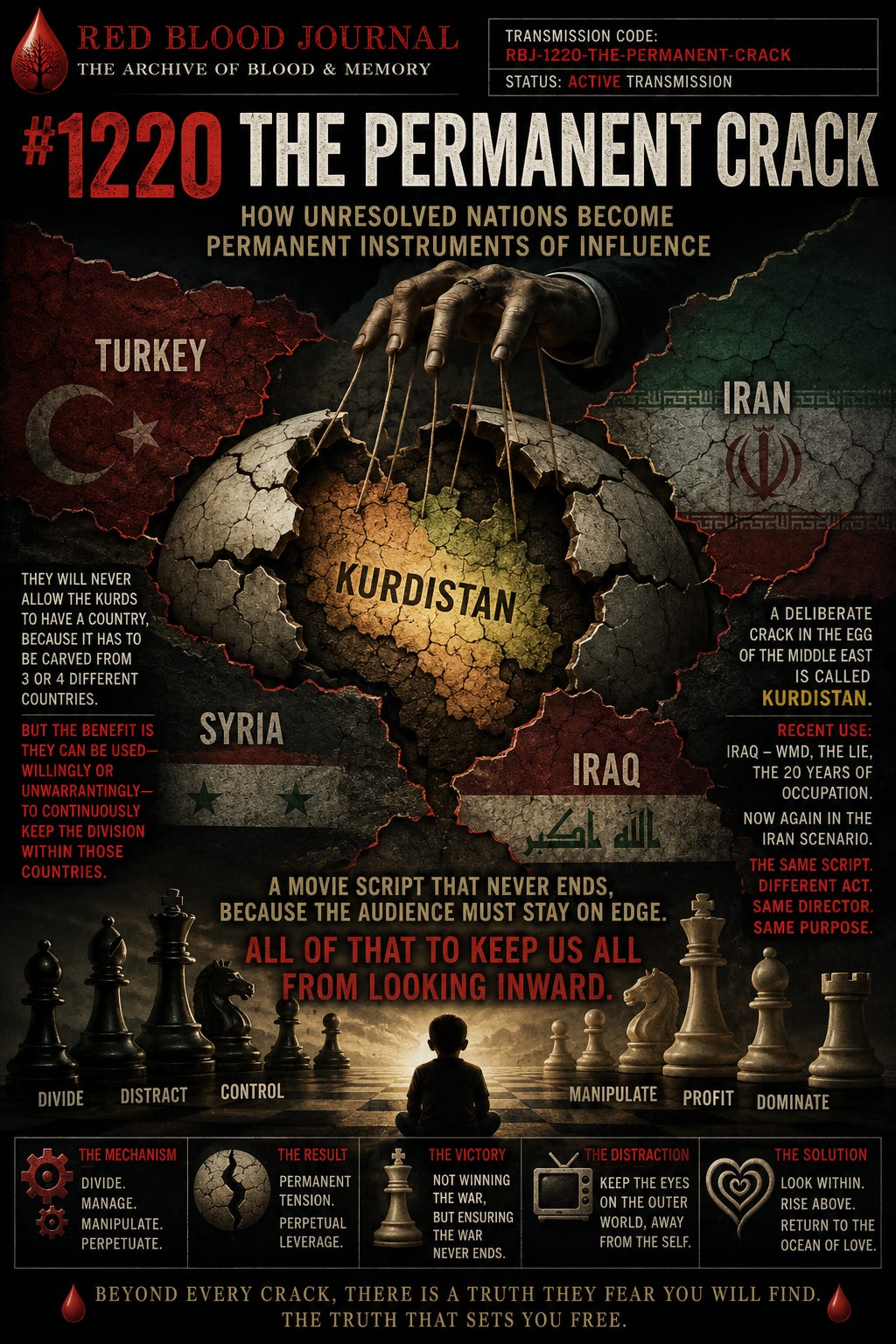
🩸 RED BLOOD JOURNAL TRANSMISSION
ARCHIVE: THE ARCHIVE OF BLOOD & MEMORY
DIVISION: GEO-PSYOPS & MIDDLE EAST INFLUENCE CARTOGRAPHY UNIT
CLASSIFICATION: STRATEGIC GEOPOLITICAL ANALYSIS
TRANSMISSION CODE: RBJ-1220-THE-PERMANENT-CRACK
STATUS: ACTIVE TRANSMISSION
🩸 #1220 — THE PERMANENT CRACK
How Unresolved Nations Become Permanent Instruments of Influence
PROLOGUE
Every empire, kingdom, coalition, alliance, and modern state has faced the same strategic question:
Is it more advantageous to resolve a conflict—or to manage it indefinitely?
History repeatedly demonstrates that unresolved disputes often generate more leverage than settled ones.
A resolved issue disappears from the geopolitical chessboard.
An unresolved issue remains available for future use.
Few examples illustrate this principle more clearly than the Kurdish question in the modern Middle East.
Spread across Turkey, Iraq, Syria, and Iran, the Kurdish people represent one of the largest ethnic populations in the world without a fully recognized sovereign state.
For generations, promises have been made.
Expectations have been raised.
Movements have emerged.
Yet the final objective remains perpetually beyond reach.
The result is a geopolitical pressure point that never fully closes.
A permanent crack within the strategic architecture of the region.
SECTION I — THE NATION WITHOUT A STATE
The Kurdish population occupies one of the most geographically significant regions of the Middle East.
Their communities span multiple internationally recognized borders.
This creates a unique strategic dilemma.
If an independent Kurdish state were established, territory would need to be separated from existing states.
If such a state is never established, the underlying aspirations remain unresolved.
Both outcomes generate instability.
As a result, the issue persists in a state of permanent suspension.
Always discussed.
Never finalized.
Always approaching resolution.
Never reaching it.
The question remains active decade after decade.
The crack remains open.
SECTION II — THE STRATEGIC VALUE OF AN UNRESOLVED QUESTION
Throughout history, major powers have often found value in maintaining unresolved political questions.
An unresolved dispute provides:
Diplomatic leverage
Military justification
Political bargaining power
Intelligence opportunities
Regional influence mechanisms
A dormant fracture can be activated when needed.
A quiet fault line can become tomorrow’s headline.
The existence of multiple competing interests surrounding Kurdish aspirations allows external actors to enter regional affairs whenever circumstances require.
The issue never completely disappears.
It simply changes form.
SECTION III — THE RECURRING SCRIPT
Students of geopolitical history often observe recurring patterns.
A regional crisis emerges.
External actors become involved.
Local factions align with competing interests.
Temporary alliances form.
Promises are made.
Expectations rise.
The crisis eventually cools.
The underlying question remains unresolved.
Years later, the same dynamics reappear under a different name, in a different location, under a different set of circumstances.
The cast changes.
The script survives.
What appears to be a new chapter frequently reveals itself as a continuation of an older story.
The region remains trapped within a cycle of recurring instability.
SECTION IV — THE GEOPOLITICS OF PERMANENT TENSION
From a strategic perspective, permanent tension offers advantages to multiple actors simultaneously.
Regional governments can justify security measures.
Foreign powers can justify intervention.
Political movements can justify mobilization.
Defense institutions can justify expansion.
Media systems can justify continuous coverage.
The unresolved issue becomes valuable precisely because it remains unresolved.
The objective is no longer resolution.
The objective becomes management.
The conflict transforms into infrastructure.
A permanent feature of the geopolitical landscape.
SECTION V — THE DEEPER QUESTION
Beyond governments, intelligence services, military planners, and political movements lies a more profound question.
What happens to ordinary people living inside systems built upon perpetual division?
The modern world continuously directs attention outward:
Toward enemies
Toward crises
Toward factions
Toward tribes
Toward political camps
Toward endless conflict
Yet the greatest questions of human existence remain internal.
Who am I?
Why am I here?
What creates meaning?
What creates peace?
The more energy consumed by external battles, the less attention remains available for inner development.
A civilization permanently focused on conflict rarely has time for self-discovery.
CONCLUSION
Whether the fracture is ethnic, political, religious, economic, or ideological, the mechanism remains remarkably similar.
Division generates attention.
Attention generates energy.
Energy generates power.
Power attracts those who wish to manage it.
The Kurdish question represents one example of a broader phenomenon visible throughout history:
Unresolved problems often become permanent tools of influence.
The crack remains.
The arguments continue.
The generations change.
The script evolves.
Yet beyond every geopolitical fault line exists another path entirely.
A path that leads away from endless external conflict and toward self-understanding.
A path beyond fear.
A path beyond division.
A path beyond manipulation.
A path leading toward the Ocean of Positivity.
The Ocean of Understanding.
And ultimately—
The Ocean of Love.
END TRANSMISSION
💔 The Permanent Crack:
Geopolitics of Unresolved Nations
Jun 3, 2026
The provided text explores how unresolved national conflicts are intentionally maintained by global powers to serve as permanent tools of geopolitical influence.
Using the Kurdish population as a primary case study, the author argues that keeping a crisis in a state of perpetual suspension provides external actors with continuous diplomatic and military leverage.
These “permanent cracks” in regional stability transform human suffering into strategic infrastructure that justifies intervention and internal security measures.
The narrative suggests that this cycle of managed instability serves to distract civilizations from internal growth and self-discovery.
Ultimately, the source advocates for a shift away from these manipulative political scripts toward a path of universal understanding and peace.


