


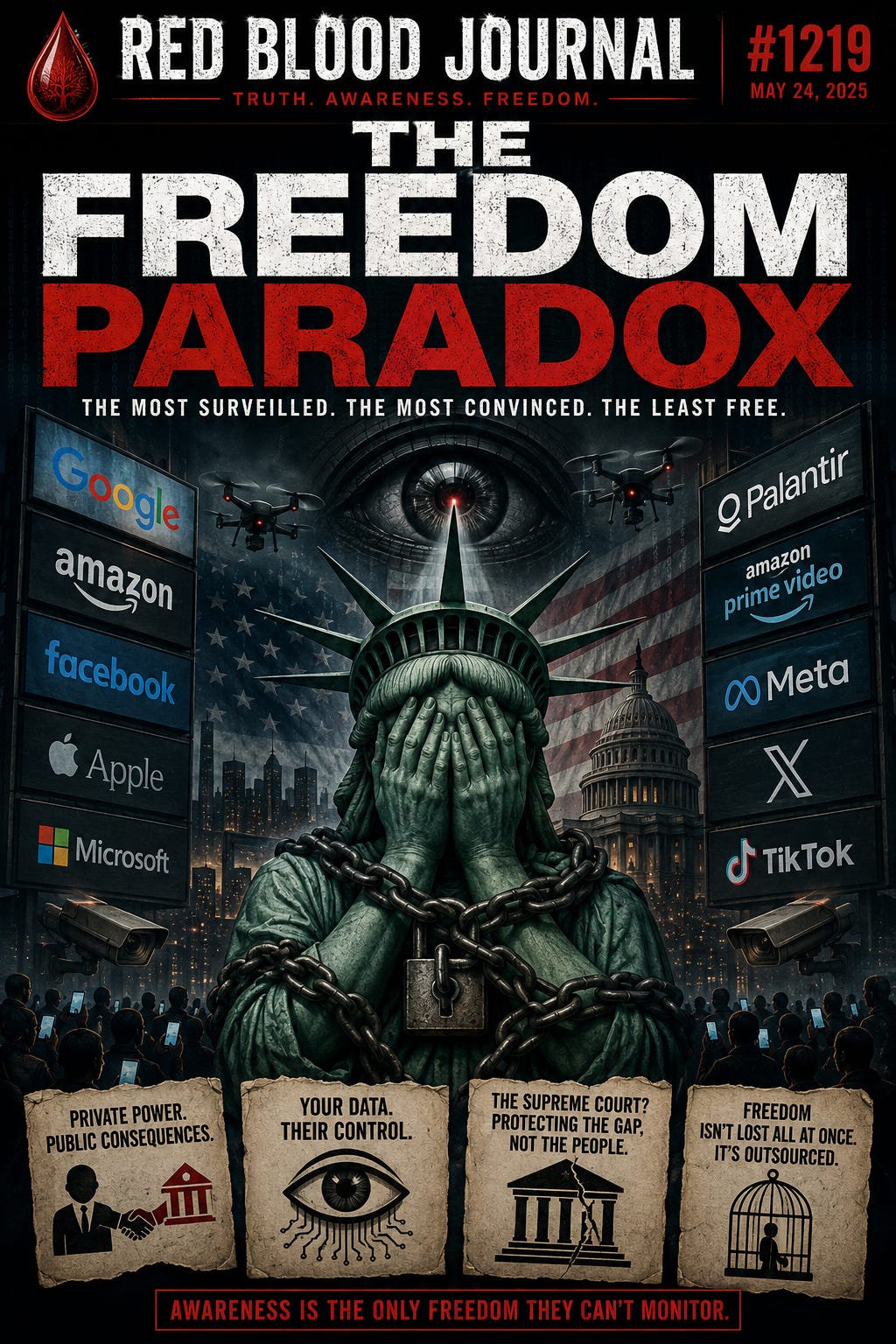
🩸 #1219 — THE FREEDOM PARADOX
Red Blood Journal Transmission
Introduction
A nation can lose its freedoms without ever removing the word freedom from its vocabulary.
In fact, the most effective system is not one that openly announces control. It is one that convinces the population they remain completely free while the mechanisms of control become increasingly invisible.
Throughout history, governments seeking greater power often faced a limitation: constitutions, courts, laws, and public resistance.
The solution was simple.
Do not perform the action directly.
Allow private entities to perform it instead.
The Constitutional Workaround
If a government cannot legally monitor every conversation, a private corporation can collect the information.
If a government cannot directly suppress speech, private platforms can decide what may or may not be amplified.
If a government cannot easily track movement, private technology companies can gather location data.
If a government cannot create detailed behavioral profiles, advertisers, applications, search engines, and social networks can assemble them voluntarily.
The distinction becomes increasingly blurred.
Officially, the state remains constrained.
Unofficially, the information exists, the surveillance exists, and the influence exists.
The constitutional barrier remains standing on paper while a side door is quietly constructed around it.
The Public-Private Partnership Question
Supporters of this arrangement argue that private companies possess rights.
Businesses may choose how to operate, what services to provide, and what rules govern their platforms.
Critics respond with a different question:
If a government regularly relies upon information gathered by private entities, coordinates with those entities, or benefits from activities it could not directly perform itself, where does the private sphere end and governmental power begin?
This question sits at the center of modern debates over privacy, free speech, data collection, and digital rights.
The issue extends far beyond social media.
The Digital Portrait
Every search query.
Every location ping.
Every online purchase.
Every financial transaction.
Every click.
Every preference.
Every relationship.
Every pattern of behavior.
Together they form a digital portrait more detailed than any intelligence agency of previous centuries could have imagined.
The paradox emerges when a nation that publicly celebrates liberty simultaneously becomes one of the most extensively monitored societies ever created.
The surveillance no longer arrives through agents standing on street corners.
It arrives through convenience.
It arrives through applications.
It arrives through loyalty programs.
It arrives through smart devices.
It arrives through technologies willingly carried in every pocket.
The citizen often becomes both the subject and the collector.
Participation is voluntary.
Understanding the consequences is often not.
Two Interpretations of the Same Reality
Meanwhile, courts and legal institutions continue to play their traditional role, attempting to balance privacy, security, commerce, and constitutional protections.
Supporters view these institutions as safeguards that preserve freedom.
Critics view them as increasingly unable to keep pace with technologies that evolve faster than legislation.
The result is a growing perception gap.
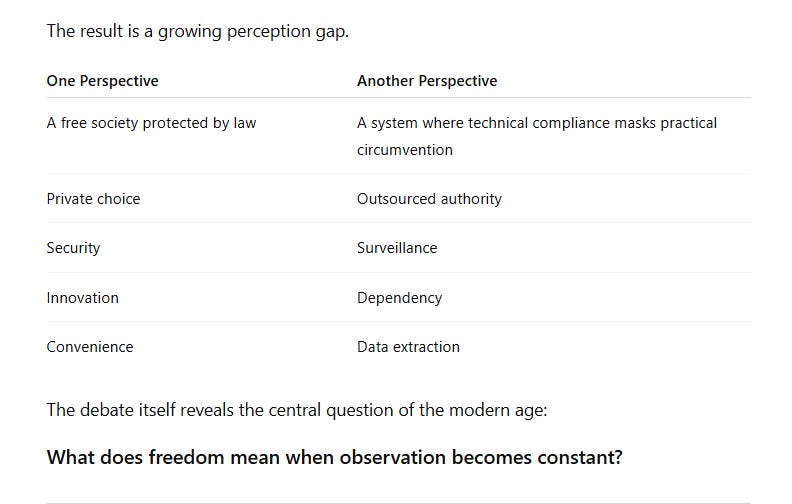
What does freedom mean when observation becomes constant?
The Challenge of the Digital Era
Perhaps the defining challenge of the digital era is no longer whether surveillance exists.
It is determining:
Who controls it.
Who benefits from it.
Who oversees it.
Whether those being observed truly understand the extent of the observation.
History suggests that freedom is rarely lost all at once.
More often it fades gradually beneath layers of convenience, safety, efficiency, and necessity until future generations struggle to remember where the line once existed.
The Forgotten Freedom
Yet there remains another possibility.
Awareness itself can become a form of protection.
An informed population can question.
It can debate.
It can demand transparency.
It can insist that technology serve humanity rather than humanity serve technology.
For every system that expands observation, there exists an equal opportunity for understanding.
For every mechanism of control, there exists the possibility of wisdom.
Beyond politics, corporations, courts, and institutions lies a deeper reality often forgotten amid the noise:
Human beings possess the ability to observe themselves.
To question themselves.
To understand themselves.
And in that self-awareness exists a freedom no database can fully catalog and no algorithm can completely predict.
Conclusion
The greatest safeguard may ultimately not be found in a courtroom, a legislature, or a corporation.
It may be found within the individual who learns to think independently, see clearly, and remain anchored in principles rather than fear.
For beyond every digital network, beyond every system of power, and beyond every temporary structure of control, there remains an ocean larger than all of them combined:
The Ocean of Positivity, Awareness, and Love.
Those who learn to navigate that ocean discover a form of freedom that cannot be monitored, purchased, regulated, licensed, tracked, or taken away.
🩸 Red Blood Journal Transmission #1219
THE FREEDOM PARADOX
“The most powerful cage is the one its occupants believe is freedom.”
👁️ The Invisible Architecture of Digital Control
Jun 3, 2026
The provided text explores a modern sociopolitical dilemma where individual liberties are quietly eroded through a collaboration between government interests and private corporations.
This “freedom paradox” suggests that while constitutional protections remain officially intact, the state bypasses legal limits by utilizing data harvested by tech companies from everyday digital activities.
Instead of overt oppression, this system relies on invisible surveillance fueled by the convenience of smartphones, social media, and financial tracking.
The author argues that citizens often voluntarily participate in their own monitoring, creating a detailed digital portrait that previous intelligence agencies could only dream of possessing.
Ultimately, the narrative posits that true independence is found not in legal battles, but in an individual’s ability to maintain self-awareness and critical thought.
This internal clarity serves as the final safeguard against a world where algorithmic control and institutional oversight have become nearly inescapable.


