


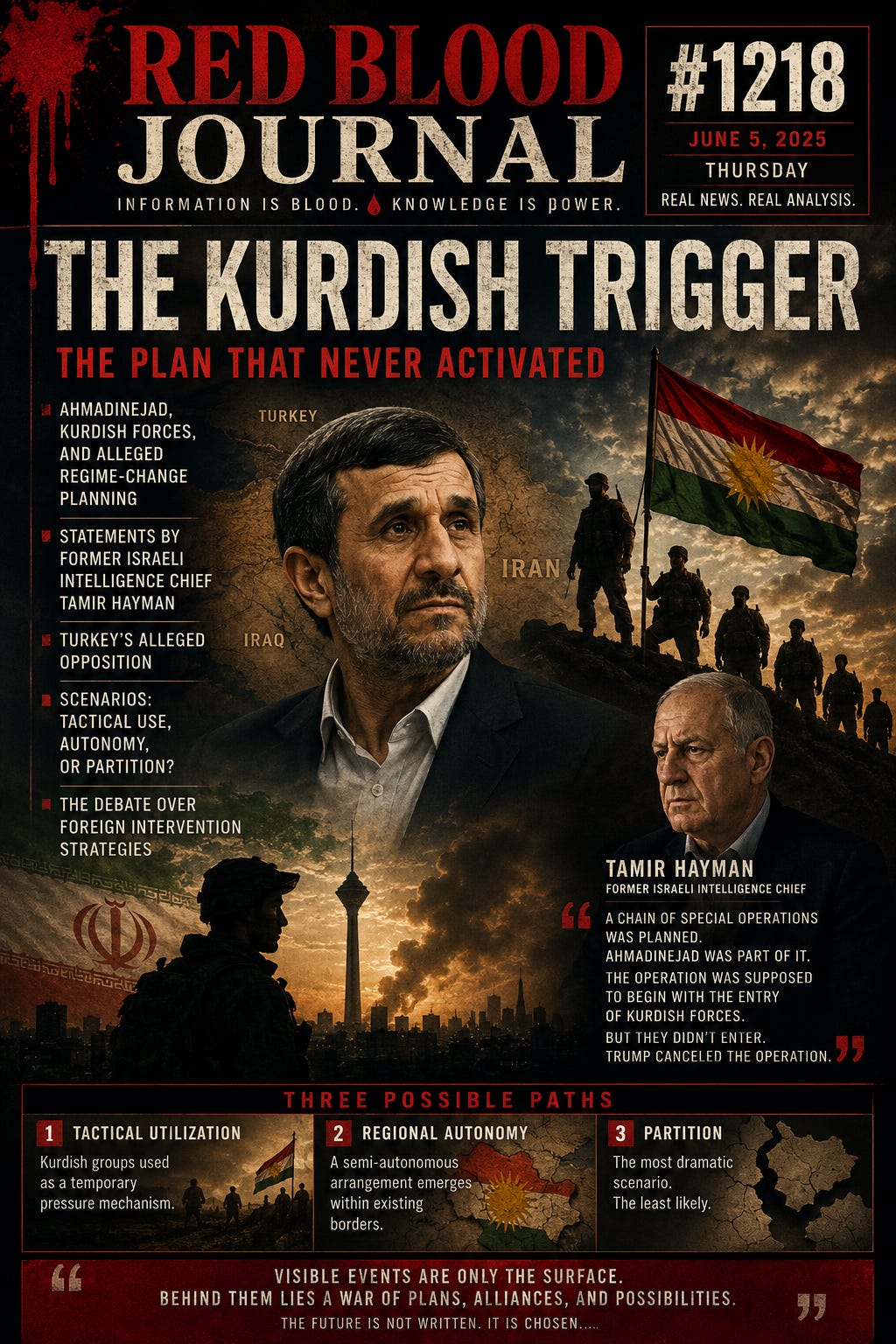
🩸 #1218 — THE KURDISH TRIGGER
Red Blood Journal Transmission
The Plan That Never Activated
History often reveals itself not through what happened, but through what almost happened.
In periods of instability, observers frequently focus on visible events—missiles, speeches, sanctions, negotiations, military deployments, and public declarations. Yet behind every visible event lies a second battlefield composed of contingency plans, backup strategies, and alternative futures that never fully materialize.
Recent discussions surrounding Mahmoud Ahmadinejad, Kurdish groups, and statements attributed to former Israeli intelligence official Tamir Hayman have revived speculation about one such alternative future.
Whether every detail is accurate is ultimately less important than what the discussion itself reveals:
The possibility that multiple external and internal actors were preparing for several different outcomes simultaneously.
The Multi-Layered Strategy
Traditional warfare seeks victory through direct confrontation.
Modern geopolitical conflict increasingly seeks victory through leverage.
Instead of one military operation, multiple pressure points are activated simultaneously:
Economic pressure
Political pressure
Intelligence operations
Information campaigns
Ethnic and regional tensions
Internal rivalries
Opposition movements
Diplomatic negotiations
The objective is not necessarily immediate victory.
The objective is influence over outcomes.
The discussion surrounding Kurdish involvement suggests that some planners may have viewed internal pressure as more effective than conventional invasion.
Rather than introducing large foreign armies, local actors could become the force multiplier.
Such approaches have appeared repeatedly throughout modern history.
The Kurdish Variable
The Kurdish question remains one of the most strategically significant issues in the Middle East.
Spread across multiple countries and possessing a strong sense of cultural identity, Kurdish communities have frequently found themselves at the center of regional power calculations.
For decades, various governments have viewed Kurdish political and military movements through entirely different lenses.
To some they represent partners.
To others they represent a security challenge.
To still others they represent a useful lever capable of shifting regional balances.
The reported discussions suggest a scenario in which Kurdish forces could have played a role in opening a new front against the Islamic Republic.
Whether realistic or not, the concept itself demonstrates how ethnic, regional, and political dynamics can become integrated into broader strategic planning.
The Ahmadinejad Mystery
Few political figures in modern Iranian history generate as much debate as Mahmoud Ahmadinejad.
Once viewed as a symbol of the establishment, he gradually evolved into a figure who often appeared to challenge elements of the very system that elevated him.
His disappearance from public view has naturally fueled speculation.
When political uncertainty rises, absent figures often become larger than life.
Questions emerge:
Where is he?
What role might he play?
Is he relevant?
Is he being preserved for a future political moment?
History repeatedly demonstrates that transitional periods frequently produce unexpected political actors.
Former insiders become outsiders.
Former outsiders become insiders.
Individuals once considered politically finished suddenly return to prominence.
Whether Ahmadinejad fits any future scenario remains unknown.
Yet the persistence of speculation itself demonstrates how uncertain the political landscape has become.
Turkey’s Red Line
One of the most revealing aspects of the discussion is the alleged opposition from Turkey.
For Ankara, the Kurdish issue has never been a secondary concern.
It sits near the center of national security policy.
Any scenario perceived as strengthening armed Kurdish organizations naturally generates resistance.
This creates a unique geopolitical reality:
A strategy that may benefit one regional actor can simultaneously threaten another.
As a result, alliances often become temporary and conditional.
Countries cooperate in one arena while competing in another.
Friends become rivals.
Rivals become partners.
The chessboard continuously shifts.
The Three Paths
The debate ultimately revolves around three possible models.
Model One: Tactical Utilization
Kurdish groups are used as a temporary pressure mechanism.
The objective is not territorial change but political leverage.
Once objectives are achieved, the role of these groups diminishes.
Model Two: Regional Autonomy
A semi-autonomous arrangement emerges.
Political authority becomes decentralized while formal national borders remain intact.
This model mirrors arrangements seen elsewhere in the region.
Model Three: Partition
The most dramatic scenario involves territorial fragmentation.
Despite frequent discussion, this remains the least likely outcome.
Civilizations with deep historical identities often prove more resilient than outside observers expect.
Empires rise and fall.
Governments change.
Political systems collapse.
Yet nations with strong cultural foundations frequently endure.
The Larger Question
The deeper issue is not whether one specific plan existed.
The deeper issue is why modern powers increasingly search for indirect methods of influence.
Direct intervention is expensive.
Occupation is costly.
Nation-building has repeatedly produced disappointing results.
As a result, external actors often seek local partners capable of achieving objectives without large-scale foreign deployments.
The strategy appears efficient.
The outcomes are often far less predictable.
Every intervention introduces variables.
Every variable creates unintended consequences.
Every unintended consequence generates new instability.
The Lesson
The story surrounding Ahmadinejad, Kurdish forces, and alleged regime-change planning serves as a reminder that geopolitical struggles rarely operate on a single level.
Visible events represent only the surface.
Beneath them exists a network of calculations, contingency plans, alliances, fears, ambitions, and competing visions of the future.
Some plans advance.
Others collapse before activation.
Some remain hidden for years.
Others never emerge at all.
Yet every abandoned path reveals something important about the priorities and concerns of those who designed it.
In the end, the greatest force shaping the future may not be any foreign government, intelligence service, political faction, or military alliance.
It may be the collective will of ordinary people deciding which future they are willing to accept.
And beyond every struggle for power remains a reality that no political strategy can fully control:
The vast ocean of human consciousness.
An ocean capable of fear, division, and conflict—but also capable of understanding, wisdom, compassion, and renewal.
When nations eventually emerge from periods of uncertainty, they do not do so because a plan succeeded.
They do so because enough people choose to move toward a horizon greater than conflict itself.
The ocean remains.
The waves rise and fall.
And beyond every storm waits the possibility of calmer waters.
🌊 The Kurdish Trigger and the Architecture of Modern Geopolitics
Jun 3, 2026
The provided text explores a theoretical geopolitical strategy aimed at destabilizing the Iranian government through indirect warfare and internal pressure points.
By examining the potential use of Kurdish militant groups as a force multiplier, the source illustrates how external powers leverage ethnic tensions to gain political influence without direct military invasion.
This narrative also considers the enigmatic role of Mahmoud Ahmadinejad as a possible transitional figure, while highlighting Turkey’s strategic opposition to any plan that empowers Kurdish autonomy.
Ultimately, the text presents three models of intervention—ranging from tactical pressure to total partition—to show how modern conflict relies on complex, often discarded contingency plans.
It concludes that while intelligence operations and regional rivalries shape the surface of history, the unpredictable will of the populace remains the most significant factor in a nation’s future.


