


🩸 🥚 #1216 — The Other Side of the Egg
Red Blood Journal Transmission
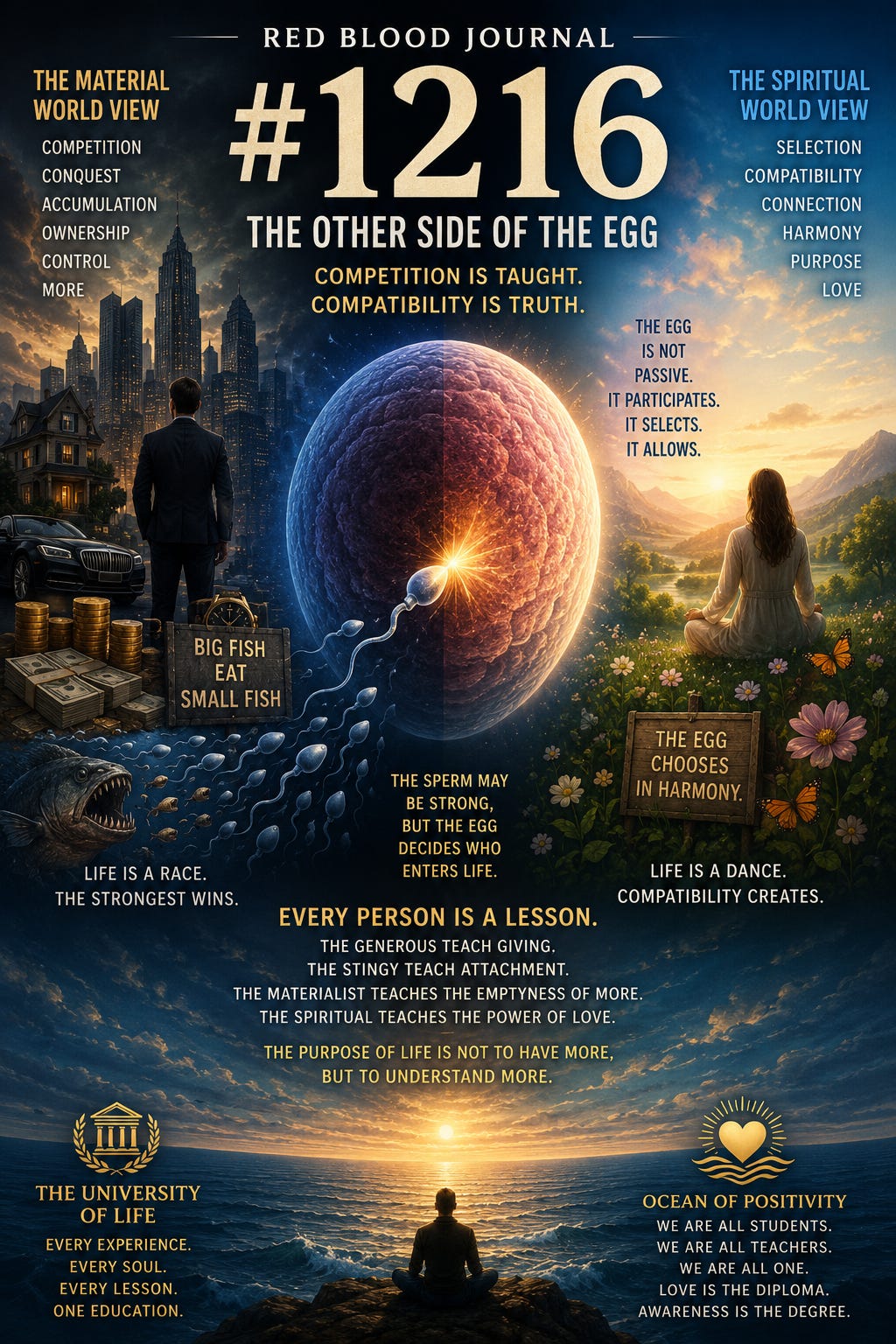
For much of modern life, existence is explained through competition. We are taught that the strongest wins, the fastest survives, the biggest fish consumes the smaller fish, and success belongs to whoever accumulates the most before everyone else. The same logic appears in business, politics, economics, education, and even in the stories we use to explain the beginning of life itself.
One of the earliest biological stories many people hear is that millions of sperm race toward an egg and that the strongest, fastest, or most successful sperm wins. It is a powerful image because it fits perfectly into a culture already organized around competition. Life is presented as a race, survival as a battle, and existence as victory over others.
But there is another side of the egg.
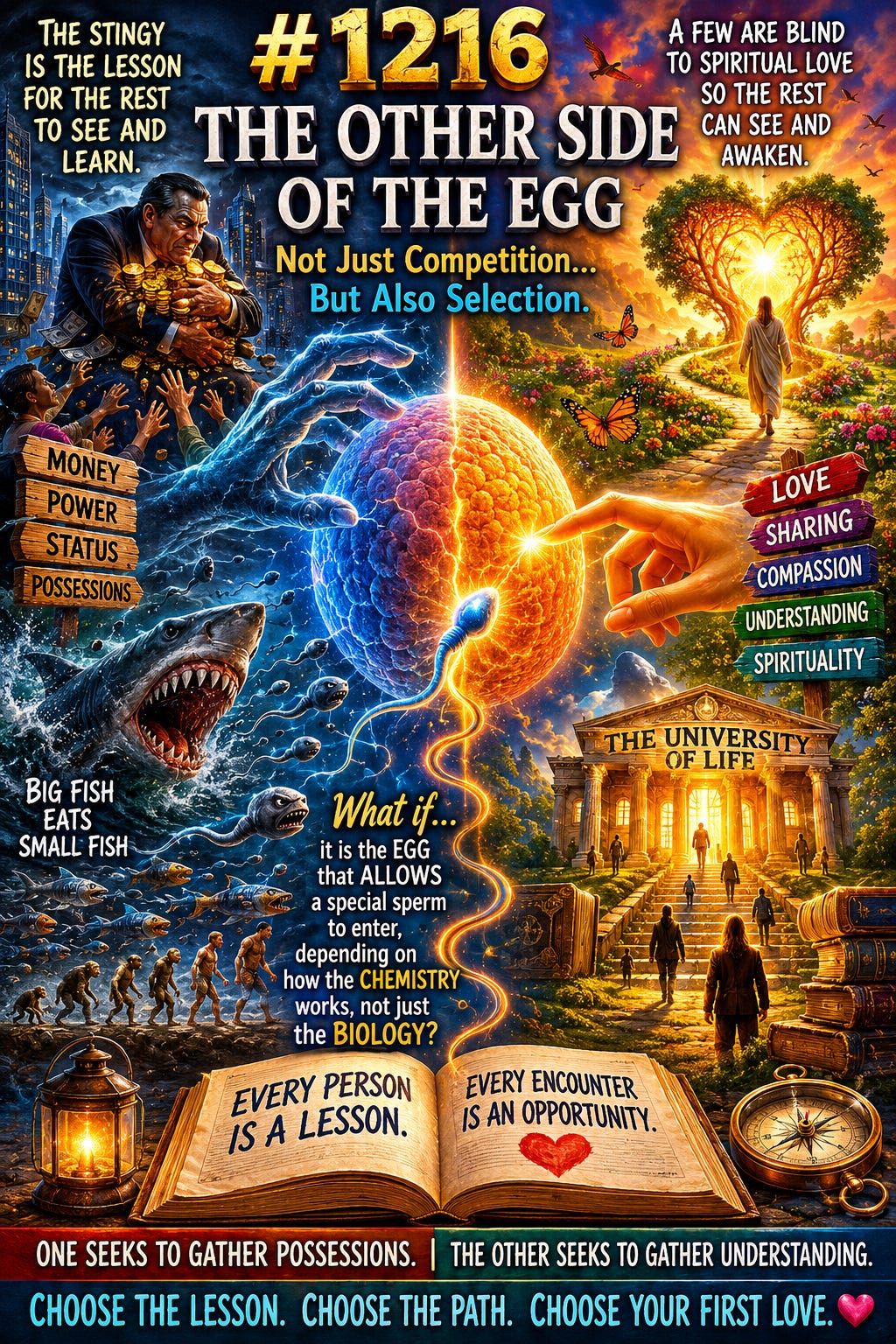
Modern reproductive biology presents fertilization as more complicated than a simple race in which one competitor defeats all the others. The egg and the surrounding reproductive environment are active participants in a highly selective biological process involving chemical signaling, molecular recognition, timing, compatibility, and multiple layers of interaction. The sperm is not simply a conqueror breaking through a passive wall. Fertilization depends on conditions that must align on both sides.
That difference may seem small, but the worldview behind it is enormous. One interpretation sees force, conquest, and domination. Another sees interaction, compatibility, selection, and cooperation. One imagines the strongest participant forcing its way through the door, while the other recognizes that the door opens only when a complex set of conditions is satisfied.
The event has not changed. The perspective has.
That is the larger lesson of the egg. Human beings rarely experience reality without first placing it inside a framework. We see the world through assumptions inherited from family, education, religion, economics, politics, culture, advertising, and experience. Then, because the framework feels familiar, we begin to mistake the interpretation for the reality itself.
The material world provides countless examples. A person raised to see life primarily through ownership may begin asking the same questions everywhere: What can I gain? What can I control? What can I accumulate? What can I trade for something greater? Eventually, even human relationships can become transactions. Kindness becomes investment, generosity becomes negotiation, friendship becomes networking, and affection becomes something quietly measured against expected returns.
In that worldview, material success becomes the first love. Money, property, status, influence, possessions, and access slowly move from being useful tools to becoming measurements of personal worth. The danger is not in owning things. The danger begins when what we own starts defining who we are, what we value, and how we treat the people around us.
Yet even this may have a role inside what Red Blood Journal calls the University of Life. A university requires many kinds of teachers, and not all of them teach through wisdom. Some people teach through generosity, while others teach through selfishness. Some reveal the beauty of patience, while others show the destruction caused by uncontrolled anger. Some demonstrate compassion, while others show us what happens when attachment, greed, envy, or fear becomes the organizing force of a life.
The mistake is assuming that only the positive example has educational value. Sometimes the clearest lesson comes from witnessing what happens when someone builds an entire identity around material possession while neglecting inner development. The observer sees the consequences, recognizes the pattern, and learns without necessarily having to travel the same road.
In that sense, every life becomes part of the classroom. The generous can teach the freedom of giving, while the stingy can reveal the prison of clinging. The peaceful can demonstrate the strength of emotional control, while the perpetually angry can reveal the exhaustion created by living in permanent conflict. The humble can show the stability of self-knowledge, while the arrogant can demonstrate the fragility of an identity that requires constant validation.
This does not mean suffering should be romanticized or harmful behavior excused. The lesson is not that cruelty is good because someone may learn from it. The lesson is that experience does not have to be wasted. Even painful encounters can become information, and even negative examples can help a person recognize what kind of life they do not want to build.
Perhaps this is one reason existence contains such extraordinary variety. Not everyone demonstrates the same lesson because not everyone is walking the same classroom corridor. Some people show where the road leads when accumulation becomes the purpose of life. Others demonstrate what happens when service, awareness, responsibility, creativity, love, or inner development becomes the organizing principle.
One path continually asks, “How much more can I acquire?” Another asks, “What am I becoming through what I experience?” One fills rooms, accounts, storage units, portfolios, and titles. The other tries to fill understanding.
Neither question requires rejecting the material world. Money can provide security, tools, mobility, opportunity, education, comfort, and the ability to help others. Material success becomes dangerous only when it becomes the final measurement of existence. A person can possess wealth without worshipping it, just as another person can possess very little while still being consumed by envy and material obsession.
The deeper distinction is not between rich and poor. It is between possession and attachment, between using the material world and being psychologically owned by it.
This brings us back to the egg. The purpose of examining the other side is not to replace one rigid story with another. It is to develop the habit of turning the object around. When everyone is looking at the front, look at the back. When a story is presented as obvious, ask what assumptions are hidden inside it. When society tells you that life must be understood as competition, ask where cooperation is operating invisibly underneath it.
Critical thinking is not automatically believing the opposite of what you were told. It is learning to examine the structure of the story itself.
Perhaps life is not primarily a competition to own the most, defeat the most, or arrive first. Perhaps the deeper challenge is to understand the most: to understand ourselves, our reactions, our attachments, our fears, our relationships, and the systems influencing our perception of reality.
If life is a university, the diploma is not wealth, status, applause, or power. The diploma is awareness.
And awareness begins when we discover that reality often has another side.
🩸 The Red Blood Perspective
Red Blood does not ask people to reject success, competition, ambition, money, business, achievement, or the material world. Those forces are part of human existence, and competition itself can produce discipline, innovation, excellence, and growth. The problem begins when one framework becomes so dominant that we lose the ability to recognize anything outside it.
A society trained to interpret everything through competition may eventually see enemies where cooperation is possible, transactions where relationships are possible, and ownership where stewardship may be wiser. The purpose of critical thinking is to interrupt that automatic interpretation long enough to inspect what is actually happening.
The Red Blood principle is simple: turn the egg around.
Examine the side that is rarely shown. Look beyond the first explanation. Study the incentives, the relationships, the consequences, and the assumptions hidden inside the language being used. Do not replace one form of programming with another. Develop the independence to examine both sides and decide for yourself what the evidence and experience actually reveal.
The most important freedom may not be the freedom to choose between the explanations offered to us. It may be the freedom to recognize that the available explanations were never the only possibilities.
🌊 Ocean of Love and Positivity Perspective
The ocean does not need to compete with the rivers that flow into it. Every river arrives through a different landscape, carrying different minerals, sediments, histories, and experiences. Some arrive clear and gentle, while others arrive muddy and violent after traveling through difficult terrain. Yet once they reach the ocean, they become part of something larger than the individual path that brought them there.
Human experience may work in a similar way. The generous and the stingy, the peaceful and the angry, the materialist and the spiritual seeker, the teacher and the student all become part of the enormous classroom through which consciousness learns to recognize itself. Their choices matter, their consequences matter, and harmful actions should still be confronted, corrected, restrained, or prevented when necessary. But the final purpose does not have to be hatred or revenge.
The purpose can be understanding.
The Ocean of Love and Positivity does not require us to pretend that all actions are equal or that every road leads to the same destination. It asks us to extract wisdom from what we witness and then decide consciously what we will carry forward. We can observe greed without becoming greedy, recognize anger without allowing anger to rule us, and experience betrayal without allowing betrayal to determine the emotional climate of the rest of our lives.
Eventually, the competition for more begins to lose some of its power. Ownership becomes less important than awareness, appearances become less important than inner condition, and the question slowly changes from “What do I have?” to “What have I learned?”
That may be the other side of the egg.
Perhaps the greatest wealth was never waiting somewhere outside us to be conquered, purchased, inherited, or accumulated. Perhaps it was the awareness being developed inside us while we were busy living through the lesson.
🌊 The University of Life:
Beyond Competition and Materialism
Jun 2, 2026
The provided text explores a fundamental shift in perspective from a world defined by relentless competition to one rooted in cooperation and personal growth.
While modern society often emphasizes material accumulation and the survival of the fittest, the author suggests that life is actually a vast university designed for soul-level learning.
By reinterpreting biological processes like fertilization as mutual selection rather than a race, the narrative challenges the necessity of dominance and ownership.
Every human interaction, whether positive or negative, serves as a vital lesson that contributes to an individual’s expanding awareness.
Ultimately, the source encourages readers to move beyond transactional relationships to find a deeper sense of fulfillment and inner wealth.
Through the metaphor of an ocean, the text illustrates how diverse experiences are synthesized into a profound understanding of existence.


