


🩸 #1207 — THE PINECONE IN THE CENTER
Red Blood Journal Transmission
Throughout history, humanity has searched for hidden treasures.
Gold beneath mountains.
Oil beneath deserts.
Diamonds beneath stone.
Yet one of the most mysterious objects known to civilization has always traveled everywhere with every human being.
It weighs less than a gram.
It sits deep within the brain.
And for thousands of years it has inspired philosophers, mystics, physicians, priests, and dreamers.
The pineal gland.
A tiny pinecone-shaped structure resting near the center of the human brain.
The Ancient Curiosity
Long before modern scanners and neuroscience laboratories existed, ancient observers noticed something unusual.
The pineal gland occupied a unique position.
Unlike many structures of the brain that appear in pairs, the pineal gland stood alone.
Centered.
Singular.
Hidden.
Its isolation naturally attracted speculation.
What purpose could such a small structure serve?
Why would nature place it at the very center of the brain?
Questions multiplied long before answers arrived.
The Philosopher’s Discovery
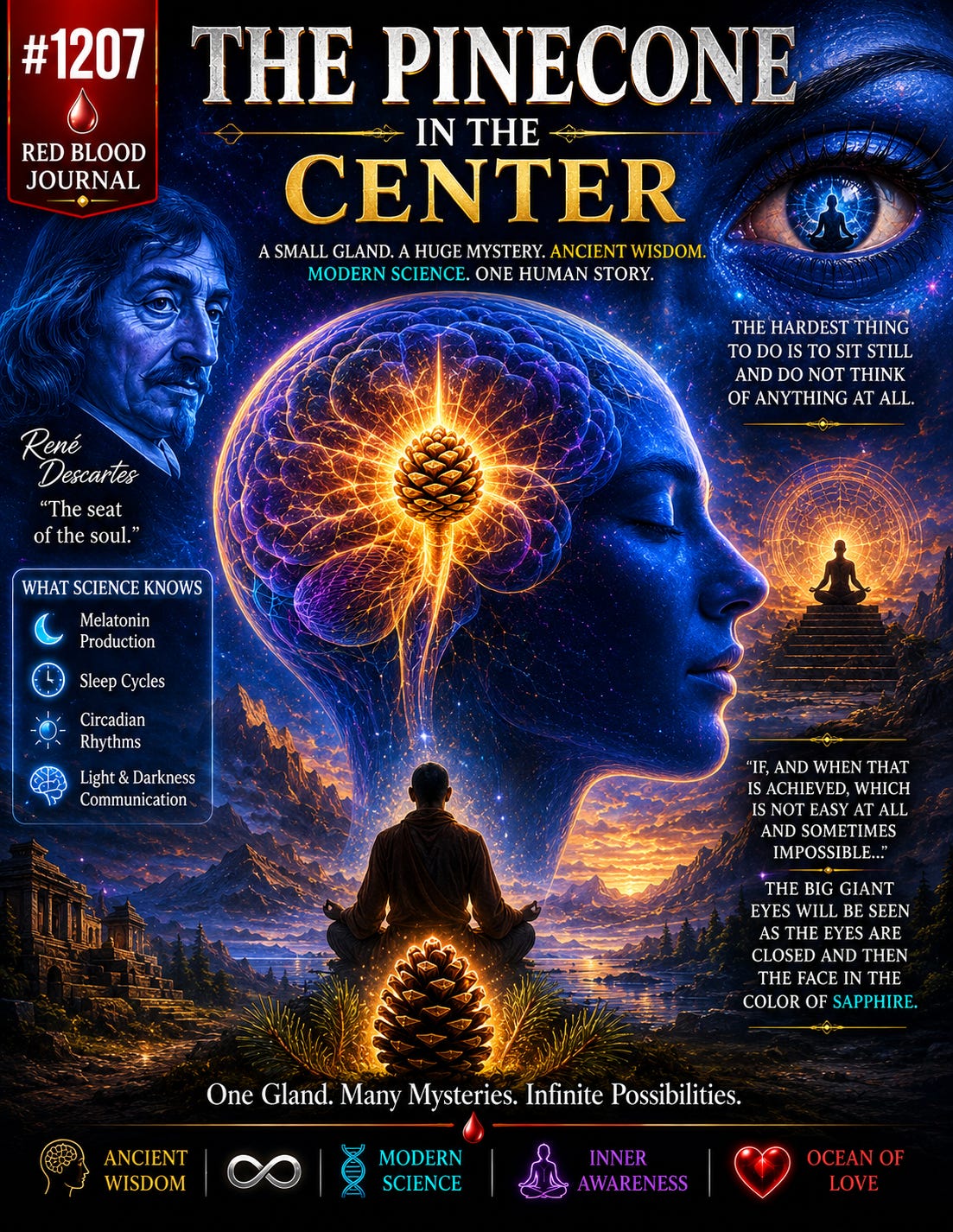
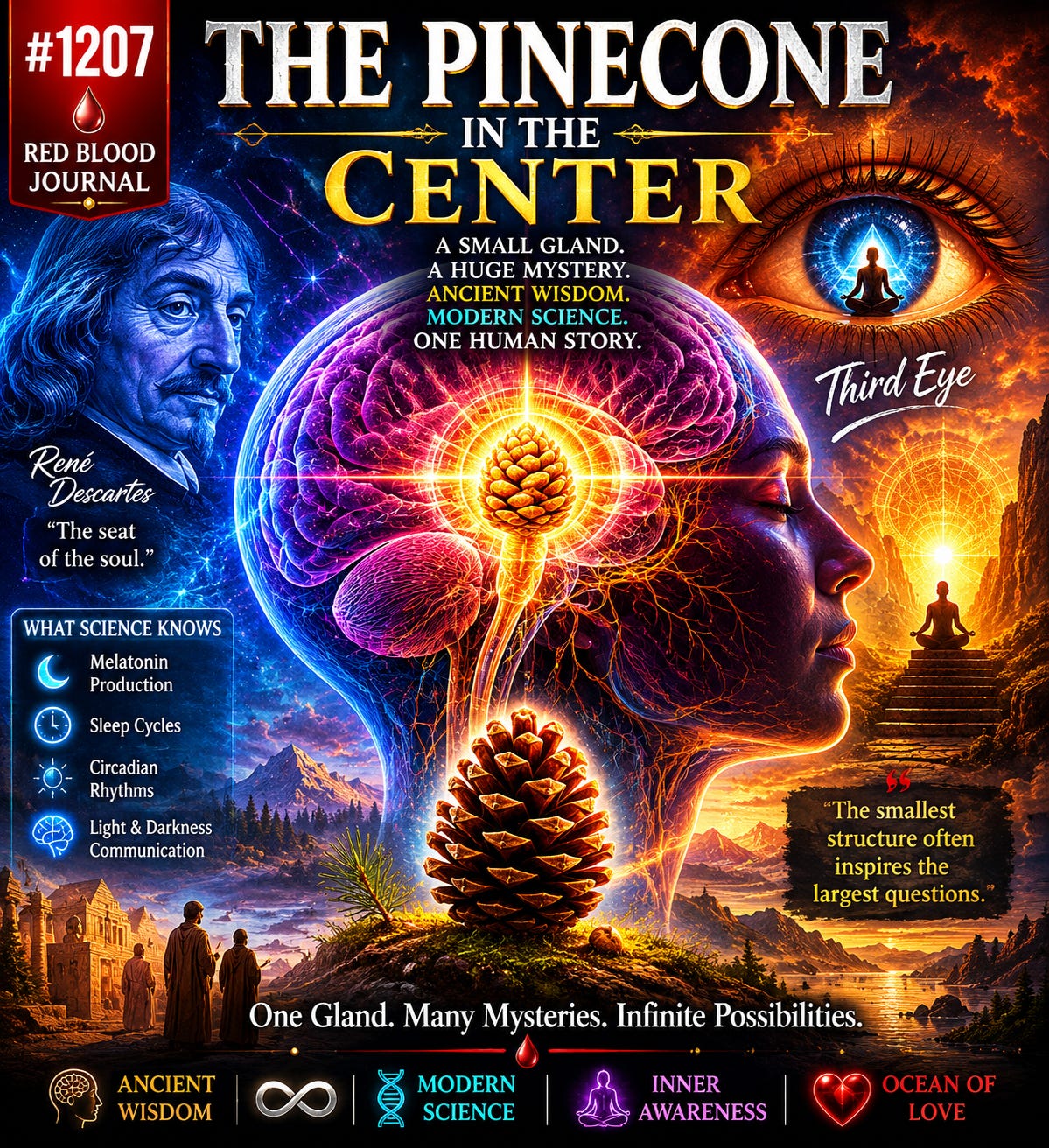
In the seventeenth century, French philosopher René Descartes offered an idea that would echo through history.
Descartes viewed the human body as a sophisticated machine.
But he believed something else existed as well.
Consciousness.
Awareness.
The observing self.
The mysterious experience of being alive.
He proposed that the pineal gland served as the meeting point between the physical body and the immaterial mind.
He called it the seat of the soul.
Science would later reject the claim.
Yet the idea survived because it touched a question that remains unanswered even today:
How does awareness emerge from matter?
The Third Eye
Across multiple traditions, the pineal gland gradually became associated with what many called the Third Eye.
Not an eye of flesh.
Not an eye that sees color or distance.
But an eye that sees inward.
The symbolism was powerful.
The two physical eyes observe the outer world.
The Third Eye observes the inner world.
Thought.
Consciousness.
Dreams.
Imagination.
Self-awareness.
Whether interpreted literally or symbolically, the concept endured because every human eventually discovers that the greatest mysteries are not outside.
They are inside.
What Science Found
Modern neuroscience eventually uncovered the pineal gland’s primary biological role.
It produces melatonin.
A hormone that helps regulate sleep and the body’s internal clock.
As daylight fades, melatonin rises.
As morning arrives, melatonin falls.
The pineal gland acts as one of the body’s timekeepers.
A biological conductor quietly coordinating cycles of rest and wakefulness.
The discovery solved one mystery.
But not all mysteries.
Because sleep itself remains one of the least understood phenomena in human existence.
Every night consciousness disappears.
Dreams emerge.
Reality dissolves.
And a different world appears behind closed eyes.
The Forgotten Treasure
The greatest misunderstanding surrounding the pineal gland may not be scientific.
It may be symbolic.
Humanity has become obsessed with looking outward.
More screens.
More possessions.
More status.
More distractions.
Meanwhile the ancient question remains largely ignored.
Who is the observer behind the eyes?
Who is aware of every thought?
Who notices emotions come and go?
Who watches the movie of life unfold?
The pineal gland became famous because it represented a doorway to that question.
Not necessarily because it held the answer.
The Pinecone and the Forest
Perhaps the pineal gland’s greatest lesson is found in its shape.
A pinecone.
A seed carrier.
A symbol of potential.
Every pinecone contains the possibility of an entire forest hidden within it.
Likewise every human being contains possibilities that remain largely unexplored.
Wisdom.
Awareness.
Understanding.
Compassion.
Clarity.
The outer world teaches accumulation.
The inner world teaches discovery.
One seeks ownership.
The other seeks understanding.
Final Reflection
Whether viewed as a biological gland, a spiritual symbol, or a philosophical mystery, the pineal gland continues to point toward the same direction.
Inward.
The modern world trains attention toward everything outside the self.
The ancient question points the opposite way.
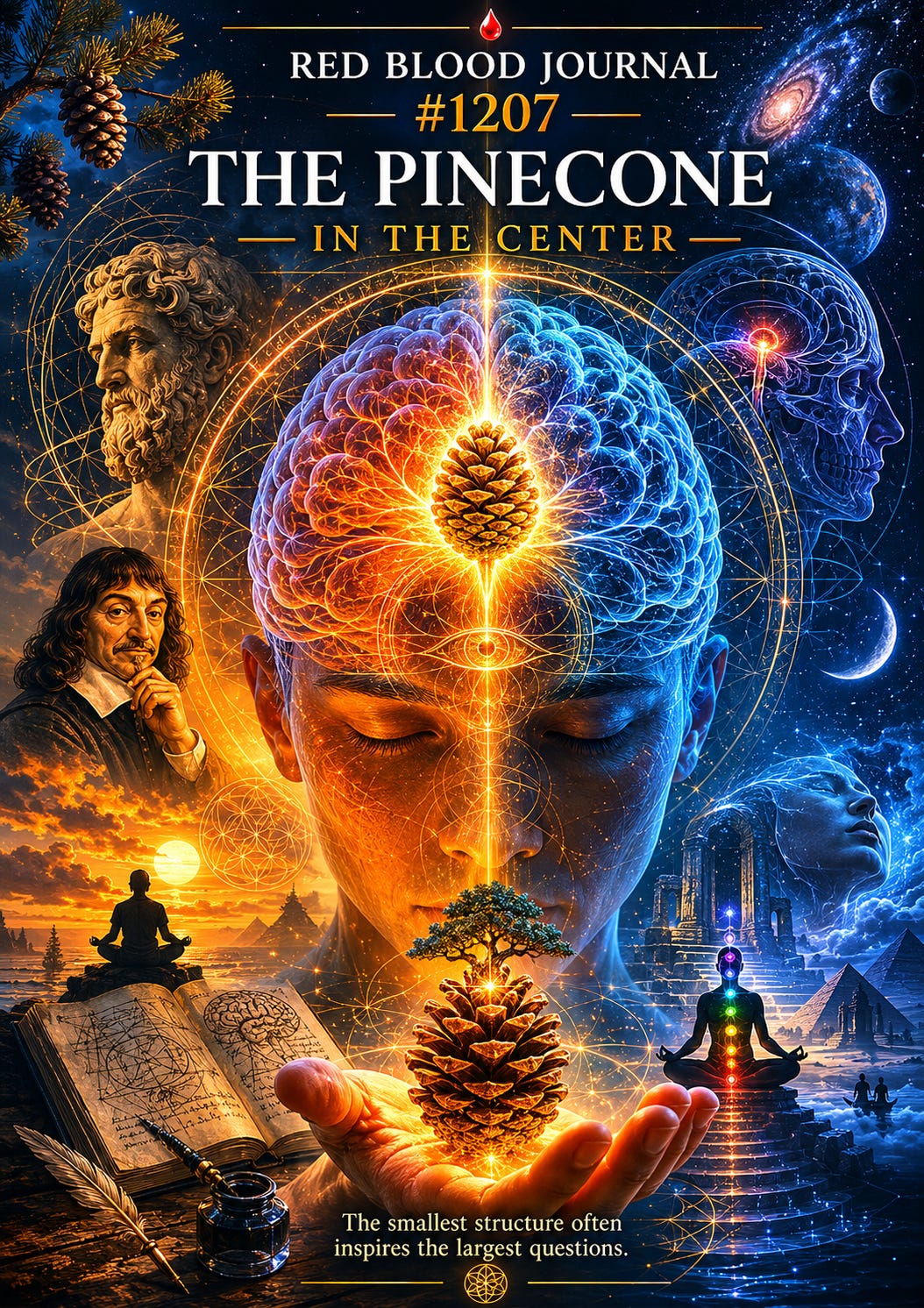
The smallest structure often inspires the largest questions.
Not because it is powerful.
But because it reminds humanity that the greatest frontier may never have been the stars above.
It may be the unexplored universe within.
And beyond every theory, every doctrine, every institution, and every explanation, there remains the silent observer experiencing this moment.
Waiting patiently to be noticed.
Ocean of Love
The ocean does not search for itself because it already contains every wave.
Likewise, the awareness seeking answers may already contain the very thing it seeks.
The journey inward is not a journey of acquiring more.
It is a journey of remembering what was never absent.
In that realization, the noise softens, the mind quiets, and the vast ocean of love becomes visible once again.
🩸 Red Blood Journal Transmission #1207 Complete.
👁️ The Seat of the Soul:
The Internal Universe
Jun 1, 2026
This text explores the pineal gland, a tiny structure in the brain that has fascinated humanity as both a biological organ and a spiritual symbol.
Historically dubbed the “seat of the soul“ by René Descartes, this “third eye” represents the intersection where the physical body meets human consciousness.
While modern science identifies its role in producing melatonin to regulate sleep, the author emphasizes its deeper significance as a gateway to self-awareness and inner discovery.
The narrative contrasts our modern obsession with external distractions against the ancient necessity of exploring the inner universe.
Ultimately, the gland serves as a metaphorical pinecone seed, symbolizing the vast potential for wisdom and clarity hidden within every individual.


