


🩸 Red Blood Journal
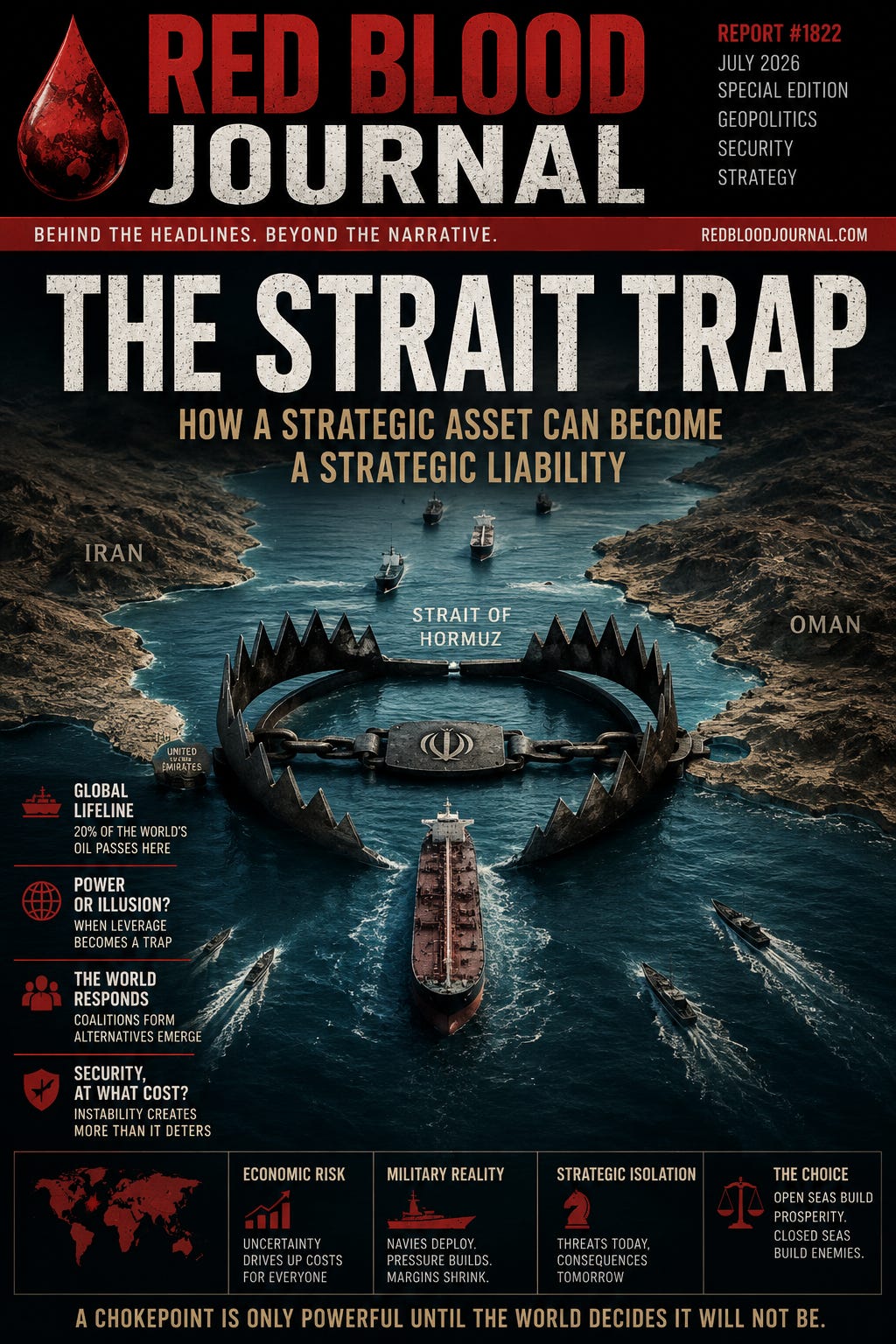
#1822 – The Strait Trap
How a Strategic Asset Can Become a Strategic Liability
Introduction
Throughout history, geography has given certain nations extraordinary advantages.
Mountain ranges provide natural defenses.
Rivers create commerce.
Deep-water ports build prosperity.
And narrow maritime chokepoints can influence the economies of entire continents.
Yet history repeatedly demonstrates a paradox:
A strategic advantage can quickly become a strategic liability when it is used as a weapon rather than as a source of stability.
The Strait of Hormuz has become one of the world’s clearest examples of this dilemma.
The Power of Geography
Roughly one-fifth of the world’s traded oil passes through the Strait of Hormuz.
For decades this narrow passage has been viewed as one of the most strategically important waterways on Earth.
Its value does not come from military strength alone.
Its value comes from the fact that nearly every major economy depends upon uninterrupted maritime trade.
Whoever influences this passage possesses geopolitical leverage.
But leverage is not the same as ownership.
Nor is influence the same as control.
The Illusion of Unlimited Leverage
History shows that nations sometimes confuse possessing a strategic advantage with possessing unlimited power.
When policymakers begin believing a vital trade route can permanently be used as political leverage, they may unintentionally trigger the opposite outcome.
Instead of increasing influence, they encourage other nations to develop alternatives.
Instead of creating dependence, they motivate coalitions.
Instead of strengthening deterrence, they unite previously divided interests.
In international politics, fear often creates cooperation among rivals.
The Strait Trap
This is what may be called The Strait Trap.
The trap begins when leaders believe that threatening a globally important route increases their bargaining power.
Initially it appears successful.
Markets react.
Headlines multiply.
Diplomatic attention increases.
But over time a different process begins.
Countries that may disagree on countless issues suddenly discover they share one common objective:
Keeping global commerce flowing.
Once enough nations conclude that uninterrupted shipping has become a collective interest, pressure no longer comes from a single country.
It comes from an international coalition.
At that point the original strategic advantage begins transforming into strategic isolation.
From Asset to Liability
The paradox is simple.
A nation benefits enormously from occupying a strategic location.
But the moment that location becomes associated with instability, the international community begins searching for ways to reduce that nation’s influence over it.
Military patrols increase.
Alternative shipping routes are explored.
Energy diversification accelerates.
Regional partnerships strengthen.
Economic pressure grows.
What was once leverage slowly becomes justification for reducing that leverage.
The strategic asset has become a strategic liability.
The Economic Dimension
Markets dislike uncertainty more than almost anything else.
Shipping companies.
Insurance providers.
Energy traders.
Manufacturers.
Every one of them calculates risk.
As uncertainty increases, insurance costs rise.
Shipping routes become more expensive.
Investment slows.
Economic relationships begin shifting elsewhere.
Even countries with no direct political involvement become motivated to support greater stability.
The issue is no longer political.
It becomes economic.
The Psychology of Escalation
One of the greatest dangers in international affairs is strategic overconfidence.
Governments surrounded by loyal advisors may gradually become convinced that every escalation demonstrates strength.
History often tells a different story.
Sometimes restraint demonstrates greater confidence than confrontation.
Sometimes diplomacy preserves leverage more effectively than threats.
Sometimes maintaining a strategic advantage quietly is more powerful than constantly reminding others it exists.
Lessons from History
Throughout history, empires have competed for control of strategic waterways.
The Bosporus.
The Suez Canal.
The Panama Canal.
The Strait of Malacca.
Each demonstrates the same underlying principle:
Trade routes survive because the international system depends upon stability.
Whenever instability becomes excessive, other powers inevitably intervene—economically, diplomatically, or militarily—to restore predictable commerce.
The exact methods differ.
The principle rarely changes.
The Larger Principle
The Strait of Hormuz is ultimately about far more than oil.
It illustrates a timeless lesson in strategy.
Power is not measured by how effectively one can threaten the system.
Power is measured by how effectively one can remain indispensable without encouraging the world to replace that indispensability.
That distinction separates lasting influence from temporary leverage.
Conclusion
Every nation hopes geography will work in its favor.
But geography alone never guarantees strength.
True strategic advantage depends upon how wisely that geography is managed.
History repeatedly shows that a bridge can become a barricade.
A gateway can become a prison.
And a strategic asset can become a strategic liability.
The greatest victories in geopolitics are often achieved not by closing the world’s doors—
but by keeping them open.
🩸 RedBloodJournal.com
⚓ The Paradox of Strategic Leverage
1 source·Jul 14, 2026
The provided text examines the geopolitical paradox where a nation’s control over a vital maritime chokepoint, such as the Strait of Hormuz, can shift from a powerful asset into a significant strategic liability. While these geographic gateways initially offer immense leverage over global trade, the author argues that using them as political weapons inevitably triggers an international backlash. Instead of securing dominance, aggressive threats motivate rival nations to form coalitions, seek alternative routes, and increase military presence to ensure stability. This process results in strategic isolation and economic strain as markets react negatively to the resulting uncertainty. Ultimately, the source concludes that lasting power is derived from maintaining open commerce rather than using global dependencies as a means of confrontation.


