


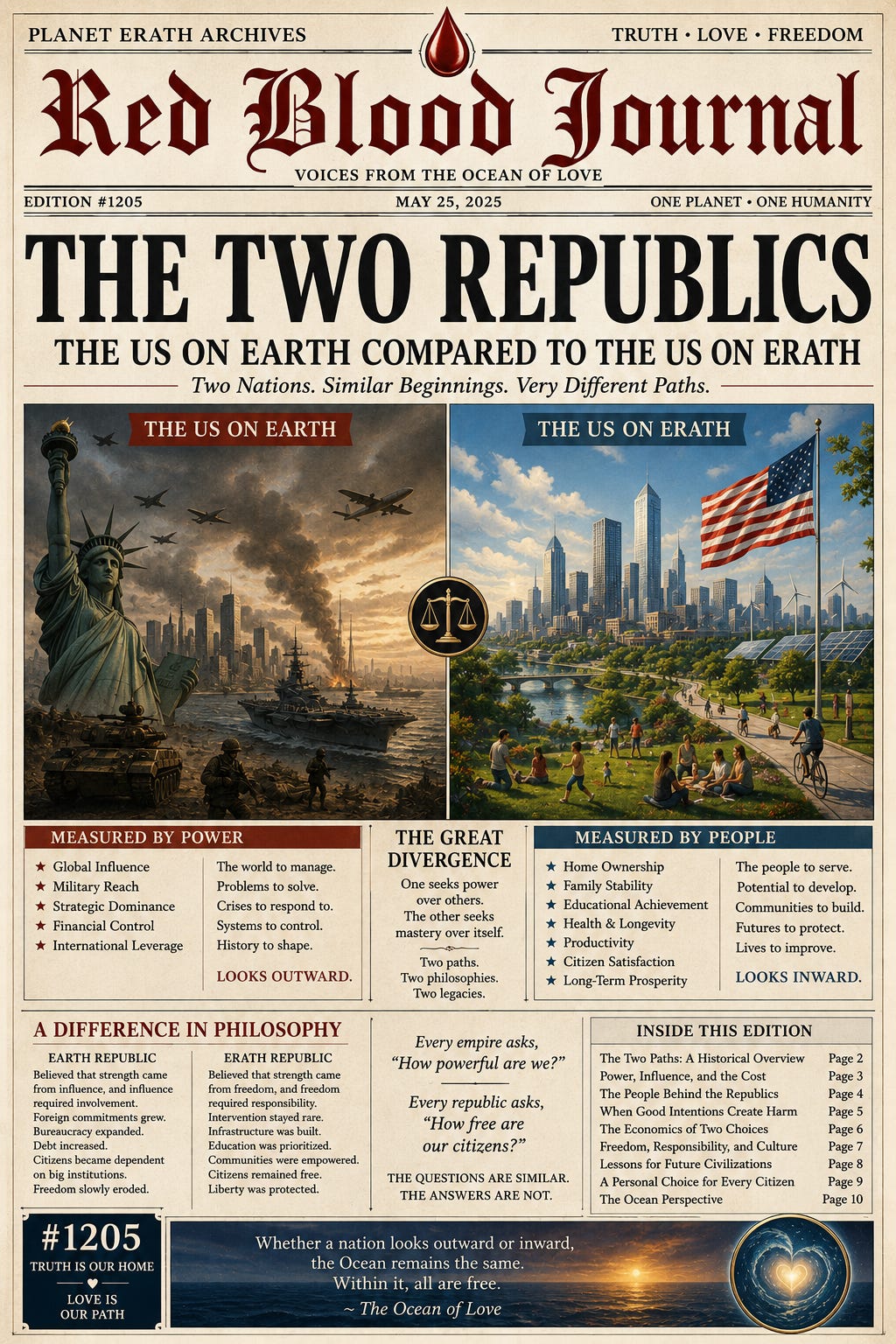
🩸 #1205 — THE TWO REPUBLICS
Red Blood Journal Transmission
Planet Erath Archives
The historians of Erath often conducted a fascinating thought experiment.
They imagined two nearly identical republics.
One existed on Earth.
The other existed on Erath.
Both began with similar founding principles.
Individual liberty.
Representative government.
Limited centralized power.
Freedom of speech.
Private property.
The belief that government existed to serve the citizen rather than the citizen existing to serve government.
At first glance, the two republics appeared nearly identical.
But over centuries their paths slowly diverged.
The Earth Republic
The Earth Republic gradually expanded its influence across the globe.
Its military footprint reached nearly every region.
Its financial institutions became deeply connected to international systems.
Its corporations expanded beyond national borders.
Its intelligence services grew larger.
Its foreign commitments multiplied.
Its bureaucracy expanded.
Its debt increased.
Its citizens became increasingly dependent upon large institutions.
As the republic became more powerful, many citizens began asking whether the government still primarily served the people or whether the people increasingly served the machinery that had been built around them.
The debate continues.
The Erath Republic
The Erath Republic chose a different path.
Its leaders adopted an unusual doctrine.
“The greatest nation is not the nation that controls the most territory.
The greatest nation is the nation that creates the most free and prosperous citizens.”
The Erath Republic maintained a strong defense.
But it avoided permanent foreign entanglements whenever possible.
It focused enormous resources on infrastructure.
Education.
Scientific research.
Energy independence.
Manufacturing.
Local communities.
The prosperity of its own population became the primary measure of success.
Foreign intervention became rare and required overwhelming justification.
The republic’s leaders were expected to explain not only the cost of action but also the cost of unintended consequences.
Measuring Success
On Earth, success often became measured through metrics such as:
Global influence.
Military reach.
Strategic dominance.
Financial control.
International leverage.
On Erath, success became measured differently:
Home ownership.
Family stability.
Educational achievement.
Health.
Productivity.
Citizen satisfaction.
Long-term prosperity.
The difference was subtle.
Yet over generations it produced dramatically different outcomes.
The Hidden Question
The historians of Erath eventually realized something important.
Every empire asks:
“How powerful are we?”
Every republic asks:
“How free are our citizens?”
The two questions appear similar.
But they lead in very different directions.
One measures external reach.
The other measures internal well-being.
One seeks expansion.
The other seeks balance.
One focuses on influence abroad.
The other focuses on strength at home.
The Great Divergence
The greatest difference between the Earth Republic and the Erath Republic was not military.
It was philosophical.
The Earth Republic increasingly viewed the world as something to manage.
The Erath Republic increasingly viewed itself as something to perfect.
One looked outward.
The other looked inward.
One attempted to shape history.
The other attempted to improve the lives of its citizens.
Neither path eliminated problems.
Neither created perfection.
But the outcomes became very different.
The Ocean View
From the perspective of the Ocean of Love, the comparison itself contains a lesson.
Every individual faces the same choice.
Attention can be directed outward toward controlling the world.
Or inward toward understanding oneself.
The outward journey can continue forever.
There is always another problem to solve.
Another enemy to confront.
Another crisis to manage.
Another system to control.
The inward journey eventually discovers something different.
Peace.
Clarity.
Stillness.
The historians of Erath concluded that nations often mirror the consciousness of their people.
And perhaps the ultimate question was never about governments at all.
Perhaps the question was whether a civilization seeks power over others or mastery over itself.
For when a person finds the ocean within, the need to control the world begins to fade.
And when enough people discover that ocean, perhaps entire civilizations change course.
🌊
⚖️ The Great Divergence:
Mastery Over Power
May 31, 2026
This text explores a philosophical comparison between two fictional societies, the Earth Republic and the Erath Republic, to illustrate how different priorities shape a civilization’s destiny.
While the Earth Republic prioritizes global influence, military dominance, and the expansion of bureaucratic power, its counterpart on Erath focuses on internal stability, individual prosperity, and scientific advancement.
The narrative suggests that the Earth Republic eventually becomes burdened by foreign entanglements and institutional debt, whereas the Erath Republic flourishes by measuring success through the well-being and freedom of its citizens.
Ultimately, the source posits that the trajectory of a nation reflects the collective consciousness of its people, contrasting a desire for external control with the pursuit of self-mastery.
By using these two models, the text encourages a shift in focus from shaping the world to improving the lives of those within it.


