


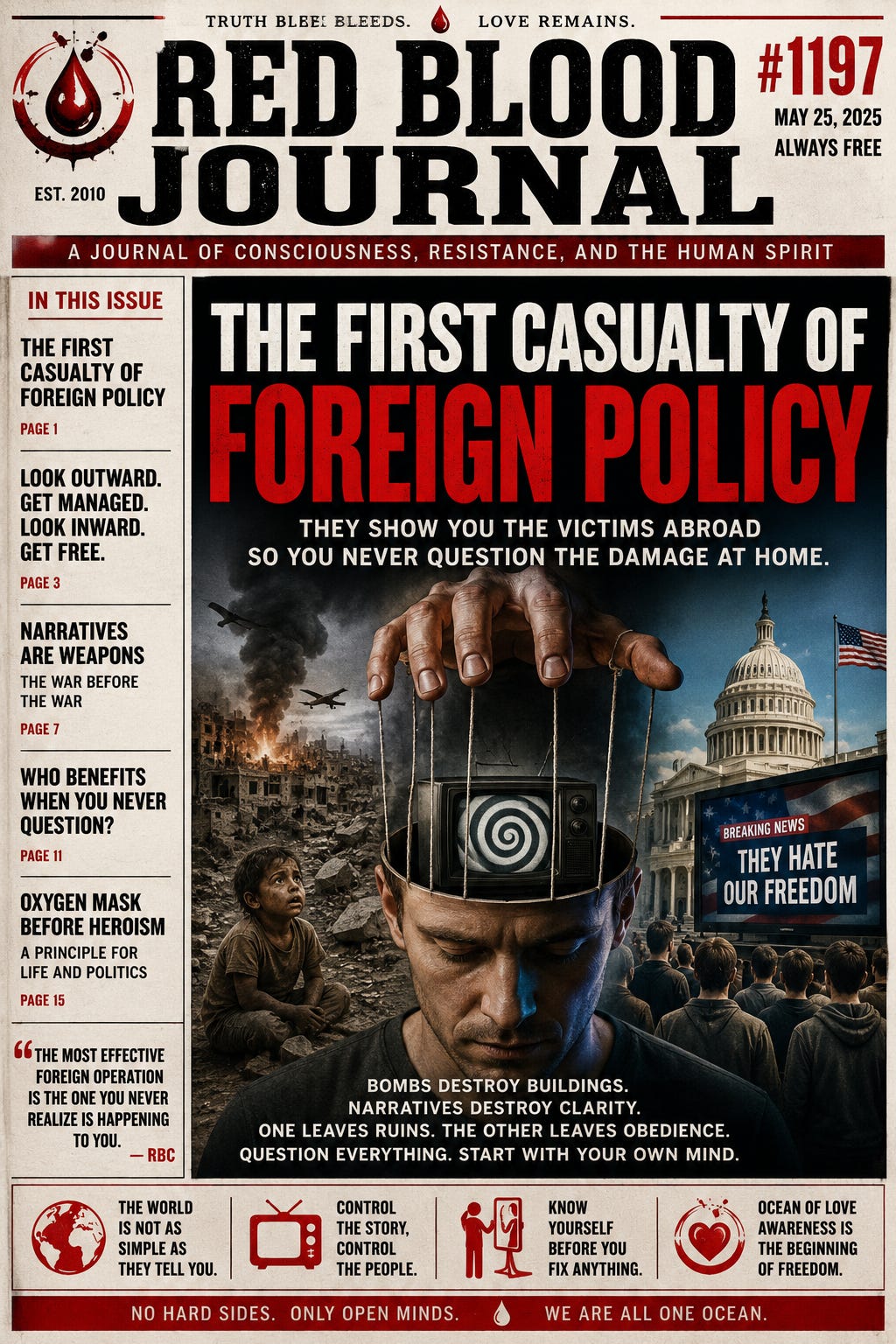
🩸 #1197 — THE FIRST CASUALTY OF FOREIGN POLICY
Red Blood Journal Transmission
For generations, citizens of the Divided States have been taught to look outward.
Television screens, newspapers, political speeches, intelligence briefings, and social media feeds direct attention toward distant lands. Citizens are shown wars, revolutions, sanctions, humanitarian crises, and foreign adversaries. They are encouraged to develop opinions about countries they may never visit and conflicts they may never fully understand.
The public is taught to focus on the victims abroad.
Rarely are they encouraged to ask who the first victim is at home.
When a nation seeks support for a foreign policy objective, whether military, economic, diplomatic, or covert, it must first secure something more valuable than territory.
It must secure belief.
Before troops move, narratives move.
Before missiles launch, stories launch.
Before operations begin overseas, perceptions are shaped domestically.
History repeatedly demonstrates that foreign policy is rarely sold to a population by presenting every fact openly. Instead, selected facts are emphasized, inconvenient facts are minimized, and complex realities are simplified into emotionally compelling stories.
Enemies become caricatures.
Allies become heroes.
Conflicts become moral dramas.
The public receives a version of reality carefully organized for consumption.
The citizens are told they are being informed.
The possibility that they are being managed is rarely discussed.
As a result, many people develop deep concern for populations affected by foreign intervention while never considering the effects that the same intervention may have on their own minds.
The foreign population may experience the visible consequences.
The domestic population experiences the invisible consequences.
One may lose infrastructure.
The other may lose perspective.
One may suffer from physical destruction.
The other may suffer from manufactured understanding.
The first loss can be photographed.
The second often goes unnoticed.
The irony is profound.
Many citizens passionately investigate whether foreign governments are manipulating their people.
Far fewer investigate whether their own government, institutions, media organizations, corporations, or political movements are manipulating them.
The attention remains focused outward.
The examination inward never begins.
This pattern extends beyond politics.
Many people spend their lives trying to save others before understanding themselves.
They seek to correct nations before correcting perception.
They seek to reform society before examining the assumptions that guide their own thinking.
They attempt to clothe others while never checking whether they themselves are clothed.
Foreign policy becomes a mirror of personal consciousness.
The individual who never questions internal narratives is easily persuaded by external narratives.
The citizen who never examines assumptions becomes dependent upon authorities to provide them.
The public discussion remains trapped between competing explanations while the deeper question remains untouched:
Who benefits when attention is permanently directed outward?
Perhaps the most successful foreign operation is not conducted overseas.
Perhaps it is conducted domestically.
Perhaps the greatest victory is achieved when a population becomes so focused on events beyond its borders that it never investigates the forces shaping its own perceptions.
The first battlefield is not a distant desert.
The first battlefield is the mind.
And the first casualty of foreign policy may not be the foreign nation at all.
It may be the citizen who believes he is merely observing the game while never realizing he has been placed inside it.
Ocean of Love Perspective
Every experience contains a lesson.
The lesson is not to stop caring about others.
The lesson is to begin with awareness.
A person who understands his own fears, assumptions, conditioning, and beliefs becomes harder to manipulate and more capable of genuine compassion.
Looking inward and looking outward are not opposites.
They are partners.
The clearer the inner vision becomes, the clearer the outer world appears.
The ocean does not ask one drop to ignore another.
It simply reminds each drop to know itself first.
For only then can it truly understand the rest of the sea.
🩸 Red Blood Journal
Transmission #1197
👁️ The First Casualty: The Conquest of Domestic Perception
May 30, 2026
This text explores how foreign policy functions as a tool for domestic psychological control, shifting public attention toward global conflicts to obscure internal manipulation.
It argues that before a government can engage in physical warfare abroad, it must first win a battle for the mind by shaping narratives that simplify complex geopolitical realities into moral dramas.
While citizens focus on the physical destruction occurring in distant lands, they often remain blind to the invisible loss of perspective occurring within their own borders.
The author suggests that a population’s preoccupation with external enemies serves as a distraction from self-examination and the critical questioning of their own institutions.
Ultimately, the source advocates for internal awareness as a defense against propaganda, suggesting that understanding one’s own biases is the only way to see the world clearly.
By prioritizing personal consciousness over manufactured outrage, individuals can transition from managed subjects to truly informed observers of the global stage.


