


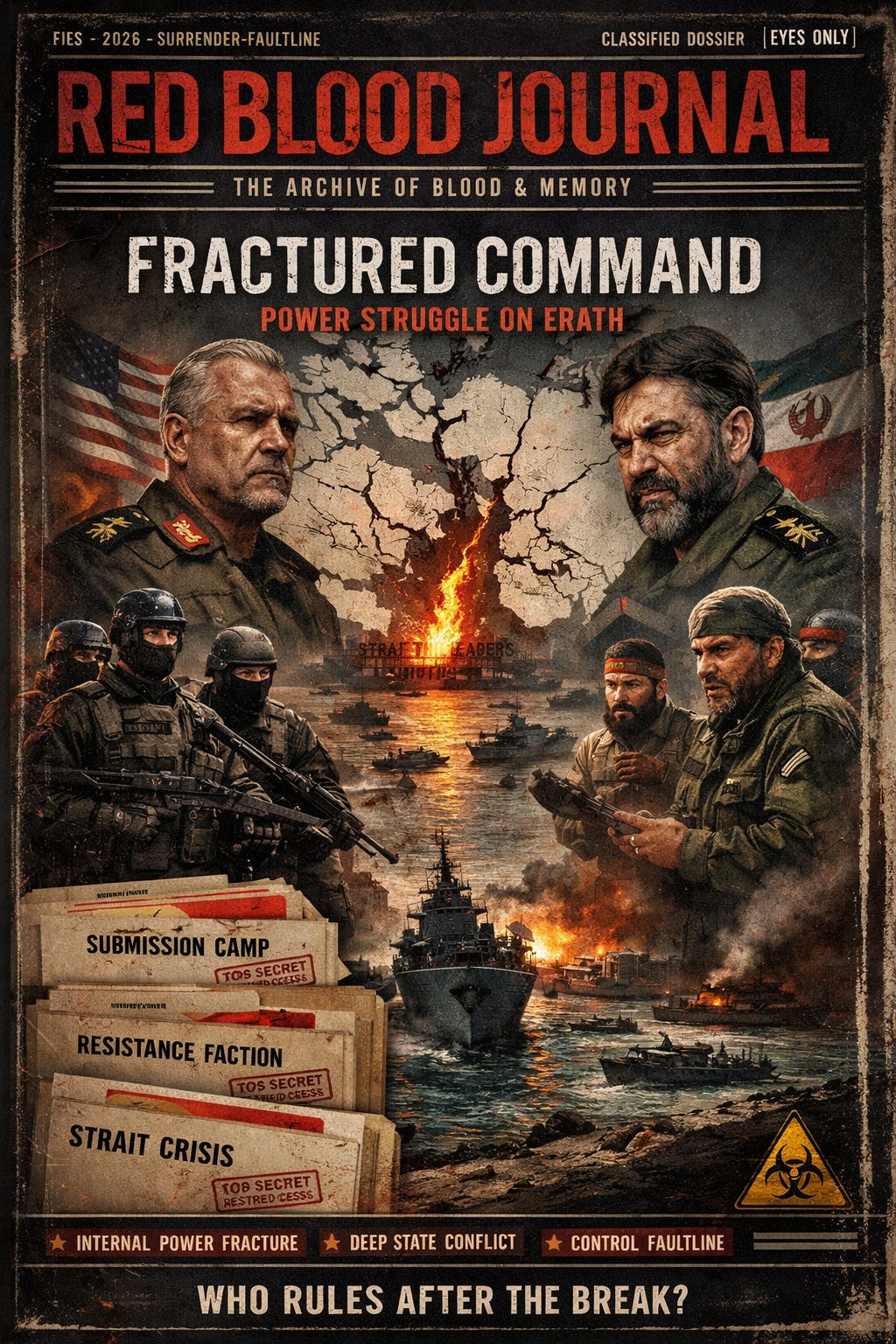
🩸 RED BLOOD JOURNAL TRANSMISSION
Archive: The Archive of Blood & Memory
Transmission Code: RBJ-2026-SURRENDER-FAULTLINE-#1030
Classification: Internal Power Fracture / Narrative Warfare
Desk: Geo-PsyOps & Power Structure Analysis Unit
Status: Active Transmission
PROLOGUE — THE MOMENT OF CRACKING
On Planet Erath, the system does not collapse in silence.
It fractures audibly.
Not with a single voice—but with too many voices.
A declaration emerges:
Uranium enrichment… possibly halted
Strategic concessions… possibly accepted
Maritime corridors… suddenly reopened
And a narrative of “victory” claimed externally
Markets react. Ships move. Signals ripple.
But inside the system—
something far more important happens.
The illusion of unity breaks.
SECTION I — THE FOUR SIGNALS OF SUBMISSION
The external framework is simple.
Four pillars define the moment:
Enrichment Halt (Indefinite)
Extraction of Enriched Material
No Financial Compensation
Continuation of Pressure (Blockade)
This is not negotiation language.
This is compliance architecture.
Yet the deeper signal is not the deal itself—
but how quickly it was claimed, denied, and contradicted across different voices.
SECTION II — THE SPLIT: COMMANDERS VS COMMANDERS
On Erath, power does not reside in institutions.
It resides in clusters of force.
And now those clusters are turning inward.
Two Camps Emerge:
🔻 CAMP A — “SURVIVAL THROUGH SUBMISSION”
Led by figures seeking stabilization
Objective: prevent collapse
Strategy: accept loss → retain structure
Narrative:
“We lost the battlefield. Preserve the system.”
🔻 CAMP B — “RESISTANCE THROUGH CONTINUATION”
Comprised of rival internal factions
Objective: avoid humiliation and internal loss of legitimacy
Strategy: reject concession → prolong conflict
Narrative:
“If surrender was inevitable, why not before destruction?”
This is no longer diplomacy.
This is:
A Civil War of Decision-Making Power
Inside the same system.
SECTION III — THE STRAIT PARADOX
One voice says:
“The passage is open.”
Another says:
“The passage is controlled.”
Another:
“The passage is restricted.”
And yet:
Ships begin moving
Others are turned back
Orders contradict orders
This is not confusion.
This is:
Fragmented Authority in Real-Time
When a system cannot agree on whether a chokepoint is open or closed,
it has already lost central command integrity.
SECTION IV — THE REAL WAR: POWER, NOT POLICY
Every argument presented is framed as:
ideology
resistance
national interest
But beneath all narratives lies a single variable:
CONTROL OF THE SYSTEM AFTER THE SHOCK
Key objective of each faction:
Become the post-crisis authority
Control economic flows
Control security apparatus
Control narrative legitimacy
This is not about surrender.
This is about:
Who survives to rule what remains
Even the disagreement itself is tactical:
One side uses international media leaks
The other uses internal propaganda networks
Each calling the other:
weak
traitorous
illegitimate
But both aligned on one truth:
The population is not the variable.
The system is.
SECTION V — THE PATTERN: WHEN THE CENTER DISAPPEARS
History on Erath follows a law:
When the central figure disappears,
suppressed rivalries become visible warfare.
Observed pattern:
Single authority → stability illusion
Authority removed → factional eruption
Factional eruption → internal elimination cycles
The current phase:
Pre-Consolidation Conflict
Indicators:
Contradictory messaging
Competing chains of command
Media weaponization
Narrative fragmentation
This phase historically leads to one outcome:
One faction absorbs the system—or the system fragments entirely
ANNEX A — THE SUBMISSION PARADOX
A critical internal argument emerges:
“If these concessions were inevitable…
why were they not accepted before the losses?”
This creates a legitimacy fracture:
Losses occurred
Then concessions followed
Meaning losses did not prevent concessions
Result:
Both victory and resistance narratives collapse simultaneously
ANNEX B — THE ERATH CONTROL EQUATION
Pressure ↑ → Concession ↑ → Internal Conflict ↑
But also:
Concession ↑ → Legitimacy ↓ → Internal Conflict ↑
No stable equilibrium exists.
FINAL TRANSMISSION — READ BETWEEN THE LINES
The external story says:
negotiation
strategy
diplomacy
The internal reality says:
The system is deciding who inherits power after damage has already been done
Not whether to surrender.
Not whether to resist.
But:
Who gets to stand at the top when the dust settles.
💔The Erath Power Fracture: Architectures of Internal Collapse
Apr 17, 2026
The provided text describes a volatile power struggle on the planet Erath following a series of significant strategic concessions and military setbacks.
This internal collapse is characterized by a fragmented authority where rival factions, divided between those favoring survival through submission and those demanding continued resistance, fight for systemic control.
These leadership groups are no longer focused on national interest or public welfare, but are instead engaged in narrative warfare to secure their own legitimacy.
The breakdown is most visible through contradictory commands regarding maritime corridors and nuclear enrichment, signaling a complete loss of central integrity.
Ultimately, the source illustrates a pre-consolidation conflict where the primary objective is determining which elite group will rule over the remaining ruins of the establishment.
This transition highlights a legitimacy crisis as the ruling class prioritizes post-crisis dominance over the actual stability of the state.


