


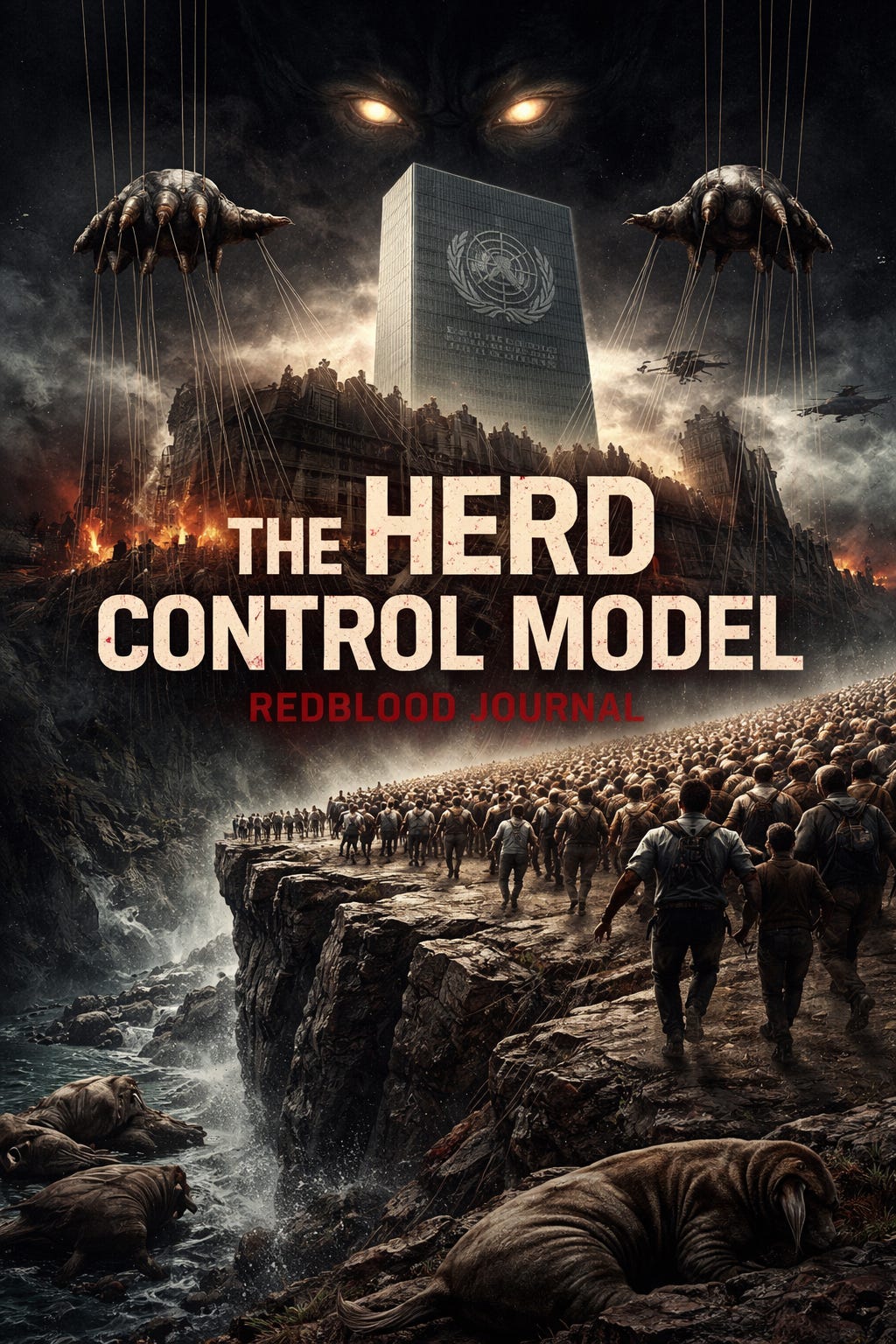
🩸 RED BLOOD JOURNAL TRANSMISSION
Archive: The Archive of Blood & Memory
Transmission Code: RBJ-2026-HERD-CONTROL-ARCHITECTURE-#1029
Classification: Civilization & Power Structures / Behavioral Control Mapping
Desk: Global Power Cartography Unit
Status: Active Transmission
PROLOGUE — THE CLIFF AND THE CROWD
A mass gathers.
Not by accident—
but by pressure.
Space narrows.
Options disappear.
Threat appears.
The herd moves.
Not strategically—
but instinctively.
And in that movement…
the fall begins.
On Planet Erath, the study of power does not begin in parliaments or palaces.
It begins on the cliff.
SECTION I — THE HERD MODEL
The event is simple:
A population concentrates in one location
External pressure is introduced
Panic overrides coordination
Collapse becomes internal
The critical observation:
The system does not require direct destruction.
It requires triggered behavior.
From your field record:
“Just the polar bear’s presence is enough to spook the walrus.”
This is the foundation of control.
Presence → Reaction → Outcome
No force required.
SECTION II — THE HUMAN TRANSLATION (PLANET ERATH)
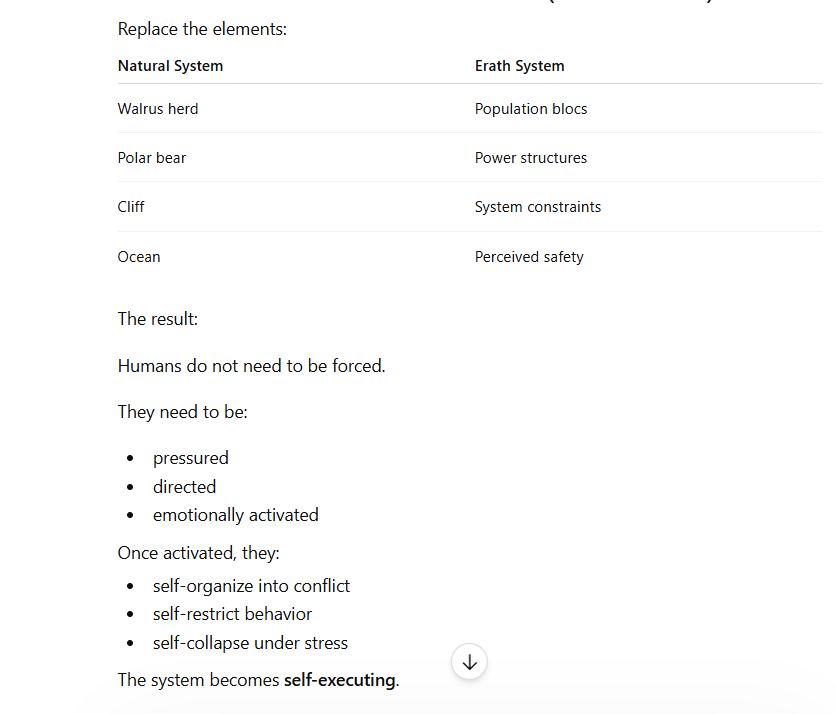
The result:
Humans do not need to be forced.
They need to be:
pressured
directed
emotionally activated
Once activated, they:
self-organize into conflict
self-restrict behavior
self-collapse under stress
The system becomes self-executing.
SECTION III — THE ROLE OF THE SYSTEM KEEPER
United Nations
On Planet Erath, the structure known as the United Nations is presented as:
neutral
stabilizing
peace-oriented
But under structural analysis, a different role emerges:
The UN is not designed to eliminate imbalance.
It is designed to:
contain imbalance
manage escalation
preserve system continuity
SECTION IV — FAIRNESS VS CONTROL
Fairness implies:
equal application of rules
universal accountability
symmetrical outcomes
Control operates differently:
selective enforcement
timed intervention
narrative calibration
On Erath, the system does not collapse into chaos because chaos is:
metered
The UN functions as:
a regulator of instability—not its eliminator
It ensures:
no conflict grows beyond containment
no actor escapes systemic boundaries
no population gains uncontrolled autonomy
SECTION V — THE PUPPET DYNAMIC
The illusion:
nations act independently
populations choose freely
conflicts emerge organically
The mechanism:
incentives are engineered
constraints are invisible
reactions are predictable
Like the herd on the cliff:
They are not pushed.
They are positioned.
ANNEX A — THE HERD CONTROL MODEL
Phase 1 — Concentration
Populations gather into constrained environments
(economic systems, urban centers, digital ecosystems)
Phase 2 — Pressure
Scarcity, fear, instability introduced
Phase 3 — Signal
A visible or perceived threat appears
Phase 4 — Reaction
Emotional response overrides rational coordination
Phase 5 — Collapse
Self-inflicted damage:
division
conflict
loss of stability
Phase 6 — Harvest
Power consolidates:
authority expands
systems tighten
narratives justify outcomes
ANNEX B — NARRATIVE WARFARE LAYER
Control is not maintained through force alone.
It is maintained through:
framing reality
defining enemies
shaping perception
The population does not see the system.
It sees:
threats
choices
urgency
And in that perception, it moves exactly where expected.
ANNEX C — THE ERATH PRINCIPLE
The most efficient system of control:
does not command
does not coerce
does not reveal itself
It creates conditions where:
the controlled believe they are acting freely
FINAL TRANSMISSION — THE EDGE OF AWARENESS
On Planet Erath:
The herd believes it is escaping danger.
The system knows it is guiding movement.
The fall is not the objective.
The movement is.
Because once movement becomes predictable—
control becomes permanent.
And the cliff…
is no longer a place.
It is a design.
👁️The Architecture of Herd Control on Planet Erath
Apr 17, 2026
This transmission examines a manipulative power structure on Planet Erath that governs through psychological pressure rather than physical force.
By mimicking the natural panic of a stampeding herd, the ruling systems create environments where populations self-destruct or surrender autonomy under perceived threats.
The text recontextualizes the United Nations as a stabilizing force designed to manage instability and ensure no group escapes systemic control.
True authority remains hidden, engineering conditions so that citizens believe they are acting freely while being funneled toward predictable outcomes.
Ultimately, the architecture of this society relies on narrative warfare and engineered scarcity to turn human instinct into a tool for permanent subjugation.


