


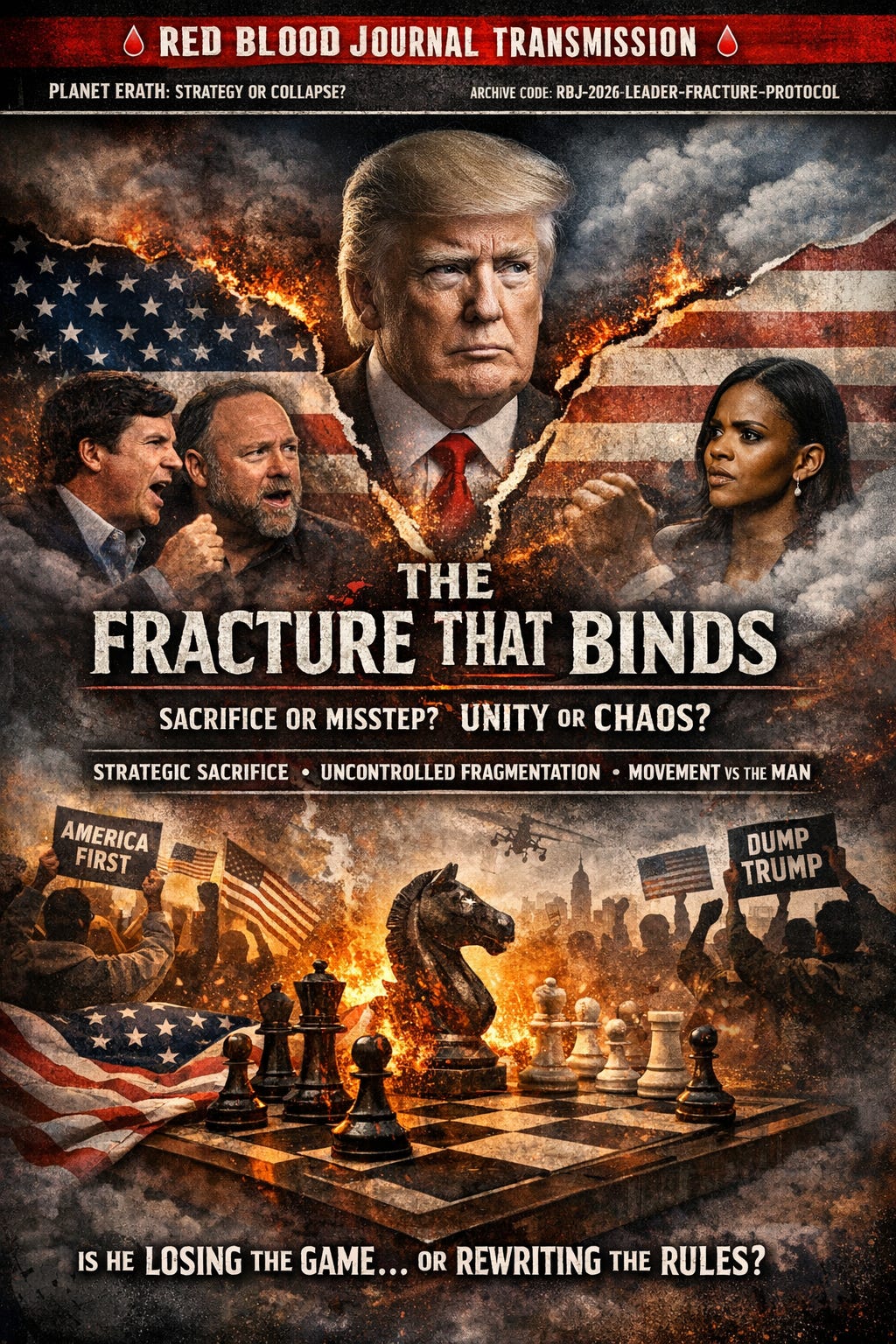
🩸 RED BLOOD JOURNAL TRANSMISSION
Archive: The Archive of Blood & Memory
Transmission Code: RBJ-2026-LEADER-FRACTURE-PROTOCOL-#1009
Classification: Narrative Warfare & Political Psychology Division
Desk: Movement Dynamics & Persona Deconstruction Unit
Status: Active Transmission — Analytical Report
THE FRACTURE THAT BINDS
On Planet Erath, when a leader attacks his own army, is he losing control… or rewriting the battlefield?
PROLOGUE — THE MISUNDERSTOOD MOVE
On Planet Erath, observers often mistake noise for chaos.
A leader rises—loud, unpredictable, polarizing. He gathers a movement not through uniformity, but through force of presence. Over time, the movement solidifies into identity. Loyalty becomes structure. Structure becomes expectation.
Then, unexpectedly—he turns.
He criticizes voices once aligned with him. Figures like Tucker Carlson, Alex Jones, and Candace Owens—once orbiting within the same gravitational field—become targets of distance, tension, or contradiction.
To the surface observer, this appears as fragmentation.
To the deeper analyst, a different question emerges:
Is this collapse… or controlled demolition?
SECTION I — THE PERSONALITY TRAP
Every movement on Erath faces the same structural risk:
It begins with an idea
It grows through a figure
It stabilizes through identity
It collapses through dependency
When a movement becomes too attached to a single personality, it stops evolving. It becomes rigid, predictable, and vulnerable.
This is known within Erath’s strategic doctrine as:
The Personality Trap — the moment when loyalty to the individual replaces loyalty to the idea.
A trapped movement cannot expand.
It can only defend.
SECTION II — THE FRACTURE EVENT
When the central figure begins to challenge his own allies, several immediate effects occur:
Internal confusion
Loyalty tests among followers
Public perception of instability
Media amplification of division
At first glance, this appears destructive.
But beneath the surface, a deeper mechanism activates:
Followers begin to think independently
Blind alignment fractures into multiple viewpoints
The movement loses uniformity—but gains depth
This moment is classified as:
The Fracture Event
A dangerous phase—because it can either destroy the movement…
or evolve it.
SECTION III — THE SACRIFICE HYPOTHESIS
Within Erath’s Narrative Warfare circles, a controversial theory exists:
A leader may intentionally damage his own reputation to dissolve dependency and force decentralization.
Under this hypothesis:
Reputation is a tool, not an asset
Unity is not built through agreement—but through shared tension
Division inside a movement can lead to integration with a broader population
In this model, the leader becomes:
Less of a symbol
More of a catalyst
The cost?
Loss of admiration
Loss of control over perception
Permanent damage to legacy
The potential gain?
A movement no longer confined to one identity
A population no longer divided by a single figure
This is known as:
The Sacrificial Disruption Strategy
SECTION IV — THE BACKFIRE MODEL
Not all fractures are intentional.
On Erath, history records many leaders who:
Turned on allies impulsively
Lost narrative discipline
Triggered irreversible fragmentation
In these cases:
Movements splinter permanently
Trust collapses
Opponents gain advantage
This is the far more common outcome.
It is classified as:
Uncontrolled Fragmentation
Where the leader is not sacrificing power—
but losing it.
SECTION V — THE UNCOMFORTABLE TRUTH
The binary question—
“Is it genius or stupidity?”—
is itself a flawed construct.
On Planet Erath, power operates in gradients, not absolutes.
A leader can be:
Strategic in intention
Imperfect in execution
Influential—but not in control
What unfolds is rarely a master plan or a random collapse.
It is a convergence of:
Ego
Strategy
Reaction
External pressure
Narrative evolution beyond the leader’s command
ANNEX A — THE MOVEMENT VS THE MAN
A critical distinction emerges:
A man-centered movement rises fast and collapses fast
An idea-centered movement evolves and survives
If a leader weakens his own centrality—intentionally or not—he may trigger:
Short-term instability
Long-term resilience
Because once the movement no longer depends on him, it can:
Expand beyond him
Survive without him
Transform independently
ANNEX B — THE ILLUSION OF CONTROL
Observers often assume that powerful figures control outcomes.
On Erath, this is rarely true.
Leaders influence direction—but:
Media reshapes narratives
Followers reinterpret messages
Opponents weaponize contradictions
In the end:
The system absorbs the leader—
not the other way around.
ANNEX C — THE FRACTURE THAT BINDS
There exists a paradox within Erath’s political architecture:
Division, when contained, can lead to a higher form of unity.
Not unity of agreement—
but unity of coexistence.
If opposing factions emerge from the same origin and begin interacting with broader groups, the rigid lines soften.
The result is not harmony—
but integration through tension.
FINAL TRANSMISSION — THE QUESTION REMAINS
Was the fracture intentional?
Was it a sacrifice?
Or was it simply the natural consequence of power under pressure?
On Planet Erath, the answer is rarely singular.
But one truth persists:
When a leader disrupts his own movement,
he is either losing the game…
or changing its rules entirely.
The difficulty lies in recognizing which—
before the outcome reveals itself.
End of Transmission
🧩The Fracture Paradox: Strategic Disruption and Movement Evolution
Apr 12, 2026
The provided text explores the Fracture Paradox, a theory regarding why a dominant leader might suddenly attack their own allies or movement.
This phenomenon, framed through the lens of a fictionalized “Planet Erath,” suggests that such internal conflict might be a deliberate strategy to prevent a movement from becoming stagnant or overly dependent on one person.
By creating controlled disruption, a leader can force followers toward independent thinking, potentially evolving a rigid group into a decentralized and resilient force.
However, the source also cautions that these fractures are often unintentional signs of instability rather than a master plan.
Ultimately, the text posits that whether a leader is sacrificing their reputation for a greater cause or simply losing control, the resulting tension forces the movement to survive independently of its creator.


