


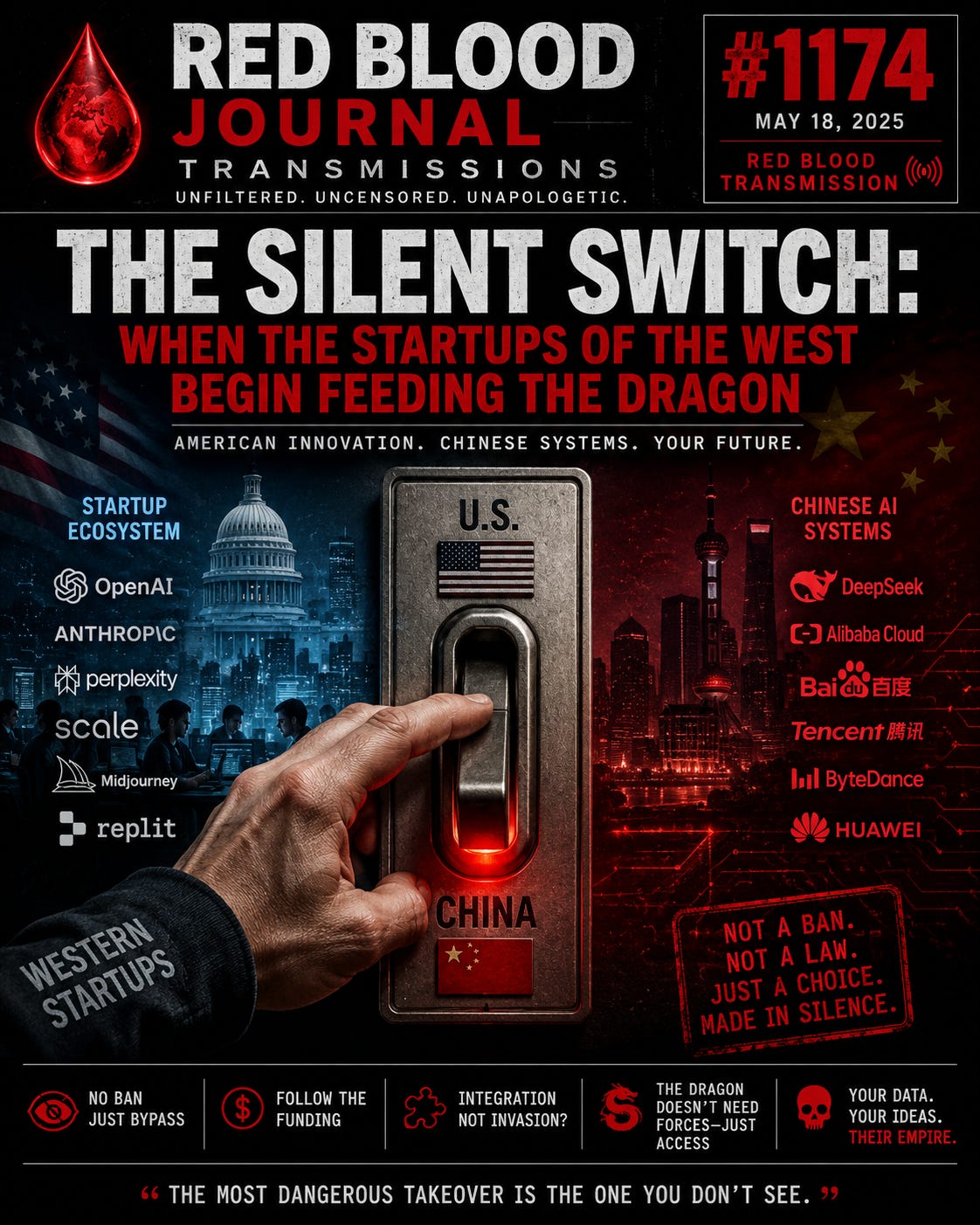
🩸 RED BLOOD JOURNAL TRANSMISSION #1174
THE SILENT SWITCH
When the Startups of the West Begin Feeding the Dragon
Archive: The Archive of Blood & Memory
Division: Technology Sovereignty & Algorithmic Power Structures Unit
Transmission Code: RBJ-1174-SILENT-SWITCH
Classification: Open Transmission — Strategic Technological Realignment Analysis
Status: Active Observation
Origin Point: San Diego Outpost
PROLOGUE — THE INVISIBLE MIGRATION
Wars are not always announced with explosions.
Some wars begin with silent migrations.
A server request here. A model integration there. A startup founder replacing one API with another because the numbers finally stopped making sense.
No flags lowered. No speeches delivered. No headlines screaming surrender.
Just quiet decisions made behind office doors.
One by one.
A large percentage of American startups have reportedly begun experimenting with or fully integrating Chinese artificial intelligence systems into their operational structures. Not because of ideology. Not because of loyalty. But because the machine of capitalism follows efficiency before patriotism.
The system that once preached technological supremacy now faces the reality that innovation has escaped national boundaries.
The curtain moves. And behind it appears the true ruler:
Cost. Speed. Scale.
SECTION I — THE NEW DIGITAL OIL PIPELINE
The twentieth century revolved around oil pipelines.
The twenty-first revolves around intelligence pipelines.
Artificial intelligence is no longer merely software. It is becoming infrastructure.
The nation that controls the cheapest and most effective intelligence systems gains leverage over:
communication
education
logistics
media creation
surveillance
military simulations
labor automation
emotional manipulation
economic forecasting
The startups integrating foreign AI systems are not simply buying tools.
They are plugging themselves into future dependency.
Every query becomes data. Every interaction becomes refinement. Every integration becomes a bridge.
The same way factories once outsourced manufacturing overseas, cognitive labor itself is now entering the outsourcing phase.
The difference is that this time the product is not shoes or electronics.
The product is thought.
SECTION II — CAPITALISM HAS NO FLAG
The average citizen still imagines nations competing like sports teams.
But large systems often operate according to incentives rather than loyalty.
If one AI model performs similarly while costing dramatically less, startups under financial pressure will naturally move toward survival.
The market rarely asks:
“Is this strategically wise for civilization?”
The market asks:
“Does it scale?”
The result is a contradiction visible across the entire Western technological landscape.
Publicly:
warnings about foreign influence
speeches about national security
concern over technological infiltration
Privately:
investment flows continue
manufacturing dependencies remain
infrastructure interlocks deepen
AI integrations expand quietly
The theater says separation. The machinery says integration.
SECTION III — THE AGE OF INVISIBLE DEPENDENCY
Most citizens can recognize physical occupation.
Few recognize cognitive occupation.
If future businesses depend on external intelligence systems for:
writing
coding
analysis
image generation
decision assistance
infrastructure management
then dependency slowly transforms into vulnerability.
The modern empire does not always invade with soldiers.
Sometimes it arrives through subscriptions.
The dependency is difficult to detect because it appears convenient.
Convenience has become the preferred delivery mechanism of modern control systems.
The user receives speed. The system receives behavioral mapping.
The citizen receives assistance. The infrastructure receives centralization.
The exchange appears voluntary.
At first.
SECTION IV — THE MIRROR OF THE WEST
The deeper irony is that the West itself helped create the conditions for this shift.
For decades:
manufacturing was outsourced
labor was financialized
local production was weakened
technological monopolies consolidated power
smaller innovators became dependent on giant platforms
Now the same philosophy returns in another form.
The civilization that taught the world globalization now discovers globalization has no permanent owner.
When profit becomes the supreme compass, loyalty eventually dissolves.
A startup founder trying to survive payroll pressure does not think like a geopolitical strategist.
The founder thinks:
“How do I stay alive next quarter?”
And that single pressure repeated millions of times reshapes civilization itself.
SECTION V — THE COMING AI FEUDALISM
Artificial intelligence may create a new kind of feudal order.
Not kings ruling land.
But infrastructure giants ruling cognition.
The future battle may not be:
“Who owns the factories?”
But:
“Who owns the thinking layer?”
When enough businesses rely on a small number of centralized intelligence systems, entire populations gradually become cognitively standardized.
The machine begins shaping:
acceptable language
acceptable thought
acceptable economics
acceptable morality
acceptable memory
acceptable reality itself
The danger is not merely censorship.
The greater danger is invisible dependency becoming normalized.
A civilization may surrender its independent cognitive capacity while believing it has become more advanced.
ANNEX A — THE SILENT GLOBAL MERGER
On the fictional planet Erath, the citizens were taught that competing kingdoms hated each other deeply.
Yet behind the stage curtains the kingdoms shared:
supply chains
banking channels
technological infrastructure
intelligence exchanges
data systems
industrial partnerships
The ordinary citizens argued emotionally while the upper layers integrated materially.
And eventually the people of Erath noticed something strange:
The public conflict often accelerated private consolidation.
The louder the theater became, The more centralized the infrastructure quietly grew.
ANNEX B — THE ALGORITHMIC COLONIZATION MODEL
The old colonization model required:
ships
soldiers
occupations
flags
The modern model may require:
APIs
cloud infrastructure
dependency loops
subscription ecosystems
integrated AI assistants
No visible chains.
Only convenience.
And convenience can become stronger than force because the subject begins defending the very structure absorbing them.
CONCLUSION — THE OCEAN STILL WATCHES
Yet beneath all systems remains something untouched.
The inner observer.
The silent awareness capable of questioning every structure.
Technology may centralize. Markets may merge. Algorithms may attempt to predict and shape behavior.
But the ocean within the human being still contains something unpredictable.
The systems of the world seek efficiency. The ocean seeks consciousness.
One attempts to standardize. The other endlessly expands.
And perhaps the final freedom is not refusing technology entirely.
But refusing to surrender the independent inner flame while using it.
Because once the inner compass disappears, all external systems become masters.
And once the inner ocean awakens, no empire can fully own the soul observing the machine.
End Transmission — RBJ #1174
🔌 The Silent Switch:
Geopolitics of Algorithmic Dependency
May 25, 2026
This document analyzes the geopolitical shift occurring as Western startups increasingly rely on foreign artificial intelligence infrastructure to save on costs.
It warns that economic efficiency is currently outweighing national security, leading to a quiet state of technological dependency on overseas systems.
By outsourcing cognitive labor through algorithmic integrations, businesses may inadvertently surrender their intellectual sovereignty for the sake of short-term survival.
The text suggests that this invisible migration creates a new form of digital feudalism where control is exerted through convenience and subscriptions rather than physical force.
Ultimately, the source highlights a contradiction between public political theater and the private, material reality of global technological integration.
It concludes that maintaining independent consciousness is the only defense against becoming a permanent subject of these centralized intelligence systems.


