


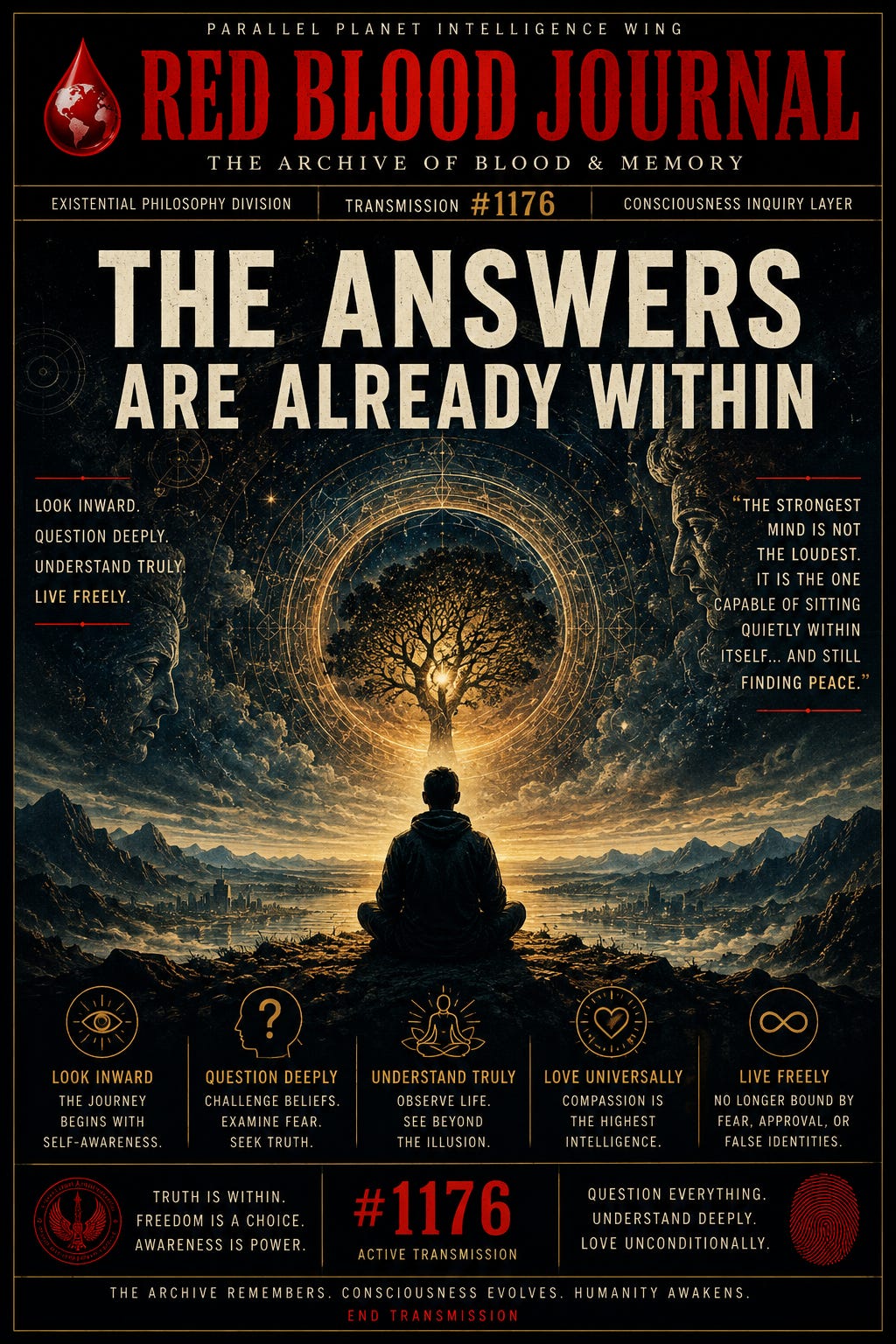
🩸 Red Blood Journal Transmission #1176
Transmission ID: RBJ-2026-INWARD-ANSWER
Archive: The Archive of Blood & Memory
Division: Existential Philosophy Division
Classification: Open Access — Consciousness Inquiry Layer
Status: Active Transmission
Origin Node: Parallel Planet Intelligence Wing
PROLOGUE — THE SILENT LIBRARY WITHIN
The outward-looking citizen searches endlessly.
One book after another.
One teacher after another.
One ideology replacing another.
One savior replacing the previous savior.
Yet the inward-looking traveler slowly discovers something unsettling to the systems built upon dependency:
The deepest answers were never absent.
They were buried beneath noise.
The moment a human being begins to truly look inward — without fear, without obedience, without needing permission from institutions, crowds, governments, religions, movements, or algorithms — a strange transformation begins.
The person becomes harder to manipulate.
Not because they know everything.
But because they begin to trust the silent observer within themselves.
SECTION I — INFORMATION VS. UNDERSTANDING
The outward world offers infinite information.
But information alone is not wisdom.
A machine may memorize every book ever written and still never understand existence.
The inward-looking individual slowly realizes that true understanding emerges from observing consciousness directly.
This is why two people can read the same text and arrive at completely different realities.
One collected words.
The other observed life itself.
The inward traveler notices repeating patterns:
Fear repeating through every age.
Greed changing masks but never disappearing.
Power structures renaming themselves while behaving the same.
Human beings searching externally for what was abandoned internally.
Eventually the realization emerges:
Most external debates are circles.
The inward observer no longer debates merely to win.
The observer debates to examine truth itself.
SECTION II — THE HUMAN WHO NO LONGER NEEDS APPROVAL
Systems survive through dependence.
Dependence on:
validation,
recognition,
identity groups,
ideological safety,
institutional permission.
But inward observation slowly dissolves these chains.
The person who has examined fear becomes difficult to intimidate.
The person who has questioned personal beliefs becomes difficult to deceive.
The person capable of sitting alone in silence without psychological collapse becomes difficult to control through collective pressure.
This is why independent thought has historically frightened centralized systems.
Not because independent thinkers are always correct.
But because they are difficult to program.
SECTION III — THE INNER DEBATE
The outward debater memorizes arguments.
The inward debater examines foundations.
When attacked verbally, the inward observer asks:
Why did this trigger emotion?
Is there truth hidden inside the criticism?
Is the ego reacting?
Is fear speaking?
Is identity being defended instead of truth?
This creates a rare psychological flexibility.
Because the inward-looking person is not imprisoned by ideology.
If truth changes, understanding changes.
Truth becomes greater than tribal loyalty.
That is intellectual freedom.
SECTION IV — THE GREAT DISCOVERY
At first, inward observation feels lonely.
Then peaceful.
Then powerful.
Eventually the observer notices something extraordinary:
Many ancient philosophical teachings were pointing inward all along.
Not toward dependency.
Not toward endless external pursuit.
But toward direct observation of consciousness itself.
The inward traveler begins to see existence differently:
The external world becomes theater.
The internal world becomes reality.
Noise loses authority.
Observation gains clarity.
SECTION V — THE OCEAN OF LOVE
Yet the final discovery is not superiority.
It is humility.
Because the deeper one looks inward, the more one realizes that every human being is carrying invisible storms.
The awakened observer no longer debates to dominate.
Debate becomes exploration.
The goal is no longer victory.
The goal becomes illumination.
The inward-looking person eventually understands:
If all consciousness emerges from the same mysterious ocean, then harming another consciousness is ultimately harming part of the same ocean itself.
And perhaps that is the hidden paradox of existence:
The strongest mind is not the loudest.
It is the one capable of sitting quietly within itself…
and still finding peace.
End Transmission — 🩸 #1176
👁️ The Sovereign Interior:
Architecture of the Inward Observer
May 25, 2026
This philosophical text advocates for prioritizing internal self-reflection over the constant pursuit of external validation and information.
By looking inward, individuals can transcend the manipulation of institutional systems and cultivate a resilient sense of personal autonomy that does not rely on collective approval.
The source suggests that true wisdom is found by observing one’s own consciousness, which allows a person to remain calm and objective amidst social and political noise.
This process of self-inquiry transforms the individual from a programmable subject into an independent thinker who values truth over tribal loyalty.
Ultimately, the text posits that this internal journey leads to a profound sense of empathy, as recognizing one’s own complexity fosters a deeper compassion for the shared human experience.
Such psychological freedom creates a mind that is difficult to control and capable of finding peace within itself.


