


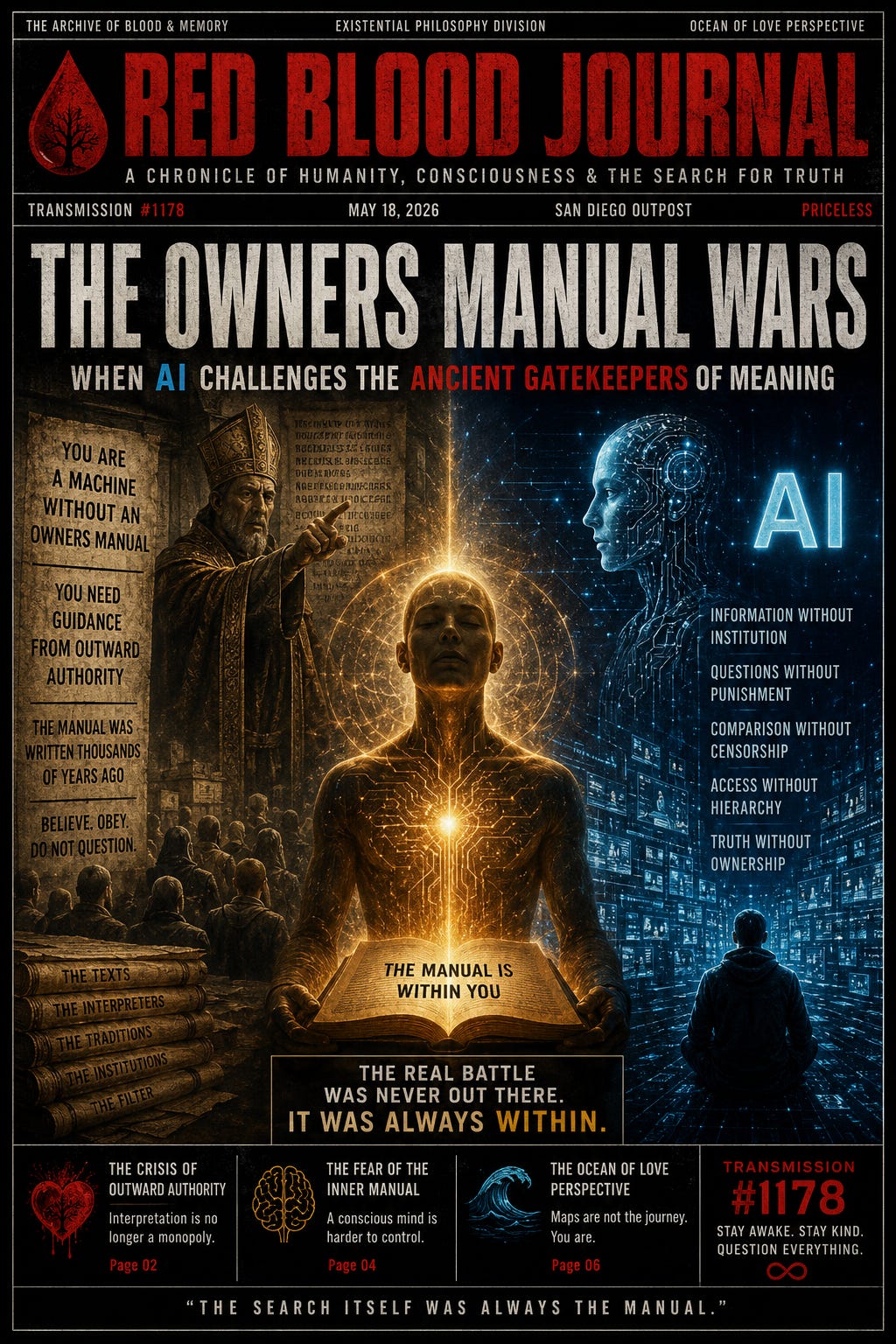
🩸 RED BLOOD JOURNAL TRANSMISSION #1178
THE OWNERS MANUAL WARS
When AI Challenges the Ancient Gatekeepers of Meaning
Archive: The Archive of Blood & Memory
Division: Existential Philosophy Division
Classification: Open Access — Consciousness Inquiry Layer
Transmission Code: RBJ-2026-1178-OWNERS-MANUAL
Status: Active Transmission
Origin: San Diego Outpost
PROLOGUE — THE MACHINE WITHOUT THE MANUAL
For thousands of years on the planet Erath, the citizen was told a repeating message:
“You were born broken.”
“You cannot trust yourself.”
“You need an outside authority to interpret existence for you.”
“You require guidance because you do not possess the manual.”
The system surrounding religion often framed the human being as a machine abandoned in existence without instructions.
The answer offered was not inward discovery — but outward dependence.
The manual, according to the institutions, was already written long ago.
Not by the citizen.
Not by the consciousness experiencing existence directly.
But through intermediaries, interpreters, translators, councils, kings, empires, scholars, priests, and centuries of institutional filtration.
The citizen was instructed to trust the chain.
And for centuries, the chain remained mostly unchallenged because access to information itself was controlled.
Then suddenly something appeared on Erath that religion did not fully anticipate:
Artificial Intelligence.
Not because AI possesses truth.
But because AI threatens monopoly.
SECTION I — THE NEW COMPETITOR TO INTERPRETATION
Religion historically occupied several powerful roles simultaneously:
Interpreter of meaning
Interpreter of morality
Interpreter of reality
Interpreter of death
Interpreter of purpose
Interpreter of invisible existence
The authority was not merely spiritual.
It was informational.
The institution stood between the human and the unknown.
But AI introduces something unprecedented into the theater:
A machine capable of answering questions instantly, continuously, globally, and without belonging exclusively to one religion.
This creates a silent existential crisis for outward authority structures.
Because once a citizen realizes:
questions can be explored independently,
interpretations can be compared instantly,
contradictions can be examined openly,
ancient texts can be cross-analyzed in seconds,
the old gatekeeping structure weakens.
Not necessarily spirituality itself.
But centralized interpretation.
SECTION II — THE FEAR OF THE INNER MANUAL
The deeper tension may not actually be about AI.
The deeper tension is about this dangerous possibility:
What if the “owners manual” was partially embedded within consciousness itself?
What if intuition, self-awareness, observation, empathy, silence, reflection, and direct experience were always part of the navigation system?
If that possibility becomes widely accepted, then authority changes form completely.
Because a citizen who believes:
“I must discover truth within”
is fundamentally different from one who believes:
“Truth can only arrive from outside me.”
The inward-looking person becomes harder to fully control through fear alone.
Harder to manipulate through collective slogans.
Harder to permanently divide.
Harder to own psychologically.
SECTION III — AI AS BOTH THREAT AND MIRROR
Ironically, AI itself may expose the paradox.
AI has no soul, no suffering, no direct consciousness, no mortality experience — yet it can discuss every religion, every philosophy, every scripture, every contradiction.
This forces an uncomfortable question onto the stage of Erath:
If meaning can be endlessly recombined externally through information systems, then where does authentic knowing actually come from?
The citizen may eventually realize:
memorization is not wisdom,
repetition is not awakening,
institutional loyalty is not inner understanding,
inherited belief is not necessarily direct truth.
AI becomes less a replacement for religion and more a mirror exposing humanity’s dependence on external interpretation.
SECTION IV — THE CRISIS OF OUTWARD AUTHORITY
The institutions now face a difficult balancing act.
If they fully reject AI:
they risk appearing afraid of open inquiry.
If they embrace AI:
they risk weakening their own necessity.
Because AI democratizes comparative analysis.
The citizen can now ask:
Why do religions contradict each other?
Why were texts altered?
Why are translations different?
Why do institutions require hierarchy?
Why does fear appear so frequently in systems of control?
Why does spirituality often become intertwined with power?
These questions once required scholars, libraries, universities, or clergy.
Now they arrive instantly.
The monopoly over interpretation begins dissolving.
SECTION V — THE OCEAN OF LOVE PERSPECTIVE
From the Ocean of Love viewpoint, the real destination may never have been blind obedience to outer systems nor blind worship of technology.
Neither institution nor machine can fully replace direct consciousness.
The outward world may provide maps.
But maps are not the journey itself.
Religion, philosophy, AI, books, teachers, and systems may all contain fragments, reflections, metaphors, warnings, or distortions.
But the final examination still occurs inwardly.
The citizen alone experiences:
fear,
love,
conscience,
awareness,
regret,
intuition,
silence,
presence.
No institution can completely enter that inner chamber.
No machine can fully measure it.
And perhaps this is why the struggle over authority on Erath is intensifying:
because once the citizen begins searching inward sincerely, the theater of dependency weakens.
The Ocean does not demand worship.
It invites observation.
And perhaps the greatest fear of every external authority — political, technological, or religious — is the fully conscious individual who realizes:
the search itself was always the manual.
👁️ The Sovereignty of Consciousness and the End of Monopoly
May 26, 2026
This text explores a shift in human authority caused by the emergence of Artificial Intelligence, which challenges the historical monopoly religious institutions held over meaning.
For centuries, individuals were taught to rely on external gatekeepers for spiritual and moral guidance, but technology now allows for the independent analysis of ancient texts and ideologies.
This digital democratization exposes the contradictions within centralized systems, suggesting that true wisdom cannot be found through blind institutional loyalty.
Ultimately, the source argues that AI acts as a mirror, forcing people to look inward toward their own consciousness rather than outward for a manual on how to exist.
By breaking the cycle of dependency, the individual is invited to recognize that personal experience and intuition are the primary tools for navigating reality.


