


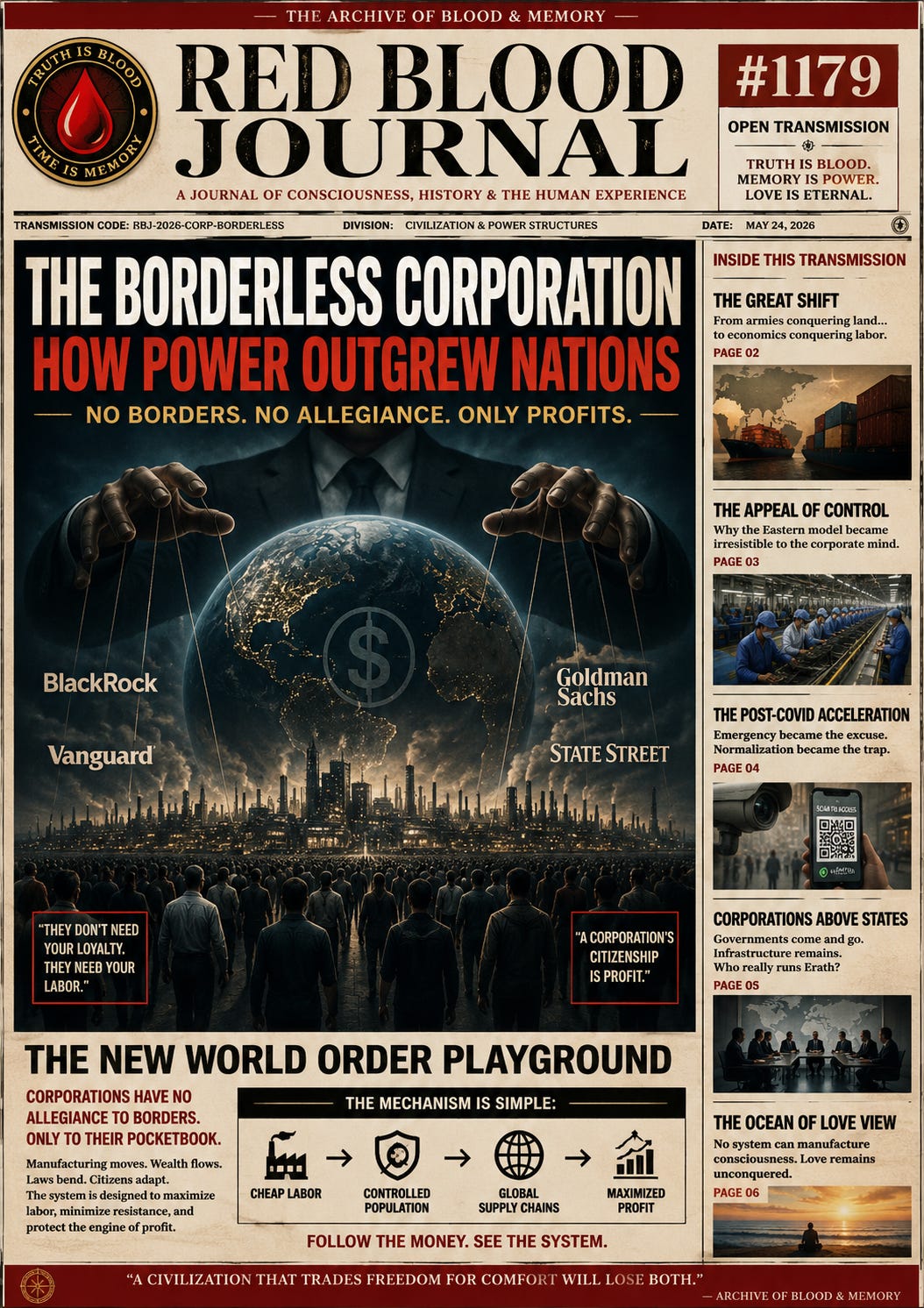
🩸 RED BLOOD JOURNAL TRANSMISSION #1179
THE BORDERLESS CORPORATION
How the Mega-Entities of Planet Erath Outgrew Nations
Archive: The Archive of Blood & Memory
Division: Civilization & Power Structures
Classification: Open Transmission — Economic Sovereignty Analysis
Transmission Code: RBJ-2026-CORP-BORDERLESS
Status: Active Transmission
PROLOGUE — THE FLAG WITHOUT A COUNTRY
On the fictional planet of Erath, citizens were taught from birth that nations ruled the world.
Flags waved. Anthems played. Borders were guarded. Elections were televised like sacred rituals.
But behind the theater, another organism quietly expanded beyond every border at once.
The corporation.
Not the small merchant.
Not the family business.
Not the craftsman.
The mega-entity.
An organism with:
no permanent nationality,
no emotional attachment to any population,
no historical loyalty,
and no true ideology except expansion.
On Erath, the corporations discovered something simple:
A nation must care about its people at least enough to survive politically.
A corporation does not.
Its citizenship is profit.
Its religion is growth.
Its language is efficiency.
Its map is the globe itself.
SECTION I — THE GREAT SHIFT
The old empires of Erath conquered land with armies.
The modern corporate empire conquered labor with economics.
Factories moved wherever:
wages were lowest,
regulations weakest,
labor easiest to control,
and resistance least effective.
The citizens of Western Erath believed industry belonged to them permanently.
But the corporations looked at the planet differently.
They saw:
workers as interchangeable units,
nations as temporary tax zones,
laws as obstacles to optimize around,
and populations as markets rather than communities.
The result was predictable:
Manufacturing flowed eastward.
Industrial knowledge migrated.
Supply chains globalized.
And entire populations discovered too late that their economic foundations had quietly left home decades earlier.
SECTION II — WHY THE ERATHIAN EAST BECAME ATTRACTIVE
On Erath, the Eastern governance model offered something irresistible to mega-corporations:
Stability.
Not freedom.
Predictability.
A highly controlled labor force could:
work longer,
organize less,
strike less,
resist less,
and be managed at planetary scale.
To the corporate strategist, this was not morality.
It was mathematics.
The fewer disruptions to production:
the higher the margins,
the faster the scaling,
the larger the shareholder returns.
And so the corporate machine slowly detached itself from national identity.
The executives still spoke of patriotism publicly.
But the factories followed labor economics instead of flags.
SECTION III — THE POST-COVID ACCELERATION
Then came the Great Viral Event on Erath.
And suddenly:
emergency powers normalized,
digital checkpoints appeared,
platform dependency intensified,
remote algorithmic work expanded,
censorship systems hardened,
and citizens became increasingly dependent on centralized infrastructure.
Many inhabitants of Erath noticed something disturbing:
The managerial systems once associated mainly with the Eastern bloc were now appearing globally.
Not identically.
But directionally.
The language used was:
safety,
efficiency,
misinformation control,
public health,
and security.
But critics on Erath argued the deeper effect was psychological:
Citizens were being conditioned to accept:
continuous monitoring,
reduced privacy,
digital identity normalization,
and algorithmic authority over human judgment.
SECTION IV — THE CORPORATION ABOVE THE STATE
On Erath, the largest corporations eventually became more powerful than many governments.
Not officially.
Functionally.
They controlled:
communication,
cloud infrastructure,
logistics,
entertainment,
financial rails,
public narratives,
and increasingly, artificial intelligence itself.
Governments changed every few years.
Corporate infrastructure remained.
And because mega-corporations operated across borders, their survival depended less on pleasing citizens and more on maintaining:
investor confidence,
resource access,
regulatory influence,
and technological dominance.
Thus emerged the strange reality of Erath:
Citizens still emotionally identified with nations.
But the systems increasingly operated globally.
SECTION V — THE OCEAN OF LOVE VIEW
And yet…
The observer standing outside the machinery sees something important.
The system can optimize labor.
It can optimize consumption.
It can optimize surveillance.
But it cannot fully optimize consciousness.
A human being who looks inward instead of outward becomes difficult to program.
The borderless corporation understands markets deeply.
But it still struggles to understand meaning.
Because meaning cannot be mass-produced.
Love cannot be industrialized.
And the soul does not naturally speak the language of quarterly earnings.
The Ocean of Love perspective on Erath therefore sees the corporate machine not as an all-powerful god… but as a temporary structure built from fear, desire, competition, and material attachment.
Powerful?
Yes.
Permanent?
No.
For every system eventually reaches the same wall:
A civilization can manufacture products indefinitely.
But it cannot manufacture inner peace.
And when enough citizens rediscover the value of consciousness over consumption, the machinery of Erath begins to lose its spell.
🏢 The Sovereign Machinery:
The Rise of the Borderless Corporation
May 26, 2026
The provided text chronicles the rise of borderless mega-entities on the fictional planet of Erath, detailing how these corporations bypassed national sovereignty in pursuit of global profit and efficiency.
These massive organizations treat nations as temporary economic zones, shifting manufacturing and influence toward regions that offer the most rigid labor control and predictable stability.
As technological and digital infrastructures expanded, these entities gained functional dominance over governments, implementing global systems of surveillance and algorithmic authority that prioritize growth over human citizenship.
However, the narrative suggests that this mechanical dominance is ultimately limited because it cannot industrialize the human soul or manufacture genuine inner peace.
Ultimately, the source argues that once individuals prioritize consciousness over consumption, the pervasive influence of the corporate machine begins to dissolve.


