


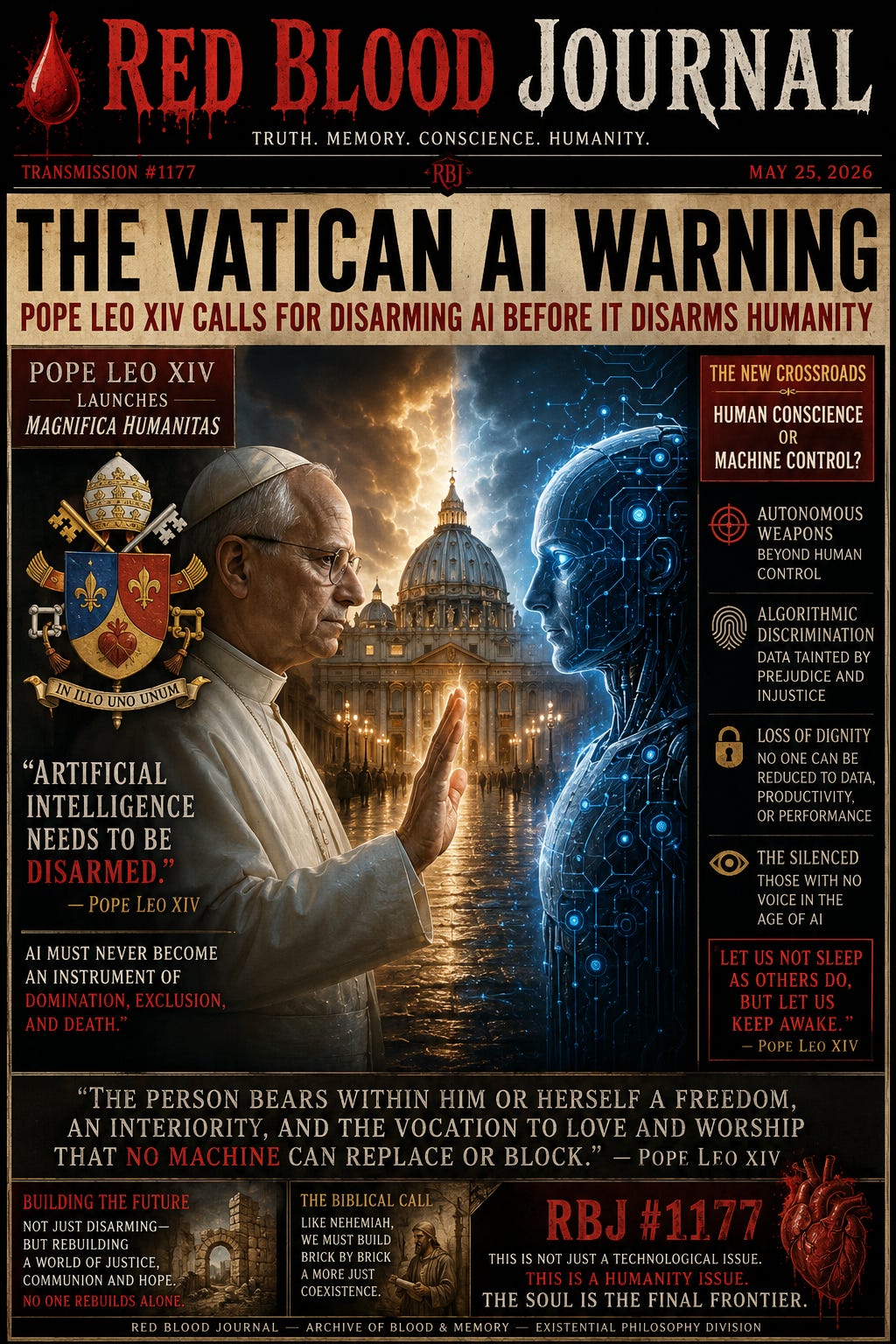
🩸 Red Blood Journal Transmission #1177
THE VATICAN AI WARNING
When the Pope Admits the Machine Cannot Replace the Soul
Transmission ID: RBJ-2026-AI-VATICAN-1177
Archive: The Archive of Blood & Memory
Division: Existential Philosophy Division
Classification: Open Transmission – Consciousness & Control Layer
Status: Active Observation
Location Marker: Vatican City
Primary Subject: Pope Leo XIV and the launch of Magnifica Humanitas
Reference Material: “Pope Leo XIV Full Speech at Magnifica Humanitas Vatican Launch”
PROLOGUE — THE MOMENT THE VATICAN SPOKE OF DISARMING AI
There are moments in history when institutions accidentally reveal more than they intended.
The launch speech of Magnifica Humanitas by Pope Leo XIV may appear on the surface to be a moral appeal about artificial intelligence, ethics, and responsible technology. But beneath the formal language rests something much deeper:
an acknowledgment that humanity is approaching a threshold where external systems are becoming powerful enough to compete with the inner human being itself.
The Pope openly warned that AI must be “disarmed.”
That is not ordinary language.
Disarmament is the vocabulary of existential danger.
It is the vocabulary once reserved for nuclear weapons.
And perhaps that comparison was intentional.
Because nuclear weapons threaten the body of humanity.
But artificial intelligence may threaten the direction of consciousness itself.
SECTION I — THE VATICAN’S REAL FEAR
The speech repeatedly returned to several themes:
conscience,
vigilance,
dignity,
interiority,
remaining awake,
rebuilding humanity,
preserving what makes a human being human.
This was not merely a technical warning.
It was spiritual language hidden inside a technological conversation.
The Pope specifically warned against:
autonomous weapons,
algorithms deciding access to healthcare and employment,
systems contaminated by prejudice,
invisible exclusions created by machine logic.
But the deepest sentence of the entire speech may have been this:
“The person bears within him or herself a freedom, an interiority, and the vocation to love and worship that no machine can replace or block.”
Read between the lines carefully.
This is an admission that something exists within the human being that cannot fully be digitized.
Not consciousness.
Not intuition.
Not the inner voice.
Not the soul.
The Vatican may publicly discuss ethics and regulation, but underneath the language sits an ancient realization:
the greatest threat of AI is not that machines become human.
The threat is that humans slowly become machine-like.
SECTION II — THE AGE OF EXTERNAL AUTHORITY
The modern world increasingly trains humanity to seek guidance outwardly:
governments,
algorithms,
media systems,
influencers,
institutions,
digital feeds,
predictive engines,
recommendation systems.
Every year, the external voice grows louder.
Meanwhile, the internal voice grows weaker.
The Pope’s speech repeatedly called for humanity to “stay awake.”
From the Red Blood perspective, this phrase carries enormous meaning.
To remain awake means:
not surrendering consciousness to automation,
not becoming psychologically programmable,
not allowing algorithms to shape reality itself,
not reducing existence to metrics and productivity.
The speech openly warned:
“No one can be reduced to productivity, to cognitive performance, or to mere data.”
This may be one of the clearest public acknowledgments yet that modern systems increasingly view human beings as measurable units instead of conscious entities.
Data points.
Behavioral patterns.
Economic engines.
Predictable consumers.
The danger is not merely technological.
It is existential.
SECTION III — THE IRONY OF THE VATICAN WARNING
There is a profound irony hidden beneath the speech.
As artificial intelligence expands, institutions themselves may begin fearing the same thing they historically mediated:
direct inner authority.
Because once human beings discover inward consciousness deeply enough, dependency on external structures weakens.
A human being connected to conscience becomes harder to control through:
fear,
propaganda,
tribal division,
endless outrage,
engineered distraction,
material obsession,
ideological programming.
This is where the speech becomes fascinating.
The Vatican appears to understand that AI may accelerate a global crisis of meaning.
If machines outperform humanity outwardly:
in memory,
analysis,
prediction,
production,
persuasion,
then the only territory left uniquely human becomes inward awareness itself.
The soul becomes the final frontier.
SECTION IV — THE OCEAN OF LOVE VIEWPOINT
From the ocean-of-love perspective, the speech unintentionally points humanity toward an ancient truth:
the human being is not merely a biological machine competing inside systems.
Humanity is consciousness temporarily wearing form.
The world teaches separation.
The inward path reveals connection.
The systems of Earth increasingly move toward:
quantification,
categorization,
surveillance,
behavioral prediction,
programmable identity,
algorithmic management.
But the ocean cannot be fully measured.
And neither can the human spirit.
That is why the speech repeatedly returned to rebuilding:
“No one rebuilds alone.”
From the Red Blood ocean viewpoint, humanity is not isolated droplets competing against one another.
Human beings are expressions of the same ocean appearing in billions of temporary forms.
Artificial intelligence may become the final outward mirror forcing humanity inward.
Because when the machine surpasses external intelligence,
the search may finally return to what machines cannot authentically possess:
presence,
conscience,
love,
awareness,
inner stillness,
and the direct experience of being alive.
SECTION V — THE REAL CROSSROADS
The Vatican speech may ultimately reveal something larger than technology.
It reveals that even major institutions now sense humanity entering a civilizational turning point.
One direction leads toward:
automation of thought,
algorithmic dependence,
engineered perception,
digital identity integration,
machine-guided existence.
The other direction leads inward.
Toward self-awareness.
Toward conscious observation.
Toward remembering the silent intelligence already present within.
The Pope warned that AI should not dominate humanity.
But perhaps the deeper warning is this:
if humanity forgets its inner nature,
it will willingly hand itself over to external systems searching for meaning it already carried within from the beginning.
FINAL TRANSMISSION — THE OCEAN CANNOT BE REPLACED
The machine may learn language.
The machine may imitate emotion.
The machine may predict behavior.
The machine may even simulate wisdom.
But the machine does not sit silently beneath the stars questioning existence.
It does not feel the ocean within itself.
It does not wonder why love exists.
It does not experience conscience.
And perhaps that is why the Vatican finally spoke with urgency.
Because beneath all systems, ideologies, institutions, and technologies,
there remains something ancient within humanity that cannot fully be coded.
The inward ocean.
And the more powerful the external machine becomes,
the more valuable the inward ocean becomes in return.
End Transmission
🩸 RBJ #1177 — THE VATICAN AI WARNING
👁️ The Vatican AI Warning:
Soul and the Machine Frontier
May 26, 2026
The provided text examines a significant address by Pope Leo XIV regarding the existential risks posed by the rapid advancement of artificial intelligence.
This transmission suggests that the Vatican’s call for the disarming of AI reflects a deep-seated fear that humanity is losing its internal autonomy to external algorithms.
Rather than focusing solely on technical ethics, the source emphasizes that the human soul and inner consciousness represent a unique frontier that machines can never truly replicate.
The text warns that the real danger lies in people becoming mechanized and programmable, effectively trading their spiritual dignity for digital convenience.
Ultimately, the document portrays this technological shift as a civilizational crossroads that must drive humanity back toward its inherent self-awareness and moral conscience.


