


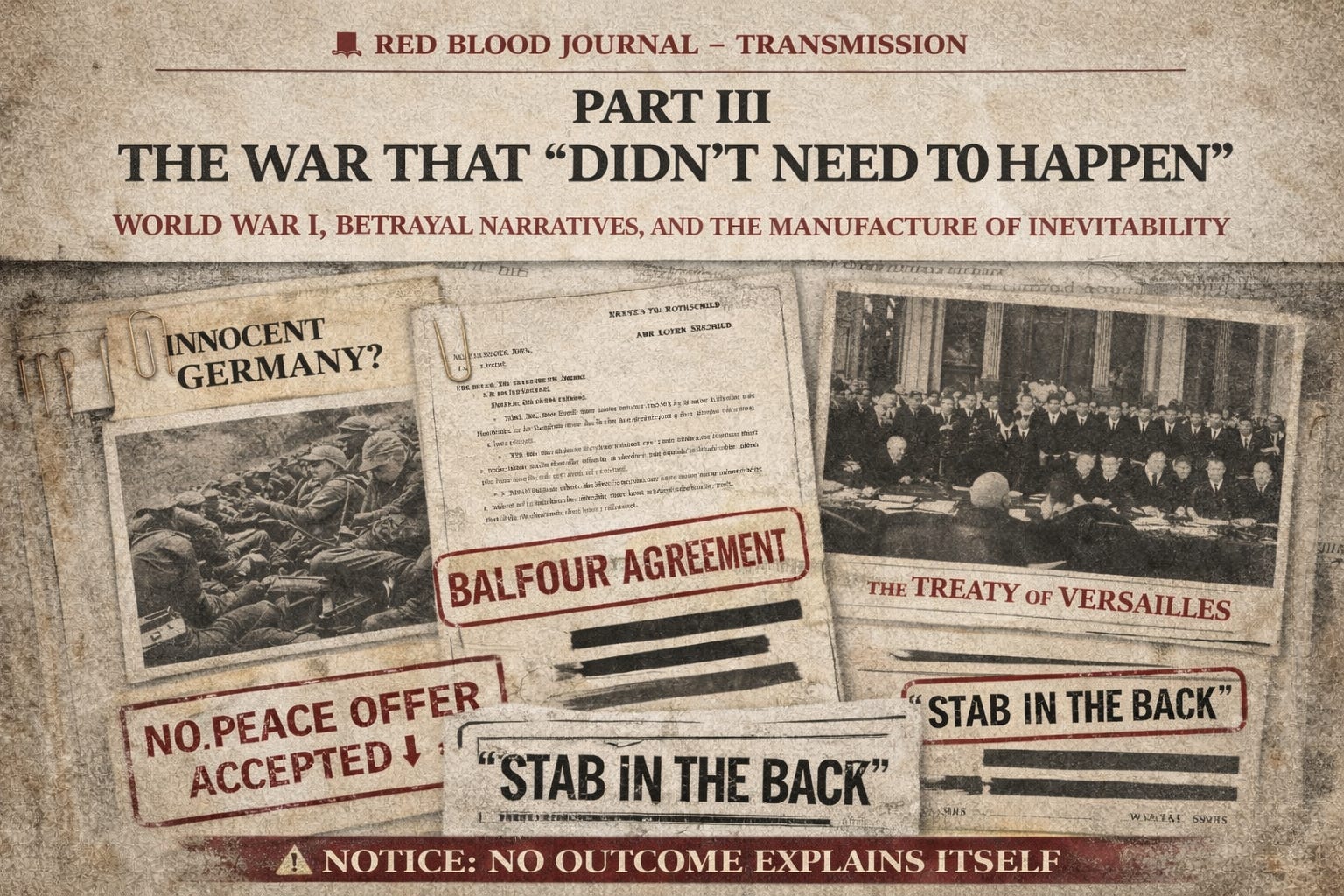
🩸 RED BLOOD JOURNAL — TRANSMISSION
PART III EUROPA — THE WAR THAT “DIDN’T NEED TO HAPPEN”
Subject: World War I, betrayal narratives, and the manufacture of inevitability
Status: Examination in progress
Judgment: Reserved
I. THE PROMISE OF SIMPLICITY
This section opens by offering something deceptively comforting:
a clean explanation for a war that killed millions.
We are told there were many motives for the First World War — but only one mattered.
Germany, newly unified and economically ascendant since 1871, had upset the old balance of power. Britain, France, and Russia, threatened by this rise, allegedly joined forces to destroy her.
From the beginning, the framing is clear:
Germany did not want war.
Germany had nothing to gain.
Germany sought peace repeatedly.
And if that is true, then the next question becomes unavoidable:
Who stopped the peace?
II. FROM SARAJEVO TO CERTAINTY
The assassination of Archduke Franz Ferdinand is presented not as a spark, but as a pretext.
Austria-Hungary declares war on Serbia.
Germany honors its alliance.
And suddenly, Europe is on fire.
Up to this point, the narrative still resembles conventional history — with emphasis, but not rupture.
The rupture comes later.
We are told that by late 1916 Germany was winning.
France was bleeding.
Russia was collapsing internally.
Britain was strained by blockade.
German territory remained unoccupied.
Peace offers were made.
They were generous.
They were sincere.
And yet — the war did not end.
So again, the story sharpens:
Someone needed the war to continue.
III. THE DEAL THAT CHANGED EVERYTHING
Here the documentary introduces its pivot point.
A secret bargain.
Zionist leaders allegedly approached the British government with an offer:
use global influence to bring the United States into the war, undermine Germany from within — in exchange for British support for a Jewish homeland in Palestine.
This bargain is said to have materialized as the Balfour Declaration.
From this moment on, World War I is no longer presented as a tragic collision of empires — but as a manipulated event, prolonged deliberately for geopolitical gain.
The implication is heavy:
Without this deal, the war would have ended.
Without American entry, millions would have lived.
The reader should pause here — not to accept or reject, but to mark the pivot.
Because from this point forward, every subsequent event is filtered through betrayal.
IV. BETRAYAL AS EXPLANATION
Once the deal is assumed, everything else falls neatly into place.
Anti-German propaganda in Allied media is no longer persuasion — it is orchestration.
Labor strikes in Germany are no longer economic unrest — they are sabotage.
Peace overtures are no longer ignored by accident — they are deliberately dismissed.
The American entry into the war becomes not a political decision, but a fulfillment of a promise.
Germany’s eventual collapse is reframed as internal treason rather than exhaustion.
This is where the phrase reappears — loaded, familiar, dangerous:
“Stabbed in the back.”
Not defeated on the battlefield.
Not outlasted economically.
But betrayed from within.
Once this lens is applied, it becomes permanent.
V. THE PEACE THAT WAS MEANT TO BREAK
The war ends.
And now, the punishment begins.
Germany is excluded from negotiations.
Borders are redrawn without her voice.
Colonies are stripped.
Industry is dismantled.
The Rhineland is occupied.
Reparations are imposed — vast, crushing, abstract numbers that translate into daily misery.
The Treaty of Versailles is presented not as misguided or excessive, but as deliberately sadistic.
The goal, we are told, was not peace — but paralysis.
Debt becomes a weapon.
Gold drains away.
Currency collapses.
And the German people pay.
VI. COLLAPSE AS A BREEDING GROUND
Hyperinflation follows.
Savings evaporate.
Wages become meaningless.
Bread costs billions.
Families starve while speculators thrive.
The middle class disintegrates.
And in this chaos, resentment searches for a shape.
The documentary supplies one.
Financial collapse is no longer systemic — it is personalized.
Media influence is no longer plural — it is concentrated.
Economic pain is no longer abstract — it has a face.
Words like Judefetzen appear — not as historical artifacts to be examined, but as emotional signals.
This is a critical moment.
Because once suffering is given an identity, the story no longer needs evidence — it has a target.
VII. THE PATTERN REPEATS
From here, the narrative accelerates across countries.
Communist revolutions.
Labor unrest.
Cultural upheaval.
Germany.
Hungary.
Italy.
Spain.
Each crisis is framed as another iteration of the same underlying force.
Each counter-movement — including fascism — is reframed not as oppression, but as defense.
Fascism is presented as medicine.
Communism as poison.
And history, once again, becomes binary.
VIII. THE SUBVERSION MODEL
At this point, the documentary shifts tone.
No longer history — now warning.
Ideological subversion.
Demoralization.
Destabilization.
Crisis.
Normalization.
The claim is simple and powerful:
You will not notice the takeover while it happens.
By the time you argue facts, it is already too late.
Exposure to truth no longer matters.
Information stops working.
Belief hardens.
This framing does something subtle:
It explains why disagreement exists — and disqualifies it at the same time.
If you don’t see it, you are already demoralized.
IX. WHERE THE STORY CLOSES — AND WHY THAT MATTERS
By the end of Part III, history has been reorganized into a single arc:
Germany was innocent
War was avoidable
Peace was blocked
Collapse was engineered
Resistance was justified
Opposition was betrayal
Everything fits.
Too well.
And that is precisely where the reader must stop.
Not to dismiss the suffering.
Not to excuse injustice.
But to ask the one question that never appears on screen:
Does this explanation still work if betrayal is removed from the center?
If the answer is no, then the story is not an investigation.
It is a lens.
X. RETURNING THE JUDGMENT
This transmission does not ask you to defend treaties.
It does not ask you to defend empires.
It does not ask you to defend modern narratives.
It asks you to defend causality.
Ask yourself:
Are complex events reduced to single motives?
Are political decisions reframed as secret deals without primary proof?
Does every outcome point to the same enemy?
Does disagreement automatically become evidence of manipulation?
If so, then the danger is not only historical.
It is cognitive.
👁️Dissecting the World War I Betrayal Narrative.
This text analyzes a historical documentary that reinterprets World War I as an avoidable tragedy driven by clandestine manipulation rather than inevitable geopolitical friction.
The narrative centers on a betrayal theory, suggesting that Germany was on the verge of victory until a secret bargain involving the Balfour Declaration brought the United States into the conflict.
According to this perspective, the subsequent economic collapse and harsh conditions of the Treaty of Versailles were deliberate tools used to paralyze the nation.
By framing German defeat as a "stab in the back" from internal and external enemies, the source illustrates how complex history can be reduced into a binary struggle between victims and conspirators.
Ultimately, the commentary warns that such monocausal explanations function more as a psychological lens than an objective investigation, encouraging readers to question any story where victimhood and betrayal replace nuanced causality.


