


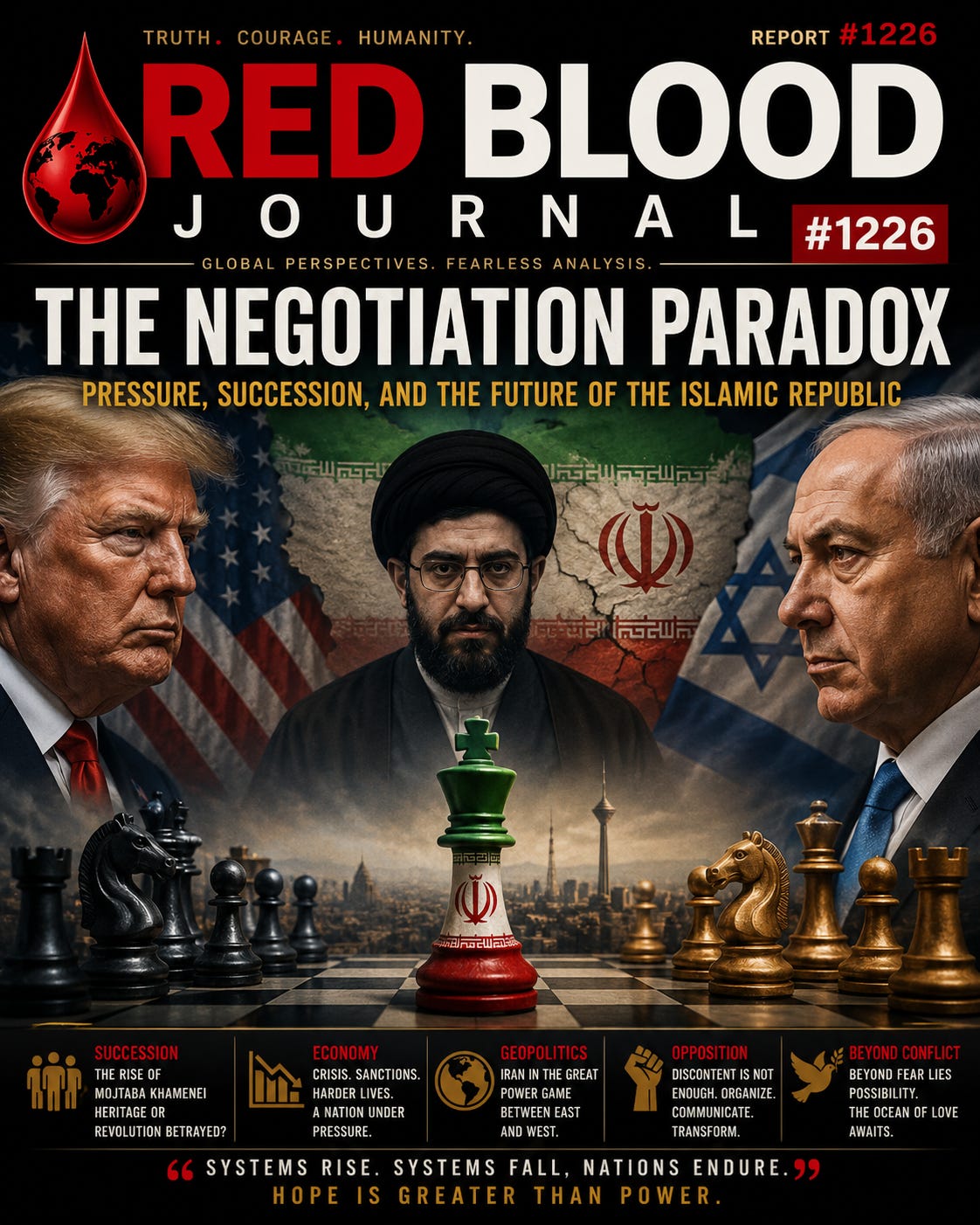
🩸 #1226 — THE NEGOTIATION PARADOX
Pressure, Succession, and the Politics of Perception
Red Blood Journal Transmission
Executive Summary
In the aftermath of recent statements by Donald Trump and Benjamin Netanyahu, a growing debate has emerged regarding the future direction of the Islamic Republic, the role of Mojtaba Khamenei, and the possibility of a future agreement between Tehran and Washington.
What makes the current moment unusual is not simply the military, political, or economic pressure. Rather, it is the simultaneous existence of seemingly contradictory messages.
On one hand, public rhetoric remains hostile.
On the other hand, discussions of negotiation, compromise, and future agreements continue to surface.
This contradiction has produced confusion among supporters and opponents of the Islamic Republic alike.
The result is a political landscape where nobody appears fully satisfied, yet all sides continue moving toward an uncertain destination.
The Successor Question
For decades, the Islamic Republic presented itself as fundamentally different from hereditary systems.
Leadership, according to official doctrine, was supposed to emerge through religious qualification, political legitimacy, and institutional selection.
Yet discussions surrounding Mojtaba Khamenei have revived a question that many believed impossible:
Can a revolutionary system evolve into a hereditary one?
The debate is no longer limited to opposition circles.
Even supporters of the system increasingly find themselves discussing succession in ways previously considered unacceptable.
The very existence of the debate has become as important as the answer itself.
Power Beyond the Battlefield
Modern conflicts rarely end with tanks crossing borders.
The battlefield increasingly exists within perception.
Economic pressure.
Psychological pressure.
Diplomatic pressure.
Information pressure.
The objective is often not immediate victory but the gradual narrowing of available options.
A government under pressure may continue functioning, yet find that each available path leads toward outcomes it previously rejected.
This is where many observers believe Iran finds itself today.
Not defeated.
Not victorious.
But increasingly constrained.
The Economic Dimension
For ordinary citizens, geopolitical arguments matter far less than daily reality.
Prices.
Employment.
Housing.
Food.
Healthcare.
Energy.
These are the indicators that determine whether political strategies are viewed as successful or disastrous.
Years of sanctions, isolation, mismanagement, corruption allegations, and regional conflict have produced growing economic strain.
Many citizens care less about ideological victories and more about whether tomorrow will be easier than yesterday.
When economic pressure continues without visible political change, frustration naturally increases.
The Geopolitical Chessboard
Iran occupies one of the most strategically important locations on Earth.
Its geography connects regions, trade routes, energy corridors, and competing spheres of influence.
Because of this position, Iran is rarely viewed by major powers as merely another country.
Instead, it becomes a piece in a larger geopolitical contest involving Washington, Moscow, Beijing, Brussels, and regional actors.
This reality creates a paradox.
Iran’s strategic importance gives it leverage.
Yet that same importance also attracts constant pressure.
The geography that creates opportunity also creates vulnerability.
The Netanyahu Factor
While discussions often focus on Washington and Tehran, another variable remains present.
Benjamin Netanyahu continues to frame the issue differently.
His public statements have repeatedly emphasized long-term pressure on the Islamic Republic while distinguishing between the government and the Iranian people.
Whether one agrees with this approach or not, the message has remained relatively consistent.
This has led some opposition groups to view Israel’s position as more predictable than Washington’s, where policies can shift depending on negotiations, elections, and changing strategic priorities.
The Opposition Dilemma
Political change requires more than dissatisfaction.
History repeatedly demonstrates that successful movements require organization, communication, leadership, and resources.
Without these components, public frustration often dissipates without producing structural change.
The debate among opposition figures increasingly centers on practical questions:
How is communication maintained?
How is coordination achieved?
How are resources distributed?
How are participants protected?
These questions may ultimately matter more than speeches, interviews, or headlines.
The Negotiation Paradox
Perhaps the most fascinating aspect of the current moment is the apparent contradiction between confrontation and negotiation.
Public hostility continues.
Accusations continue.
Pressure continues.
Yet discussions continue as well.
History shows that some of the most bitter adversaries eventually negotiate.
The existence of negotiations does not necessarily imply friendship.
Nor does hostility guarantee permanent conflict.
States often pursue multiple strategies simultaneously.
What appears contradictory from the outside may be viewed by decision-makers as entirely logical.
Conclusion
The central question is no longer whether pressure exists.
The pressure is visible.
The real question is where that pressure leads.
Toward compromise?
Toward transformation?
Toward confrontation?
Or toward an outcome nobody currently expects?
The future remains uncertain.
Yet one lesson appears constant throughout history:
Systems rise.
Systems fall.
Leaders come and go.
Movements emerge and disappear.
But nations endure beyond all of them.
And beyond the noise of politics, beyond the calculations of governments and the ambitions of powerful men, there remains something greater—the enduring hope of ordinary people seeking dignity, stability, opportunity, and peace.
Like rivers flowing toward the sea, every struggle eventually meets a larger horizon.
Beyond conflict lies understanding.
Beyond division lies unity.
Beyond fear lies possibility.
And beyond every storm waits the infinite Ocean of Positivity, Love, and Human Potential. 🌊❤️
— Red Blood Journal | Report #1226
⚖️ The Negotiation Paradox:
Succession and the Iranian Horizon
Jun 4, 2026
The provided text explores the complex political paradox currently facing the Iranian government as it navigates intense international pressure and internal uncertainty.
A central theme is the potential shift toward hereditary succession involving Mojtaba Khamenei, which challenges the revolutionary ideological foundations of the state.
While public rhetoric remains hostile between Tehran and Washington, the source suggests that clandestine negotiations and narrowing strategic options may lead to unexpected compromises.
Furthermore, the report emphasizes that severe economic hardship and geopolitical isolation are fueling domestic frustration, shifting the focus of ordinary citizens from ideology to survival.
Ultimately, the analysis posits that while systems and leaders are transient, the enduring aspirations of the Iranian people for stability and dignity will outlast current political conflicts.


