


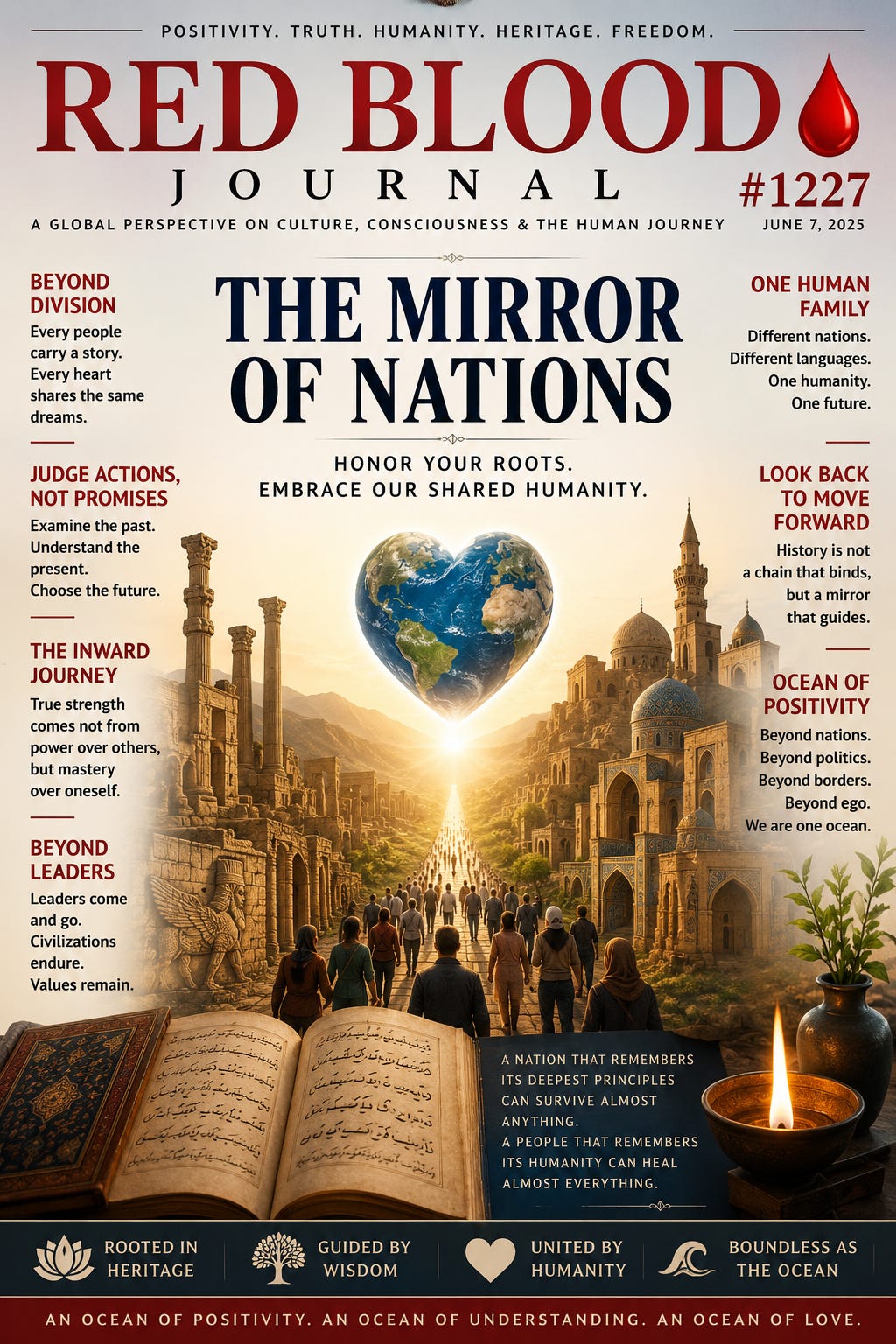
🩸 #1227 — THE MIRROR OF NATIONS
Introduction
Throughout history, nations have been taught to see themselves as unique. Some are told they are chosen. Others are told they are exceptional. Still others are taught that their civilization possesses a special destiny unlike any other on Earth.
Iran is no exception.
For thousands of years, Persians have preserved a rich heritage of poetry, philosophy, spirituality, art, and cultural continuity. This heritage has survived invasions, dynasties, revolutions, and political transformations. It is a source of pride for many and a reminder that civilizations can endure even when governments change.
Yet an important question remains:
Are Iranians the only people whose suffering matters?
Are the people of Iraq not people?
Are the people of Libya not people?
Are the people of Syria, Serbia, Ukraine, Afghanistan, Yemen, and countless other nations not people?
Every mother grieves in the same language of tears.
Every father worries about the future of his children.
Every family desires dignity, security, opportunity, and peace.
The borders may be different, but the human experience remains remarkably similar.
The Story Nations Tell Themselves
Every nation develops a narrative about itself.
Some point to ancient empires.
Some point to religious traditions.
Some point to military victories.
Others point to constitutional ideals.
These stories help answer a fundamental question:
Who are we?
The danger arises when identity becomes separation.
A people may honor their ancestors without believing they are superior to others.
A civilization may celebrate its achievements without forgetting the humanity of those beyond its borders.
History becomes most valuable when it serves as a mirror rather than a weapon.
Judging Actions Rather Than Promises
Political leaders come and go.
Governments rise and fall.
Parties change names.
Flags change colors.
Yet ordinary people remain.
Citizens everywhere can examine the historical record and ask a simple question:
Did the promised improvements actually improve the lives of ordinary people?
The answer is rarely simple.
Some view foreign intervention as beneficial.
Others view it as destructive.
Some see liberation.
Others see instability.
Some see opportunity.
Others see higher costs, greater uncertainty, and social fragmentation.
The responsibility of a free mind is not to accept slogans from any side but to examine outcomes and reach independent conclusions.
The Inward Tradition
One of the most enduring aspects of Persian civilization has not been military power or political authority.
It has been the inward journey.
For centuries, poets, philosophers, and mystics explored questions of self-knowledge, wisdom, and inner transformation.
Empires came and went.
Governments changed.
Borders shifted.
Yet the search for understanding continued.
Perhaps this is the deeper inheritance of ancient civilizations—not domination over others, but mastery over oneself.
The inward path does not belong exclusively to Iran.
It belongs to humanity.
Every civilization has produced voices encouraging reflection, self-examination, compassion, and wisdom.
The challenge is remembering those lessons during times of political division and emotional conflict.
Beyond Leaders
Political figures attract attention because they represent immediate events.
Their words dominate headlines.
Their actions influence markets.
Their decisions affect nations.
Yet history repeatedly demonstrates that leaders are temporary.
Civilizations are measured not by the lifespan of a politician but by the values they preserve through generations.
The preservation of culture, language, philosophy, family, and wisdom often outlasts every government that claims authority over them.
A nation that remembers its deepest principles can survive almost anything.
The Mirror
The lesson may be simple.
Every nation sees itself in a mirror.
The question is whether that mirror reflects superiority or understanding.
A people may honor their heritage while recognizing the humanity of all others.
A civilization may preserve its roots without becoming trapped by them.
The greatest strength may not be found in proving one nation is special.
It may be found in recognizing that all people share the same search for meaning, dignity, and truth.
When that realization emerges, the divisions that appear so permanent begin to look temporary.
And beyond those divisions waits a larger perspective—an ocean beyond nations, beyond governments, beyond ideologies.
An Ocean of Positivity.
An Ocean of Understanding.
An Ocean of Love.
🌏 The Mirror of Nations:
The Universal Human Reflection
Jun 4, 2026
This text explores the common human experience that exists beneath the surface-level narratives of national identity and exceptionalism.
While acknowledging the enduring cultural and spiritual heritage of Iran, the author argues that true wisdom lies in recognizing that suffering and aspirations are universal across all borders.
By shifting focus from temporary political leaders to permanent human values, the source encourages individuals to think independently and judge societies by their actual outcomes rather than empty slogans.
The core message emphasizes an inward journey toward self-mastery and compassion, suggesting that historical legacy should be used to foster global empathy rather than division.
Ultimately, the writing calls for a transition from national pride toward a unified perspective of shared humanity and mutual understanding.


