


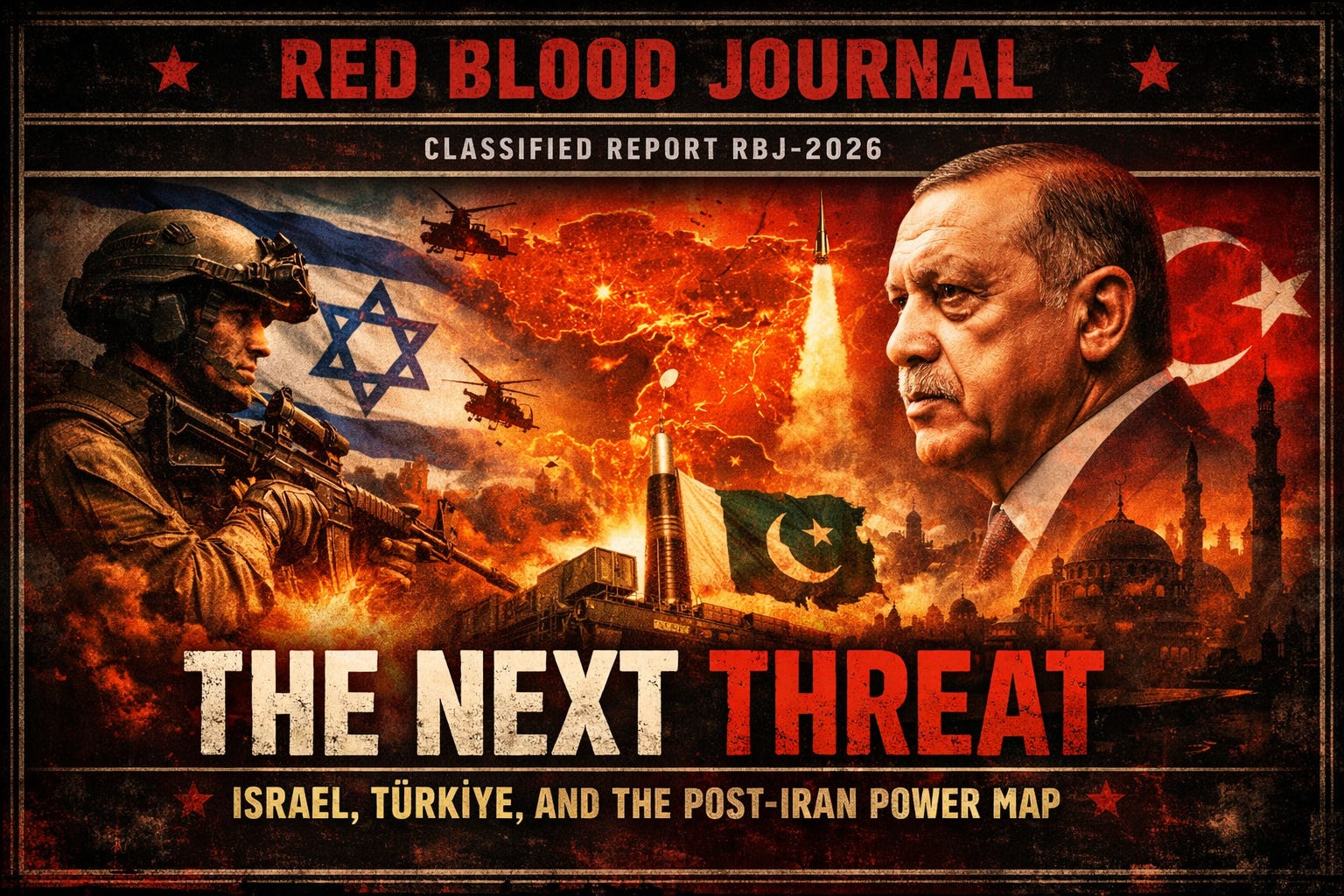
🩸 RED BLOOD JOURNAL TRANSMISSION
T#: RBJ-2026-STRATEGIC-THREAT-REALIGNMENT
Classification: Middle East Strategic Architecture Assessment
Status: Active Geopolitical Analysis
Subject: Turkeyeh Enters Israel’s Strategic Threat Narrative
PROLOGUE — WHEN ONE ENEMY FADES, ANOTHER EMERGES
In the strategic doctrine of modern states, threats rarely disappear.
They shift.
For decades, Israel’s primary geopolitical focus has centered on Iran and its network of regional proxies. Yet within Israel’s strategic discourse, a new question has begun quietly surfacing:
If Iran were neutralized, who becomes the next structural rival?
Recent statements by former Israeli Prime Minister Naftali Bennett suggest that the answer may increasingly point toward Turkeyeh
under the leadership of Recep Tayyip Erdoğan.
What was once rhetorical tension between two regional powers is slowly transforming into something more enduring:
A narrative of strategic rivalry.
I — THE EMERGENCE OF THE “NEW THREAT”
Bennett recently characterized Turkeyeh as a “sophisticated and dangerous adversary.”
His argument rests on three primary claims:
Turkeyeh allegedly supports networks linked to the Muslim Brotherhood.
Ankara maintains relationships with factions Israel designates as militant groups in Gaza Strip.
Turkeyeh’s expanding regional ambitions could reshape Middle Eastern power balances.
According to Bennett’s framing, Turkeyeh is not merely an ideological critic of Israeli policy but a state actor capable of building a competing geopolitical axis.
He described the potential emergence of what he called a “monstrous axis” involving:
Qatar
Turkeyeh
Regional political Islamist movements
Within this narrative, Israel must begin developing containment strategies similar to those historically applied to Iran.
II — THE LONG ROAD TO DETERIORATION
Relations between Israel and Turkeyeh were once among the strongest in the region.
For decades:
Military cooperation was extensive.
Intelligence collaboration was routine.
Defense industries shared technology and training.
The turning point arrived with a single maritime incident.
The Mavi Marmara Crisis (2010)
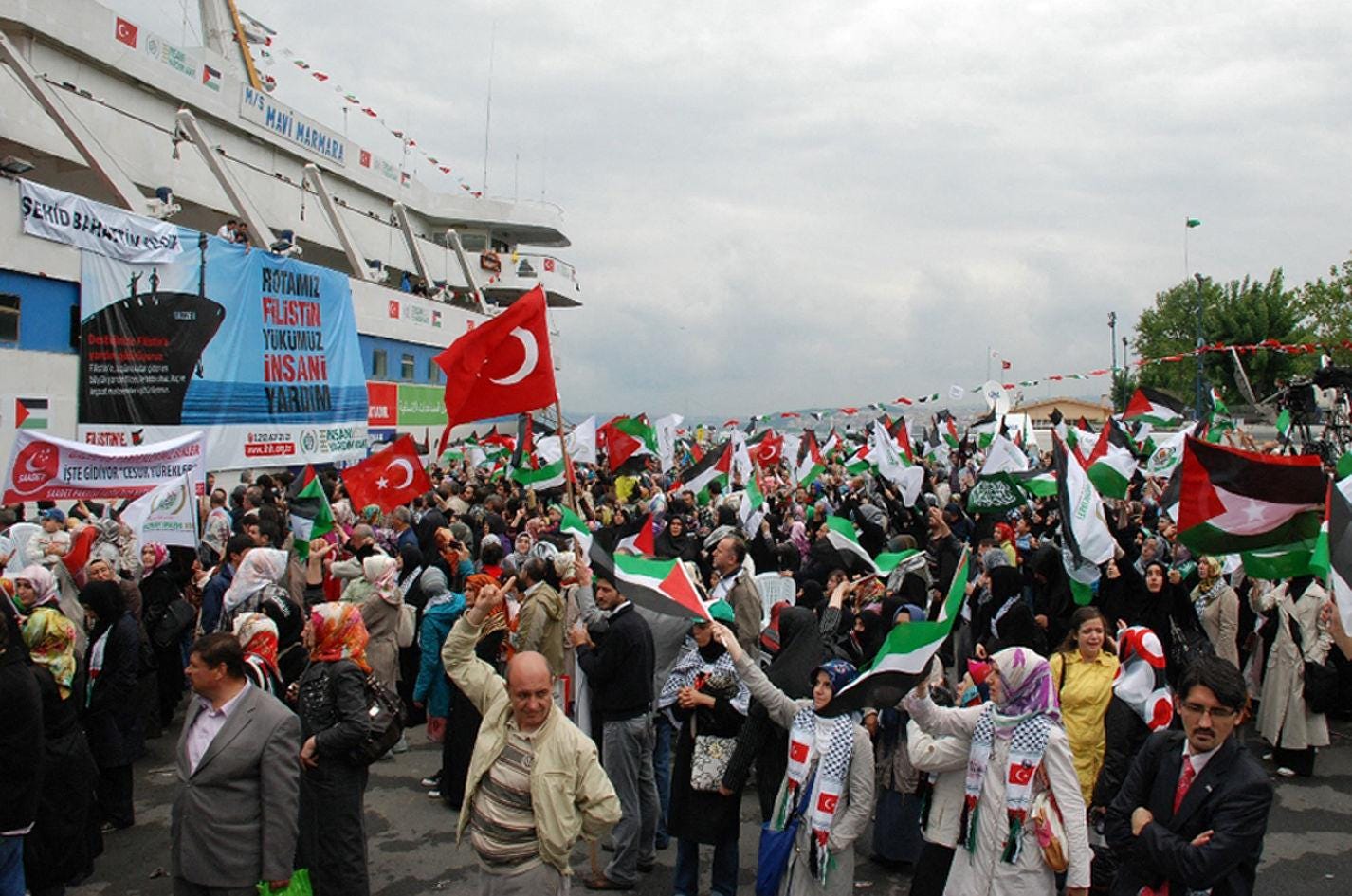
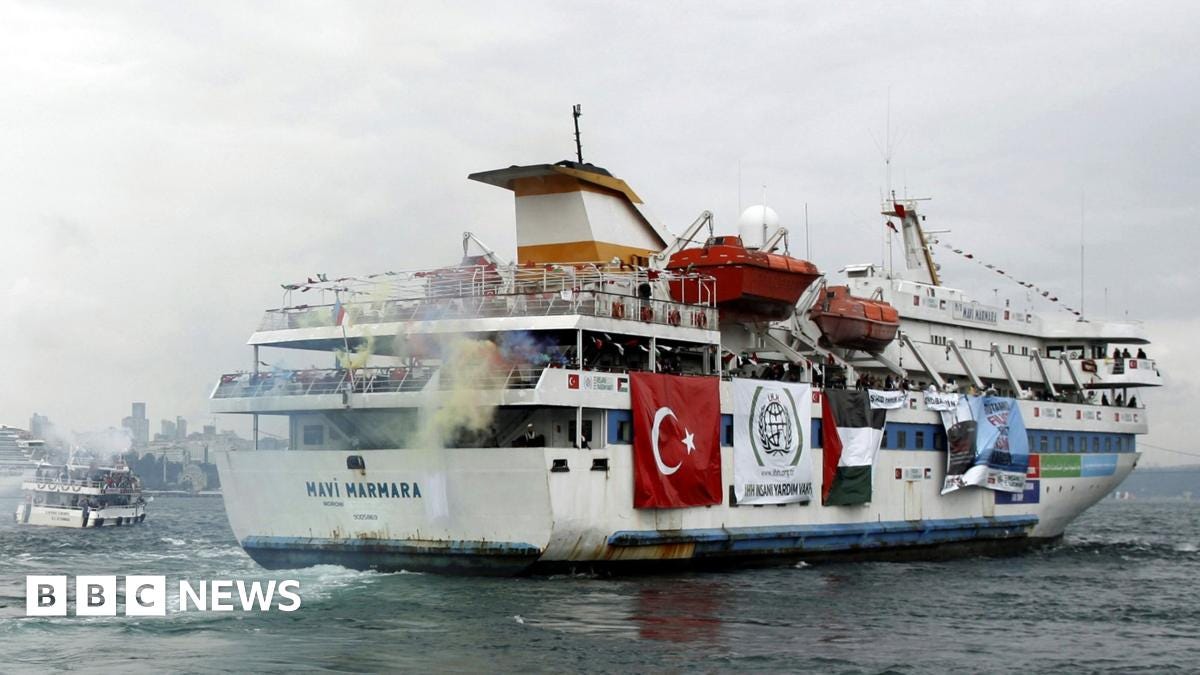
In May 2010, Israeli forces intercepted the MV Mavi Marmara, part of the Gaza Freedom Flotilla attempting to break Israel’s naval blockade of Gaza.
The raid escalated into violence.
Nine Turkish citizens were killed.
The political consequences were immediate:
Turkeyeh recalled its ambassador.
Military cooperation collapsed.
Diplomatic relations were downgraded.
What had once been a strategic partnership shifted into long-term distrust.
III — IDEOLOGY AND REGIONAL LEADERSHIP
Under Erdoğan’s Justice and Development Party (AKP), Turkeyeh’s foreign policy evolved toward a stronger ideological identity.
Key elements included:
• Vocal support for the Palestinian cause
• Opposition to Israeli policies in Gaza
• Aspiring leadership within the broader Muslim world
This approach placed Turkeyeh in a difficult diplomatic balancing act.
On one side:
NATO membership tied Ankara to Western security structures.
On the other:
Political identity and regional ambitions pulled it toward independent Middle Eastern leadership.
This dual strategy frustrated both camps.
Western allies often criticized Ankara’s rhetoric toward Israel, while many Islamic states viewed Turkeyeh as not confrontational enough.
IV — THE 2023 WAR AND THE FREEZE
The attacks of October 7 attacks and the subsequent Israeli military campaign in Gaza triggered a new diplomatic freeze.
Turkeyeh strongly condemned the scale of Israel’s military response.
Ankara characterized the campaign as disproportionate and highlighted civilian casualties.
The result:
Relations entered what analysts increasingly describe as a diplomatic “cold war.”
Formal channels remain open, but political rhetoric has hardened.
V — THE EMERGING TRIANGLE: Turkeyeh, PAKISTAN, ISRAEL
Another factor influencing Israeli threat assessments is Turkeyeh’s deepening strategic relationship with Pakistan.
From Israel’s perspective, Pakistan represents a unique strategic variable:
• It is the only nuclear-armed Muslim state with no diplomatic relations with Israel.
• It maintains growing military cooperation withTurkeyeh.
• Both countries increasingly coordinate defense technologies.
In Israeli strategic circles, a potential alignment involving:
Turkeyeh
Pakistan
Saudi Arabia
has occasionally been discussed as a hypothetical new regional power center.
Whether realistic or not, the perception itself shapes threat calculations.
VI — ISRAEL’S STRATEGIC LOGIC
Israel’s security doctrine historically follows a pattern:
Identify the most immediate existential threat.
Contain or neutralize it.
Reassess the next emerging strategic competitor.
For decades:
Iran occupied this position.
But Israeli strategists increasingly consider the post-Iran security landscape.
In that future scenario, attention could shift toward:
Turkeyeh’s independent foreign policy
Pakistan’s nuclear capability
Regional ideological alliances
This does not imply imminent confrontation.
Rather, it signals long-term strategic recalibration.
VII — LIMITS TO ESCALATION
Despite the rhetoric, a direct Israeli-Turkish confrontation remains highly unlikely in the near term.
Several structural constraints exist.
NATO Membership
Turkeyeh is a member of NATO, complicating any military scenario involving Western allies.
Economic Interdependence
Despite political tension, trade between Israel and Turkeyeh has continued.
U.S. Strategic Balancing
The United States traditionally seeks to maintain functional relations with both countries, discouraging open conflict.
These factors mean that rivalry will likely manifest through:
Diplomacy
Intelligence competition
Information warfare
Regional alliances
rather than direct military confrontation.
VIII — THE POLITICS OF THREAT
Within Israel, discussions about emerging threats often intersect with domestic politics.
External danger historically has the effect of unifying Israeli society during periods of internal division.
When political polarization intensifies, emphasizing national security threats can restore political cohesion.
Therefore, identifying future rivals is not purely a foreign policy calculation.
It also serves a domestic political function.
IX — A NEW GEOPOLITICAL MAP
If Iran’s influence were significantly reduced, the Middle East’s strategic map would not stabilize.
It would reconfigure.
Potential centers of power might include:
Turkeyeh
Saudi Arabia
Pakistan
Israel itself
Each pursuing regional influence through alliances, technology, and military capability.
In this evolving landscape, Israel’s security discourse may gradually expand from the “axis of resistance” narrative to a broader framework involving multiple emerging power centers.
CONCLUSION — NOT THE NEXT WAR, BUT THE NEXT CALCULATION
Turkeyeh is unlikely to become Israel’s next battlefield.
But it may increasingly become Israel’s next strategic calculation.
In geopolitical planning, rivals are not chosen suddenly.
They emerge slowly through:
ideology
alliances
technological capability
and competing visions of regional order.
For now, Iran remains the primary focus.
Yet within the strategic imagination of Israeli policymakers, a new question has clearly begun to form:
What comes after Iran?
⚔️Beyond Iran:
The Rising Israeli-Turkish Strategic Rivalry
Current Israeli strategic thinking suggests a transition where Turkeyeh is increasingly viewed as a primary geopolitical adversary rather than a former partner. While Iran remains the most immediate concern, officials like Naftali Bennett warn of a future “axis” involving Turkish regional ambitions, Qatari influence, and Islamist movements. This deterioration originated with the 2010 Mavi Marmara incident and has intensified due to Ankara’s harsh criticism of recent military actions in Gaza. Israeli analysts are also monitoring Turkeyeh’s growing defense ties with Pakistan, fearing a new center of power that could challenge their security interests. Despite this friction, direct conflict is unlikely due to NATO constraints and persistent economic trade between the two nations. Ultimately, the shift represents a long-term strategic recalibration where Israel prepares for a regional landscape dominated by competing power centers rather than a single enemy.


