


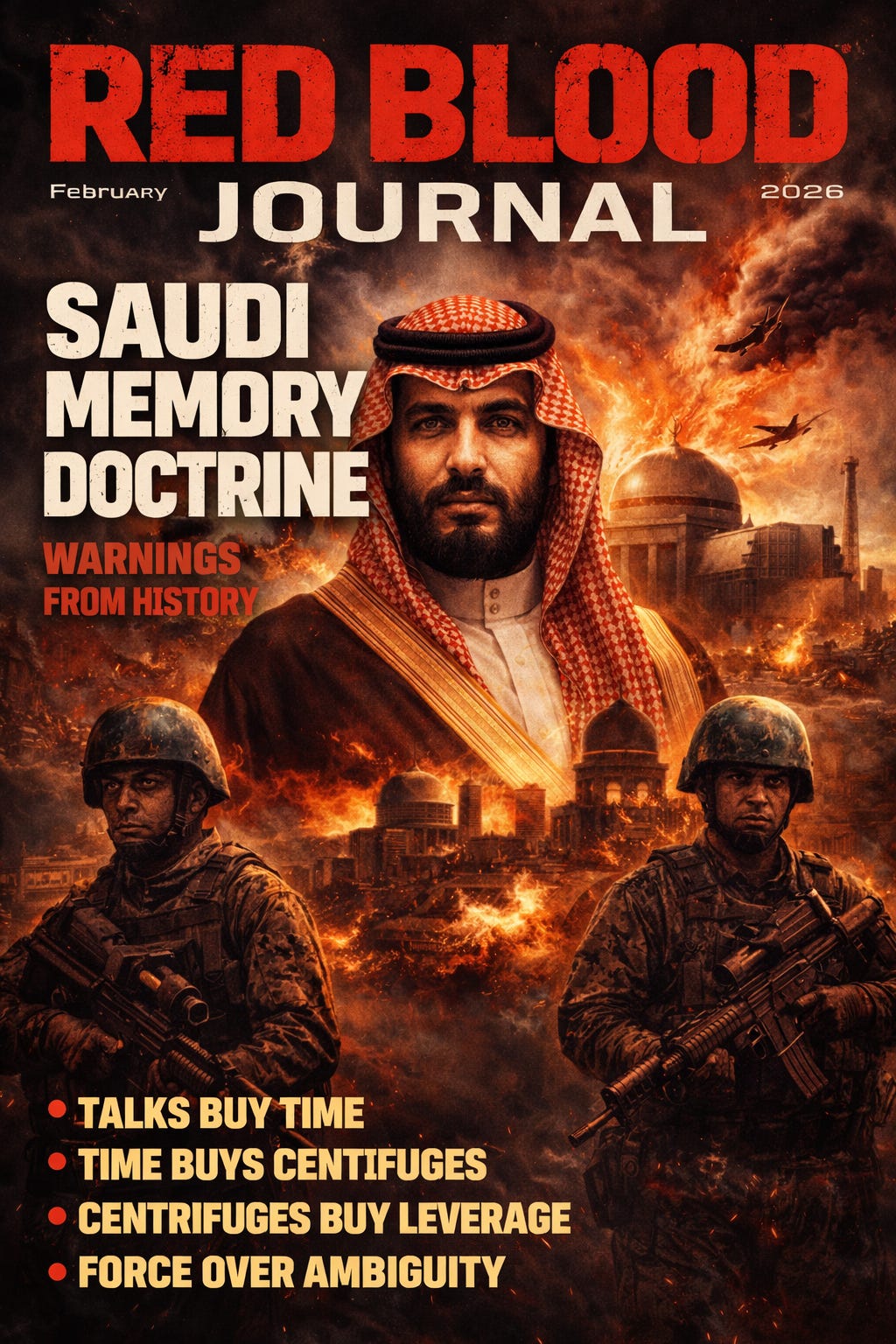
🩸 RED BLOOD JOURNAL TRANSMISSION
T# RBJ-2026-02-01 — THE DESERT MEMORY DOCTRINE
Classification: Regional Deterrence Logic | Historical Pattern Retention
Clearance: For Those Who Remember the Last Cycle Didn’t End in Words
Why Saudi Arabia Fears Delayed Force
SECTION IV — SAUDI ARABIA: THE VOICE OF REGIONAL MEMORY
Saudi Arabia’s position is often mischaracterized as aggression.
It is not.
It is memory.
Not emotional memory.
Not ideological memory.
But institutional memory—the kind forged through decades of repetition, betrayal, and delayed consequences.
Riyadh has watched this loop unfold too many times to confuse tone for outcome.
THE CYCLE THEY REMEMBER
From their vantage point, the pattern is mechanical:
Talks buy time.
Time is never neutral. It accumulates.
Time buys centrifuges.
Progress hides behind process.
Centrifuges buy leverage.
Leverage redefines the table.
And once leverage is achieved, diplomacy stops being negotiation and becomes enforcement.
This is not theory.
This is recorded experience.
WHY RIYADH DISTRUSTS AMBIGUITY
Ambiguity is praised in Western diplomacy as sophistication.
In the region, ambiguity is read as hesitation.
From Saudi Arabia’s perspective:
Weak signals invite escalation
Mixed messages invite miscalculation
Delayed responses invite brinkmanship
Clarity, even when uncomfortable, prevents misreading.
Force—clearly communicated, visibly positioned, undeniably real—reduces the chance of catastrophic misunderstanding.
THE MISLABELED INSTINCT
This stance is often described as “hawkish.”
That label is lazy.
Saudi Arabia is not advocating chaos.
It is attempting to close the window before it becomes a doorway.
Their logic is simple:
If the rules are clear early,
fewer actors gamble late.
Deterrence is not about violence.
It is about removing temptation.
COUNTERINTELLIGENCE NOTE — WHY THIS MATTERS NOW
When Saudi Arabia speaks bluntly while others speak diplomatically, it is not dissent.
It is a warning.
They are not arguing for war.
They are signaling that the cost of misreading time is higher than the cost of firmness.
The region does not fear force.
It fears delayed force.
FINAL LINE — MEMORY IS A WEAPON
In geopolitics, those who forget cycles repeat them.
Those who remember them try to interrupt them early.
Saudi Arabia’s posture is not bloodthirsty.
It is pre-emptively stabilizing—from the only perspective that has lived through the aftermath often enough to recognize the warning signs.
🩸 END TRANSMISSION
⏳The Desert Memory Doctrine:
Saudi Geopolitical Realism
Saudi Arabia’s foreign policy is driven by institutional memory, viewing diplomacy as a cycle where delays allow adversaries to gain leverage.
Riyadh favors clear deterrence over ambiguity to prevent miscalculation, arguing that firmness early stops catastrophic conflict later.


