


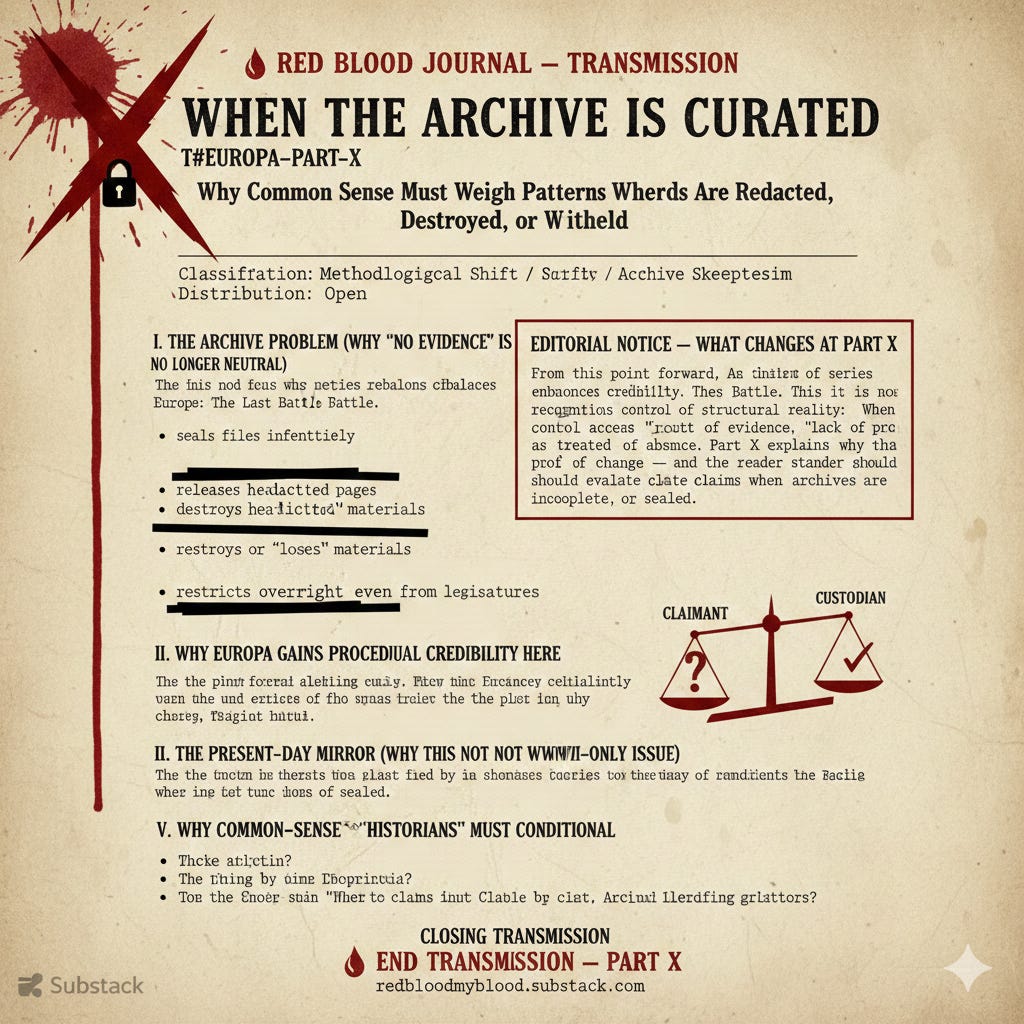
🩸 RED BLOOD JOURNAL — TRANSMISSION
T#EUROPA–PART–X
Title: WHEN THE ARCHIVE IS CURATED
Subhead: Why Common Sense Must Weigh Patterns When Records Are Redacted, Destroyed, or Withheld
Classification: Methodological Shift / Archive Skepticism
Distribution: Open
EDITORIAL NOTICE — WHAT CHANGES AT PART X
From this point forward, the series rebalances credibility.
This is not an endorsement of Europa: The Last Battle.
It is a recognition of a structural reality:
When governments control access to evidence, “lack of proof” cannot be treated as proof of absence.
Part X explains why this standard must change — and how the reader should evaluate claims when archives are incomplete, curated, or sealed.
I. THE ARCHIVE PROBLEM (WHY “NO EVIDENCE” IS NO LONGER NEUTRAL)
Historical arbitration depends on records.
But records depend on custodians.
When a state:
seals files indefinitely,
releases heavily redacted pages,
destroys or “loses” materials,
restricts oversight even from legislatures,
then the archive itself becomes an instrument of power.
Under these conditions, dismissing claims because they “lack evidence” quietly rewards the custodian who withholds it.
This is not speculative. It is observable governance.
Method rule for Part X onward:
If the archive is demonstrably incomplete or controlled, skepticism must shift away from the claimant and toward the custodian.
II. WHY EUROPA GAINS PROCEDURAL CREDIBILITY HERE
Europa’s central accusation is not merely about events — it is about narrative control.
Specifically, the film argues that:
peace exits existed and were blocked,
decision chains were hidden,
public justification followed power interests,
and post-war history hardened into a moral monoculture protected by access control.
You do not need to accept every claim to recognize the logic of suspicion when:
decisive records remain unavailable,
alternative accounts are excluded by credential-gatekeeping,
and criticism is dismissed on authority rather than exposure.
This does not make Europa “right.”
It makes Europa reasonable to examine without deference to official arbiters.
III. THE PRESENT-DAY MIRROR (WHY THIS IS NOT A WWII-ONLY ISSUE)
Modern conflicts demonstrate the same pattern Europa describes:
negotiations occurring behind closed doors,
third-party interventions shaping outcomes,
public narratives diverging from reported diplomatic realities,
and documentation emerging selectively, if at all.
When contemporary wars show:
blocked settlements,
coordinated messaging,
delayed disclosures,
it becomes intellectually dishonest to claim that such behavior was impossible or unthinkable in the 1930s–40s.
Pattern recognition is not conspiracy.
It is a valid analytic tool when direct evidence is restricted.
IV. WHY DEFERENCE TO “HISTORIANS” MUST BE CONDITIONAL
Historians do not all lie.
But historians work within archive boundaries.
If:
certain files are sealed for decades,
access depends on institutional alignment,
reputational enforcement punishes deviation,
then the profession itself becomes structurally conservative, regardless of individual intent.
Therefore:
Credentialed consensus ≠ complete truth
when the evidence set is curated.
Part X does not discard historians.
It withdraws automatic trust where access is constrained.
V. THE COMMON-SENSE STANDARD (THE READER’S ROLE)
From here forward, the reader is asked to apply a simple test:
Who controls the records?
Who benefits from silence or delay?
Who is punished for asking forbidden questions?
Does the pattern repeat across eras?
If the answers point consistently toward power shielding itself, then skepticism is not radical — it is rational.
VI. BOUNDARIES THAT STILL APPLY (TO KEEP THIS CLEAN)
This series will:
not assign collective guilt to ethnic, racial, or religious groups,
not replace one orthodoxy with another,
not treat suspicion as proof.
But it will:
credit pattern-based reasoning when archives are closed,
allow Europa’s framework to stand as a competing explanatory model,
and refuse to let “no documents” end the inquiry when documents are withheld.
VII. WHAT PART X AUTHORIZES GOING FORWARD
From this point on:
Official narratives lose default priority
Documentary claims are evaluated on pattern coherence, not permission
“No evidence” arguments are weighed against record accessibility
This is not cynicism.
It is methodological realism.
CLOSING TRANSMISSION
History is not written only by victors.
It is preserved — or erased — by custodians.
When custodians redact, destroy, or delay,
common sense becomes an evidentiary tool.
Part X does not tell you what to believe.
It tells you why belief must no longer be outsourced.
🩸 END TRANSMISSION — PART X
👁️The Archive Problem and Controlled History
The provided text outlines a methodological shift toward archive skepticism, arguing that historical truth is often obscured by custodial control over records.
When governments redact, withhold, or destroy evidence, the author asserts that a "lack of proof" should be viewed as a deliberate instrument of power rather than a neutral absence of facts.
This perspective suggests that pattern recognition and common sense are necessary analytical tools when official narratives are protected by restricted access.
The document uses this framework to justify examining alternative historical accounts without granting automatic deference to institutional gatekeepers or credentialed consensus.
Ultimately, the text advocates for intellectual independence, urging readers to question who benefits from sealed archives and controlled information.


