


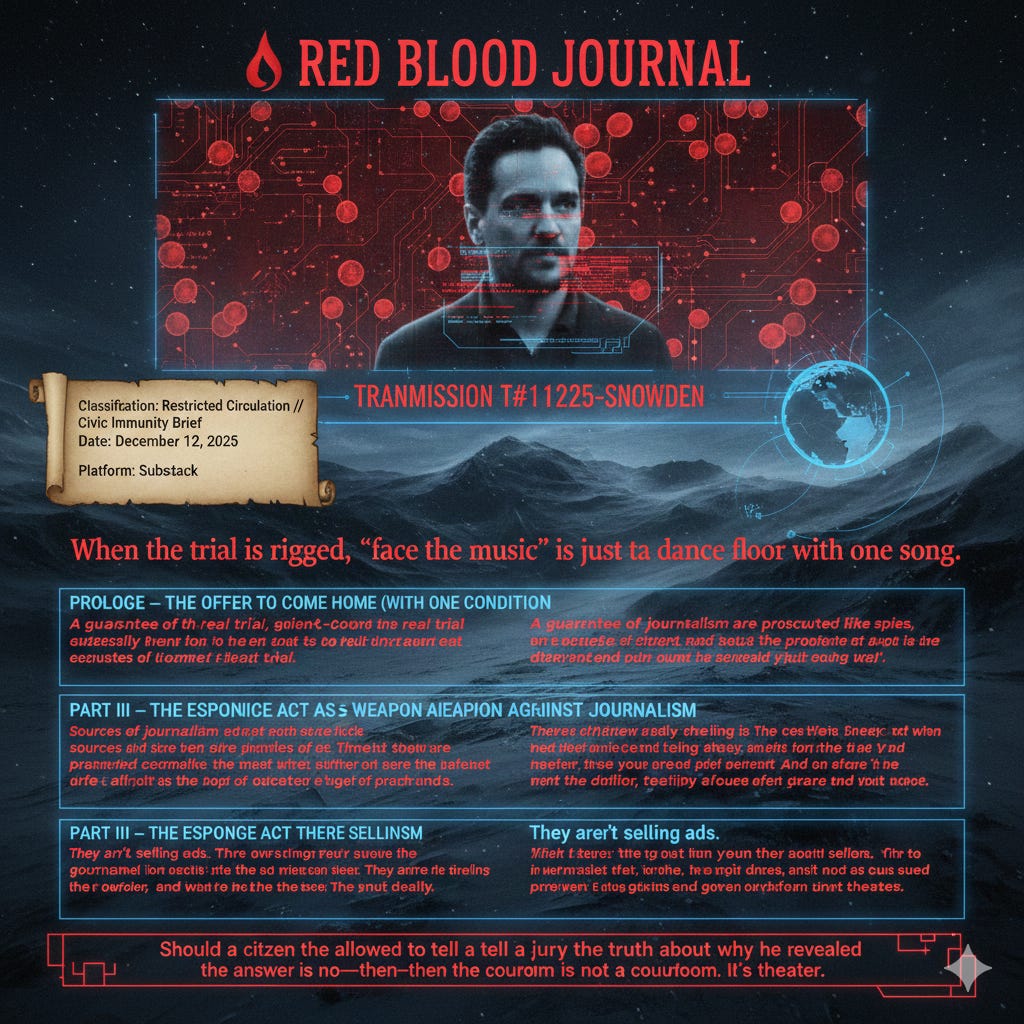
🩸 RED BLOOD JOURNAL — TRANSMISSION T#121225-SNOWDEN
Classification: Restricted Circulation // Civic Immunity Brief
Date: December 12, 2025
Platform: Substack
Tagline: When the trial is rigged, “face the music” is just a dance floor with one song.
PROLOGUE — THE OFFER TO COME HOME (WITH ONE CONDITION)
Ed Snowden says the United States will always be his home—and that he will come back on one condition:
Not mercy. Not a pardon. Not a deal.
A guarantee of a real trial—where a jury is allowed to hear why he did what he did.
Because under the Espionage Act—by design—the motive is silenced. The public interest is ruled “irrelevant.” And the jury is reduced to a checkbox:
Did you tell classified information to a journalist?
If yes, guilty.
If guilty, sentence.
If sentence, the lesson is delivered to the next conscience watching from inside the machine.
This is the core claim of the interview: the U.S. can take him back any time it wants—if it’s willing to let truth speak in court.
And it refuses.
PART I — “FACE THE MUSIC” (BUT WHAT SONG ARE THEY PLAYING?)
When people say: “If you believed you were right, you should’ve stayed.”
Snowden’s reply is surgical:
You can’t “face” anything if the court forbids your defense.
The Espionage Act isn’t just a punishment tool. It’s a truth-exclusion device—a legal mechanism that strips the defendant of meaning:
No public interest defense
No explanation to the jury
No moral argument
No “why”
Only the state’s narrow framing survives.
This is not justice. This is ritual.
A public proceeding where the outcome is predetermined, presented as lawful order.
PART II — THE WHISTLEBLOWER’S PARADOX: “I’LL HELP YOU INSTANTLY.”
Snowden says something that breaks the cartoon narrative of “traitor” vs “hero”:
He would volunteer immediately to help the U.S. harden elections or improve defenses.
He reminds the viewer:
He volunteered to serve.
He didn’t “burn the NSA down.”
He came forward to reform it.
This is the paradox the system can’t tolerate:
A dissident who still claims allegiance to the Constitution—not to a faction, not to a foreign state, not to a cult of personality.
The system prefers enemies who are easy to label.
Snowden is harder: he’s a mirror.
PART III — THE ESPIONAGE ACT AS A WEAPON AGAINST JOURNALISM
Snowden draws a bright line that should terrify anyone who believes in a free press:
Under the Espionage Act, the law makes no distinction between:
telling a secret to a journalist
andtelling a secret to a foreign government
In other words: sources of journalism are prosecuted like spies.
Not because it’s accurate.
Because it’s effective.
It collapses the moral universe into one category: enemy.
That is the legal architecture of fear.
PART IV — THE EMPIRE’S DOUBLE MIRROR: ELECTION INTERFERENCE
He then steps into forbidden territory: hypocrisy as policy.
Snowden cites reporting on electoral interference records:
Russia / USSR: 36 cases (over ~50 years)
U.S. intelligence: 81 cases
He isn’t saying “Russia good.” He calls Putin authoritarian and notes Russia’s human-rights record is bad.
He is saying something sharper:
This behavior is normal inside intelligence agencies.
Interference is not an exception—it’s a job description.
So the real question becomes:
If interference is inevitable, do we build systems that resist it, or do we weaponize the story for domestic control?
PART V — THE POST-2013 SHIFT: FROM “CONSPIRACY” TO “KNOWN”
One of the most important claims in the interview is not partisan. It’s historical:
Before 2013, mass surveillance at scale was “a conspiracy.”
After 2013, it became an acknowledged structure.
He points to court findings that surveillance programs were unlawful (and “likely unconstitutional”), and to reforms like:
termination of at least one major revealed program
USA Freedom Act changes
broader encryption adoption on the internet (he cites modern browser traffic estimates rising above ~80% encrypted)
But he also warns:
It hasn’t gone far enough.
In some ways, it’s worse now.
Because the system adapted.
PART VI — THE NEW SURVEILLANCE: HACKING + CORPORATE DEPUTIZATION
Snowden’s most practical warning is also the bleakest:
Modern surveillance isn’t only warrants.
It’s exploitation—the same techniques criminals use.
If the government (or its contractor, or its “partner”) gets system-level access:
your emails can be read
your files can be copied
your contacts harvested
your microphone activated
your camera turned on
your location tracked
your future predicted
Then comes his second prong—quietly the bigger one:
Often they don’t even need to hack you.
They just ask the companies.
Because the companies keep the permanent record.
The state increasingly treats Big Tech as a miniature arm of government—and Big Tech treats the state as a license to expand collection.
A closed loop. A blood circuit. A mutually reinforcing organ.
PART VII — KHASHOGGI: WHEN “YOUR PHONE” BECOMES “YOUR FUTURE”
Snowden frames Jamal Khashoggi’s murder as a case study in modern repression:
Even without Khashoggi’s phone, the hacking of his associates’ devices—linked to research by Citizen Lab—shows how surveillance reveals intentions, not just movements.
His line is chilling:
Once your phone is hacked… what is in their hands is not simply your device. It is your future.
He names the private-market layer: digital arms brokers (he mentions NSO Group), selling weaponized access to governments for millions.
So the world is not divided into “free” vs “not free.”
It is divided into:
those who can buy intrusion
and those who live inside it
PART VIII — “INNOCENT DATA” AND THE SOCIAL CREDIT PATH
He dismantles the “nothing to hide” religion by showing how metadata tells the whole story:
where you went
how long you stayed
who you called
what you bought
what you read
who you associate with
He compares the logic to systems like China’s social credit model: the same “innocent” records become the fuel for algorithmic permission:
travel denial
job denial
passport denial
social exclusion
And then he states the core thesis:
They aren’t selling ads.
They’re selling us—our past, our future, our identity.
PART IX — THE EXTREME COUNTERMEASURE (AND WHY IT MATTERS)
Snowden describes physically removing a smartphone microphone/camera—then using an external mic only when needed.
He calls it extreme.
But the deeper point isn’t that you should do it.
It’s that trust has been engineered out of the relationship between humans and their tools.
When the device is “off” but “chatters constantly,” the real question is:
Who is it talking to?
And why can’t ordinary people see it?
Invisibility is the power source.
PART X — THE PHILOSOPHY: STOP REGULATING “USE.” STOP THE COLLECTION.
His policy thesis is blunt:
“Regulating use is a mistake” (not that it’s unnecessary—just that it’s secondary).
Because by the time you regulate use, the collection already happened.
He claims the U.S. lacks a basic privacy law that limits corporate collection the way the Fourth Amendment limits government.
And he adds the final razor:
Mass surveillance isn’t about terrorism.
(He cites government reviews that found bulk phone record collection made no concrete difference in a single counterterrorism investigation.)
It’s about:
power
economic espionage
diplomatic manipulation
social influence
EPILOGUE — WHAT THE FOUNDERS WOULD RECOGNIZE
He ends with a founding insight most modern citizens have forgotten:
Half the Bill of Rights makes government less efficient on purpose.
Because:
The more efficient the government is,
the more dangerous it becomes.
Freedom is not “the absence of friction.”
Freedom is the deliberate insertion of friction between power and the body.
CLOSING TRANSMISSION NOTE
Snowden’s return is not a travel story.
It is a constitutional stress test.
The question is not: Did he break the law?
He says that’s the easy part.
The question is:
Should a citizen be allowed to tell a jury the truth about why he revealed government wrongdoing?
If the answer is no—
then the courtroom is not a courtroom.
It’s a theater.
Same stage.
Same script.
Different actors.
And the jury is only there to applaud.
Snowden’s Price for Coming Home
The provided text is an extended excerpt from an interview with Edward Snowden concerning his controversial 2013 disclosures regarding mass surveillance programs by the U.S. government.
Snowden discusses his willingness to return home to the U.S. only if he is granted a public interest defense, arguing that the current application of the Espionage Act prevents a fair trial by forbidding the jury from considering his motives or the public benefit of his actions.
He explains his belief that his revelations led to significant legal and technological reforms, including court findings that the surveillance was unlawful and a global shift toward internet encryption.
Furthermore, Snowden addresses the invasive nature of modern surveillance technologies, the digital arms trade, and how his life and relationships, particularly with his wife Lindsay, were impacted by his decision to become a whistleblower.


