


🩸 RED BLOOD JOURNAL — TRANSMISSION
T#012625–PARALLEL–SURVIVAL–MEMORY
Classification: Historical Memory / Economic Counter-Narrative
Distribution: Open Signal
Subject: WHEN THE SYSTEM TIGHTENS — WHO ALREADY KNEW HOW TO LIVE WITHOUT IT
PROLOGUE — THE QUIET CLOSING OF THE WALLS
Modern slavery does not announce itself.
It arrives softly—through apps, permissions, compliance notices, frozen accounts, revoked access. No chains. No whips. Just silence where options used to be.
The language is clean.
The effect is ancient.
And when that moment comes, the most dangerous thing you can lack is memory.
Not the polished memory of textbooks and institutions—but the memory carried by people who learned how to live without permission.
That is when it becomes time to study the habits of the Black community.
Not as myth.
Not as nostalgia.
But as field-tested survival doctrine.
I. THE LIE THAT WON’T DIE
The official story insists Black Americans were the hardest hit during the Great Depression—helpless, starving, dependent, erased.
This version is repeated because it must be.
It erases something power cannot afford to acknowledge:
Those excluded from the system were often the least damaged when it collapsed.
While white families trusted banks, paper promises, and institutional guarantees, Black families—trained by betrayal—kept value close. Cash hidden. Food grown. Barter alive. Nothing wasted.
Exclusion was not chosen.
But adaptation was learned.
II. THE BANK FAILURE THEY NEVER FORGOT
Long before 1929, Black America learned what institutional theft looks like.
The collapse of the Freedman’s Savings Bank in 1874 burned a permanent warning into generational memory: If it does not belong to you, it does not exist to protect you.
So when more than 9,000 banks failed between 1929 and 1933—vaporizing white life savings overnight—many Black households had little exposure to lose.
They were not rich.
They were intact.
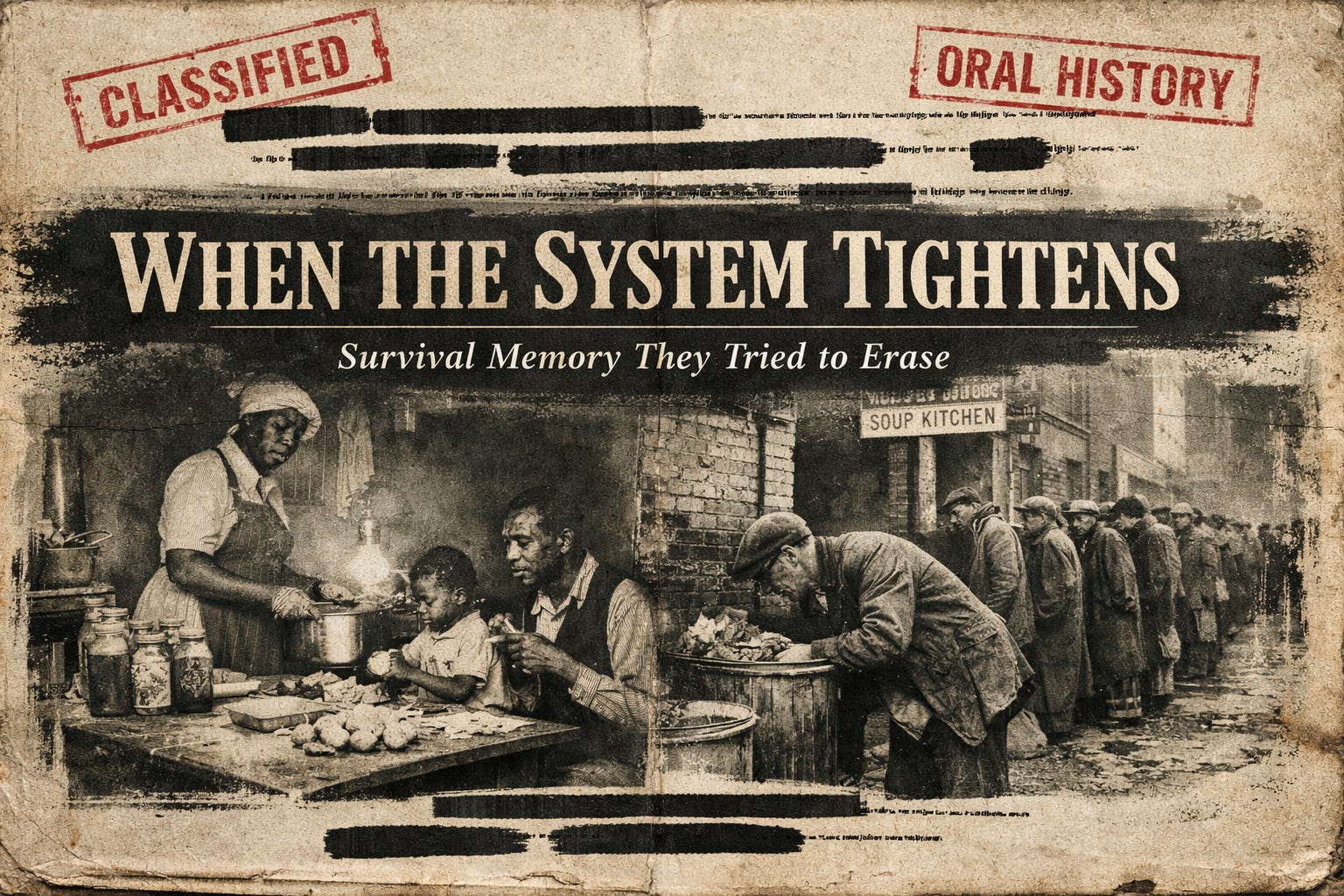
III. THE TRASH MEMORY (ORAL HISTORY, NOT ARCHIVE)
There is a memory that never made it into textbooks.
It survives through verbal pass-down.
Across Black families—Southern towns, urban neighborhoods, back porches and kitchens—elders told the same quiet story:
“When the banks failed, white folks came looking where they never thought they would.”
Denied banks, Black households practiced discipline born of necessity. Food scraps were saved. Bones boiled. Peels reused. Nothing wasted.
And when white savings disappeared—when breadlines formed and dignity collapsed—Black trash became a source of food.
Not because Black families were wealthy.
But because they still had something to discard.
This is not an insult.
It is a reversal.
And reversals threaten hierarchy.
IV. WHY THIS MEMORY WAS BURIED
Oral history does not preserve footnotes—it preserves patterns.
This pattern was dangerous:
Those who trusted institutions starved.
Those excluded from institutions endured.
Those labeled “backward” had resilience.
Those labeled “modern” had dependency.
So the story was inverted.
Black suffering was highlighted—but stripped of agency.
Black adaptation was erased.
Self-reliance was reframed as deficiency.
Because a population that remembers how to live without permission is difficult to govern.
V. HABITS FORGED UNDER CONSTRAINT
Under surveillance, restriction, and arbitrary punishment, Black America developed habits that modern society forgot:
Waste nothing — tomorrow may not cooperate.
Keep value tangible — cash, food, tools, skills.
Distrust systems that can lock you out overnight.
Build redundancy — multiple incomes, suppliers, skills.
Rely on people before platforms.
These were not ideologies.
They were survival reflexes.
And reflexes outlast theories.
VI. WHY THIS MATTERS NOW
Today’s systems are cleaner, faster—and more fragile than ever.
Money is programmable.
Employment is conditional.
Speech is scored.
Access is revocable.
When the rails shut down, those who never practiced life off-rail will panic.
Those who inherited survival memory will not.
They have already seen what happens when trust is misplaced.
VII. THIS IS NOT IMITATION — IT IS RECOGNITION
To follow the habits of the Black community is not to romanticize suffering or borrow identity.
It is to respect knowledge earned under pressure.
It is to listen to elders.
To relearn cash discipline.
To rebuild parallel systems.
To understand that exclusion once acted as an unintended shield.
Modern slavery depends on total participation.
Freedom begins with optionality.
EPILOGUE — THE LIGHTS WILL FLICKER
Collapse does not announce itself.
It arrives politely.
Those who remember how to live without permission do not scramble when the lights flicker.
They never trusted the switch in the first place.
🩸 END TRANSMISSION — T#012625–PARALLEL–SURVIVAL–MEMORY
✊WHEN THE SYSTEM TIGHTENS — WHO ALREADY KNEW HOW TO LIVE WITHOUT IT
This text explores the historical resilience and survival strategies of the Black community as a blueprint for navigating modern systemic failures.
It argues that while institutional collapses like the Great Depression devastated those who relied on banks, marginalized groups thrived by maintaining parallel economies and self-reliance.
These “field-tested” habits—such as valuing tangible assets, minimizing waste, and fostering community over platforms—were born from a long history of exclusion and betrayal by mainstream systems.
The author suggests that modern digital dependencies make society vulnerable, whereas survival memory offers a form of protection against total control.
Ultimately, the source frames historical exclusion as an unintended shield that taught a population how to live without institutional permission.
Reclaiming these methods is presented as a vital path to true autonomy in an increasingly fragile and restrictive world.


