


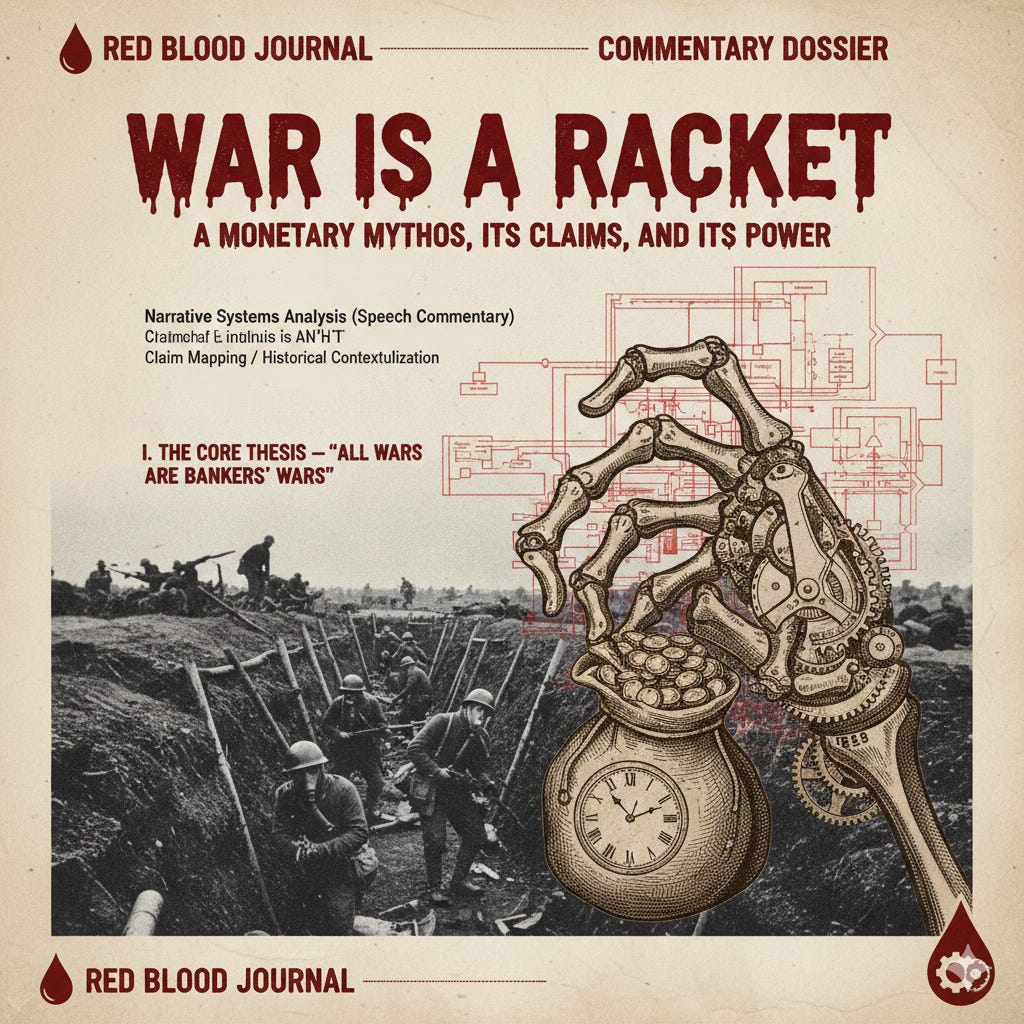
🩸 RED BLOOD JOURNAL — COMMENTARY DOSSIER
Title: WAR IS A RACKET — A Monetary Mythos, Its Claims, and Its Power
Classification: Narrative Systems Analysis (Speech Commentary)
Method: Claim Mapping / Historical Contextualization
Status: Commentary on a circulating speech (verbatim excerpts supplied)
PROLOGUE — WHAT THIS IS (AND ISN’T)
This is not an endorsement, nor a takedown.
It is a forensic commentary on a long-circulating speech that argues all modern wars are driven by private central banking. The speech is rhetorically potent, historically selective, and widely shared across dissident media ecosystems.
Our task here is to map its architecture:
What claims it makes
What history it invokes
Where evidence is solid, disputed, or absent
Why the narrative persists — and why it mobilizes people
I. THE CORE THESIS — “ALL WARS ARE BANKERS’ WARS”
Central claim:
Wars are not ideological, religious, or defensive — they are initiated to preserve private control over money issuance and debt.
Narrative engine:
Private money issuance = enslavement
State-issued money = sovereignty
Any leader who disrupts private credit creation is removed (assassination, war, coup)
This framework is repeated across:
American Revolution
War of 1812
Civil War
World Wars I & II
Cold War interventions
Middle East wars
Modern petrodollar conflicts
Why it resonates:
It offers a single unifying cause for complex events — psychologically powerful, morally clarifying, emotionally activating.
II. HISTORICAL PILLARS — WHAT’S REAL, WHAT’S CONTESTED
1. Colonial Currency & the American Revolution
✔️ True: Colonies issued local scrip; Britain restricted it.
❌ Disputed: Franklin’s quote is paraphrased at best, not reliably sourced verbatim.
❗ Oversimplification: Taxation, governance, and imperial control mattered as much as money.
Verdict: Partially grounded, rhetorically inflated.
2. First & Second Banks of the United States
✔️ True: Fierce political battles over central banking.
✔️ True: Andrew Jackson opposed the Second Bank.
❌ False certainty: Claims of direct Rothschild war threats lack documentary proof.
❌ Assassination motive claim is speculative.
Verdict: Real conflict, conjectural causation.
3. Greenbacks & the Civil War
✔️ True: Lincoln issued Greenbacks.
✔️ True: European elites debated recognition of the Confederacy.
❌ Overreach: War framed primarily as banker retaliation ignores slavery, federalism, and geopolitics.
Verdict: Important financial dimension — not sole driver.
4. Federal Reserve, Income Tax & Jekyll Island
✔️ True: Jekyll Island meeting occurred.
✔️ True: Federal Reserve is quasi-public.
❌ False: Fed is not a single private cartel owned by families.
❌ False: 16th Amendment invalidity claims are rejected by courts.
Verdict: Institutional critique mixed with legal myth.
5. Germany, Weimar, Hitler & Central Banking
⚠️ Highly problematic section.
❌ Misleading portrayal of Nazi economics.
❌ Omission of repression, forced labor, and militarization.
❌ Dangerous implication that prosperity justified regime actions.
Verdict: Historically distorted and ethically hazardous.
6. Smedley Butler & “War Is a Racket”
✔️ Solid sourcing.
✔️ Butler’s critique of corporate militarism is authentic.
✔️ Widely cited in academic and anti-imperialist literature.
Verdict: One of the speech’s strongest pillars.
7. JFK, EO 11110 & Assassination Claims
✔️ EO 11110 existed.
❌ It did not meaningfully dismantle the Fed.
❌ Assassination causation claim is speculative.
Verdict: Correlation elevated to causation.
8. Petrodollar Wars (Iraq, Libya, Iran)
✔️ Oil currency politics matter.
✔️ Dollar hegemony influences foreign policy.
❌ Wars reduced to single motive.
❌ Ignores regional politics, internal repression, alliances.
Verdict: Selective but not baseless.
III. THE SPEECH AS A PSYCHOLOGICAL WEAPON
This is where the analysis becomes most important.
Why this speech spreads:
Moral clarity: Good vs evil
Narrative closure: One enemy explains everything
Identity formation: Listener becomes “awake”
Emotional absolution: Suffering is not random — it’s theft
The danger:
Monocausal thinking
Historical flattening
Moral displacement
Justification drift
When every war becomes only bankers’ wars, nuance dies — and with it, the ability to build real alternatives.
IV. WHAT THE SPEECH GETS RIGHT (AND WHY IT MATTERS)
Despite its excesses, it surfaces real questions:
Who controls money issuance?
Why is debt structurally unavoidable?
Why are wars consistently profitable?
Why do financial interests survive regime change?
Why are monetary debates absent from mainstream education?
These are legitimate inquiries — even when wrapped in overreach.
V. THE RED BLOOD POSITION — A HARDER TRUTH
Wars are not only banker wars.
But no modern war occurs without financial beneficiaries.
Money is not the sole driver —
but it is always in the room,
often writing the rules after the blood dries.
EPILOGUE — WHY THIS COMMENTARY EXISTS
This speech circulates because it fills a vacuum left by:
Hollow history education
Sanitized war narratives
Financial illiteracy by design
Suppressing it won’t work.
Mocking it won’t work.
Only disciplined analysis will.
🩸 Red Blood Journal
We map the story beneath the story — without surrendering to myth or forgetting who profits when myths replace facts.
The provided source is a Commentary Dossier from the Red Blood Journal offering a Narrative Systems Analysis of a popular circulating speech titled “War Is a Racket: A Monetary Mythos.”
This analysis forensically maps the claims and architecture of the speech, which centrally argues that all modern wars are initiated to preserve private control over money issuance by central bankers.
The commentary systematically evaluates the historical pillars cited by the speech—covering events from the American Revolution to the Petrodollar Wars—finding that while certain facts are true, the speech often relies on conjectural causation, oversimplification, and historical distortion to promote a single unifying cause.
Ultimately, the analysis concludes that while financial beneficiaries are present in every war, reducing complex conflicts to a monocausal “bankers’ wars” narrative leads to moral displacement and historical flattening, though it also notes the speech raises legitimate questions about war profitability and debt structure.


