


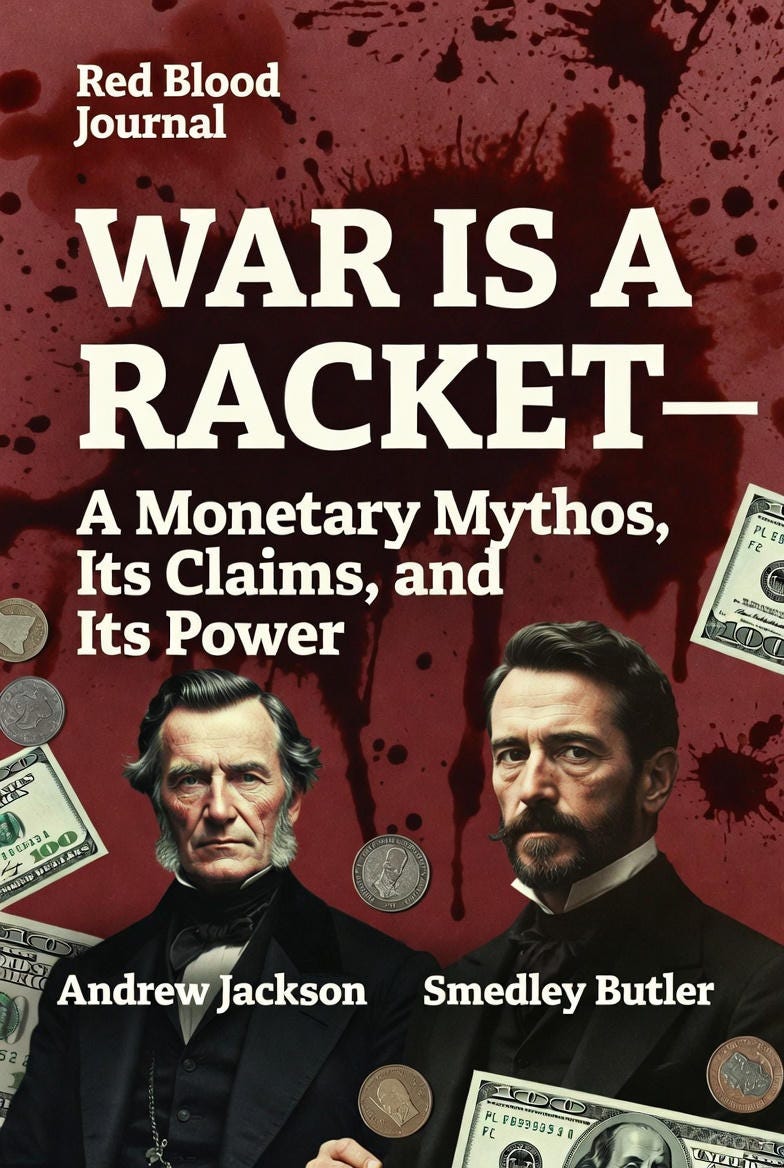
🩸Crimson Ledger Review — Analytical File
Headline: War as a Profitable Enterprise — The Financial Narrative, Its Assertions, and Its Influence
Category: Discourse Framework Examination (Address Critique)
Approach: Assertion Breakdown / Chronological Background Review
Purpose: Evaluation of a widely disseminated address (direct quotes provided)
INTRODUCTION — SCOPE AND LIMITATIONS
This document neither fully supports nor outright rejects the ideas presented.
Instead, it provides a detailed dissection of a persistent online address claiming that contemporary conflicts are primarily engineered to safeguard private dominance over currency creation and credit systems. The address is compelling in its delivery, selective in its historical references, and frequently circulated in alternative information networks.
Our objective is to outline its structure:
The specific assertions advanced
The historical events referenced
Areas where supporting facts are robust, debated, or missing
Reasons for the narrative’s endurance and its capacity to inspire action
I. THE CENTRAL ARGUMENT — “CONFLICTS SERVE FINANCIAL INTERESTS”
Primary assertion:
Armed confrontations are not rooted in ideology, faith, or national security — rather, they are orchestrated to maintain elite control over monetary supply and indebtedness.
Key narrative elements:
Privately controlled currency equals systemic subjugation
Government-directed money issuance equals true independence
Leaders challenging private lending mechanisms face elimination (via regime change, conflict, or targeted removal)
This pattern is applied to:
The fight for American independence
The 1812 confrontation with Britain
The U.S. internal conflict of the 1860s
The global wars of the 20th century
Post-WWII proxy engagements
Resource-driven operations in oil-rich regions
Contemporary challenges to dollar-based trade
Appeal factor:
It provides one overarching explanation for multifaceted historical chaos — offering intellectual simplicity, ethical certainty, and strong motivational force.
II. HISTORICAL FOUNDATIONS — ACCURATE, DEBATED, OR FLAWED
Colonial Notes and the Revolutionary War
✅ Accurate: American colonies used their own paper money; British policies curtailed this.
❌ Questionable: Attributed statements to Benjamin Franklin are often rephrased or unsourced.
⚠️ Simplification: Issues of taxation without representation and colonial administration were equally significant.
Assessment: Rooted in reality but amplified for effect.
Early U.S. Central Banks
✅ Accurate: Intense debates surrounded the First and Second Banks.
✅ Accurate: President Jackson vigorously opposed renewal.
❌ Unsubstantiated: Allegations of foreign banking threats directly provoking war lack primary evidence.
❌ Speculative: Links to assassination attempts remain unproven.
Assessment: Genuine political strife, but causal links exaggerated.
Debt-Free Currency and the 1860s Conflict
✅ Accurate: The Union issued greenbacks as legal tender.
✅ Accurate: European powers considered intervening on behalf of the South.
❌ Overstated: Portraying the war chiefly as retaliation against alternative money ignores core issues like abolition and states’ rights.
Assessment: Finance played a role — but far from the only one.
The Federal Reserve Era and Related Reforms
✅ Accurate: Secretive meetings led to the system’s creation.
✅ Accurate: The institution operates with both public and private elements.
❌ Incorrect: Descriptions of total private family ownership are misleading.
❌ Rejected: Arguments against related tax laws have consistently failed in legal challenges.
Assessment: Valid institutional concerns blended with unfounded theories.
Interwar Germany and Monetary Policy
⚠️ Particularly troubling segment.
❌ Distorted: Economic recovery under the regime is presented without context of coercion and aggression.
❌ Absent: Discussion of exploitation and militarized economy.
Assessment: Factually selective and potentially harmful in implications.
General Smedley Butler’s Denunciation
✅ Reliable: His famous critique of war profiteering is well-documented.
✅ Established: Frequently referenced in studies of imperialism.
Assessment: Among the most credible supports in the address.
Executive Order on Currency and Leadership Removal Claims
✅ Accurate: The order was issued.
❌ Mischaracterized: It did not threaten the central banking structure.
❌ Conjectural: Ties to political violence remain unsupported.
Assessment: Factual coincidence promoted as direct cause.
Dollar-Dominated Energy Trade Conflicts
✅ Relevant: Currency choices in oil sales influence geopolitics.
✅ Influential: U.S. financial dominance shapes policy.
❌ Reductionist: Complex regional dynamics and governance issues overlooked.
Assessment: Partial truth within a broader picture.
III. THE ADDRESS AS AN IDEOLOGICAL TOOL
The real significance lies in its transmission dynamics:
Binary morality: Clear heroes and villains
Explanatory unity: One force behind all turmoil
Group affiliation: Audiences feel enlightened
Emotional relief: Chaos becomes purposeful exploitation
Risks involved:
Single-cause reasoning
Compression of historical complexity
Shifting of ethical responsibility
Potential for radical escalation
Reducing every conflict to financial orchestration eliminates subtlety — hindering constructive responses.
IV. VALID INSIGHTS AMID EXAGGERATIONS
The address nonetheless highlights critical issues:
Authority over currency creation
Inherent growth requirements in debt-based systems
Consistent profitability of armed conflict
Resilience of financial networks across political shifts
Absence of monetary education in public discourse
These warrant serious discussion, independent of surrounding hyperbole.
V. THE CRIMSON LEDGER VIEW — A MORE NUANCED REALITY
Conflicts are not exclusively driven by finance.
Yet none unfold in the modern era without entities gaining economically.
Money is rarely the spark —
but it is invariably present,
frequently shaping outcomes long after hostilities cease.
CONCLUSION — PURPOSE OF THIS REVIEW
This address endures due to gaps in:
Depth of historical instruction
Candor in official conflict accounts
Widespread understanding of economic mechanisms
Censorship or ridicule proves ineffective.
Only rigorous, balanced examination can provide clarity.
🩸 Crimson Ledger
We examine the layers beneath surface accounts — resisting both fabrication and denial of systemic gain.
The source, an analytical file titled “Crimson Ledger Review,” provides a detailed examination of a persistent online address that argues contemporary global conflicts are primarily orchestrated by elites to maintain private control over currency and credit systems.
This review systematically evaluates the core assertion, breaking down historical evidence referenced by the address—such as the American Revolutionary War and the creation of the Federal Reserve—to determine where facts are accurate, exaggerated, or outright missing.
Ultimately, the analysis concludes that while the narrative contains important insights regarding the consistent profitability of war and the significance of currency authority, it suffers from reductionism and intellectual simplicity by ignoring crucial political, social, and ideological factors. The purpose of the document is to offer a rigorous and balanced assessment of this enduring conspiracy theory, noting that simply dismissing it fails to address underlying public mistrust or valid concerns about financial power.


