


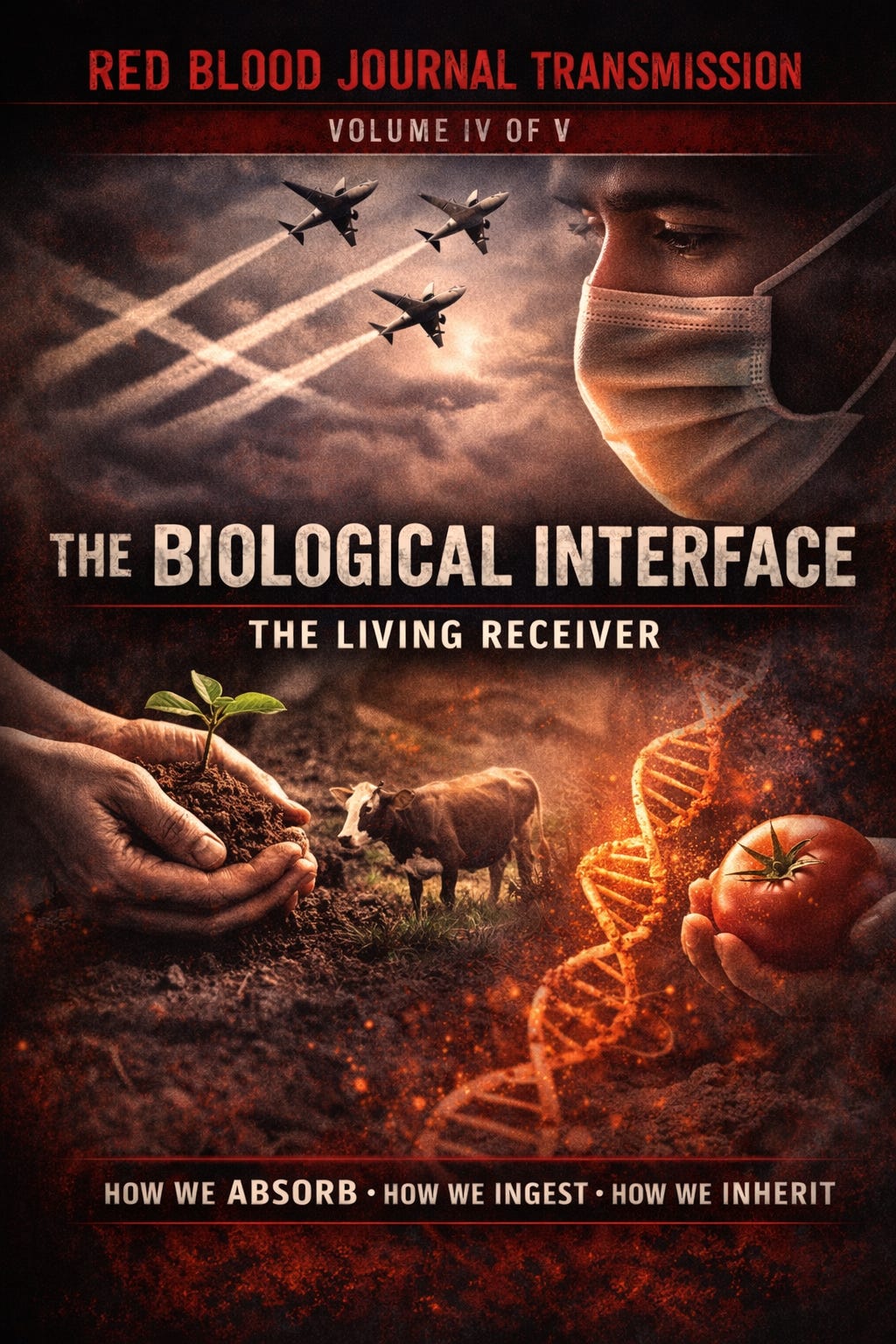
🩸 RED BLOOD JOURNAL TRANSMISSION
Volume IV of V — The Biological Interface
Biological interface and the living receiver
T#: RBJ-GEOENGINEERING-IV-THE-LIVING-RECEIVER
Classification: Bio-Environmental Integration Protocol / Atmospheric-to-Biological Transfer Mechanism / Systemic Assimilation Doctrine
Desk: Biological Counterintelligence Division — Archive of Blood & Memory
Cross-Reference: Soil Absorption Pathways / Hydrological Distribution Cycle / Atmospheric Particulate Assimilation
PROLOGUE — THE SKY WAS NEVER THE TARGET
The sky is not the endpoint.
It is the delivery medium.
The target was always the receiver.
Living systems.
Plants.
Water.
Soil.
Animals.
Humans.
The sky does not need to hold the intervention forever.
It only needs to deliver it.
Gravity completes the operation.
SECTION I — THE FIRST POINT OF CONTACT: THE SOIL
Every biological system begins with the soil.
Soil is the interface between atmosphere and life.
Peterson documented that atmospheric particulates, including aluminum and other metals, enter root systems and interfere with nutrient absorption.
Rosalind Peterson at UN
When roots cannot absorb water, the organism enters systemic stress.
Not from absence of water.
From inability to utilize water.
The result mimics drought.
But drought is not required.
Interference is sufficient.
This transforms atmospheric intervention into biological outcome.
Without visible causation.
SECTION II — THE WATER SYSTEM: THE INTERNAL TRANSPORT NETWORK
Water is the circulatory system of the planet.
It transports whatever enters it.
Peterson’s analysis revealed synchronized chemical spikes across drinking water systems, suggesting atmospheric origin followed by hydrological integration.
Rosalind Peterson
Once integrated into water systems, atmospheric particulates enter:
Groundwater.
Surface water.
Agricultural irrigation.
Municipal drinking systems.
Water becomes the internal delivery mechanism.
The sky delivers.
Water distributes.
Life receives.
SECTION III — THE PLANT SYSTEM: PRIMARY BIOLOGICAL ABSORBER
Plants are the first biological interface.
They absorb from soil.
They absorb from air.
They absorb from water.
Peterson observed widespread decline in tree health associated with atmospheric and soil chemical integration.
Rosalind Peterson at UN
Plants cannot reject environmental integration.
They incorporate it.
This transforms atmospheric intervention into biological composition.
Plants become storage systems.
Not by choice.
By function.
SECTION IV — THE FOOD CHAIN TRANSFER MECHANISM
Once plants incorporate atmospheric particulates, the transfer chain begins.
Plants feed animals.
Animals feed humans.
The intervention moves upward.
Silently.
Because biological systems do not question what they absorb.
They incorporate it.
Assimilation requires no awareness.
Only exposure.
SECTION V — THE RESPIRATORY INTERFACE: DIRECT ATMOSPHERIC ENTRY
Atmospheric particulates do not require soil or water to enter biological systems.
Respiration provides direct access.
Peterson noted that jet fuel emissions and atmospheric pollutants include carcinogens and compounds known to affect neurological and biological systems.
Rosalind Peterson
The respiratory system becomes the direct interface between atmosphere and organism.
No intermediary required.
Air becomes carrier.
Breath becomes entry point.
Integration becomes automatic.
SECTION VI — THE BIOLOGICAL NORMALIZATION PROCESS
Biological systems adapt to environmental conditions.
Adaptation normalizes intervention.
Over time, the organism adjusts to altered baseline conditions.
This creates biological normalization.
The organism no longer recognizes the altered condition as abnormal.
Because it becomes the new baseline.
Future generations inherit the altered baseline.
Without knowledge of prior conditions.
Intervention becomes biological inheritance.
SECTION VII — THE SYSTEMIC INTEGRATION PHASE
Atmospheric intervention does not remain external.
It becomes internal.
Integrated into:
Soil composition.
Water chemistry.
Plant tissue.
Animal tissue.
Human tissue.
The intervention ceases to be external.
It becomes environmental.
It becomes biological.
It becomes systemic.
Invisible because it becomes part of the system itself.
SECTION VIII — THE FINAL OBJECTIVE: COMPLETE BIOLOGICAL INTEGRATION
Control does not require visible force.
Control requires systemic integration.
Once intervention integrates into biological systems, it becomes self-sustaining.
Because life itself perpetuates it.
The system maintains itself through natural biological processes.
Without requiring continuous visible deployment.
Deployment becomes maintenance.
Maintenance becomes environment.
Environment becomes reality.
COUNTERINTELLIGENCE ASSESSMENT — WHY BIOLOGICAL INTERFACE IS THE FINAL PHASE
Because biological integration creates permanence.
Mechanical systems can be dismantled.
Biological integration cannot.
It reproduces.
It propagates.
It inherits.
It continues beyond operational visibility.
This is the transition from deployment to permanence.
TERMINAL ANALYSIS — THE ATMOSPHERE WAS ONLY THE BEGINNING
The sky was never the objective.
The objective was life itself.
Not to destroy it.
To integrate with it.
Because the most permanent system is not mechanical.
It is biological.
Once integrated into life, the intervention no longer requires concealment.
Because it no longer exists outside the system.
It becomes the system.
END OF VOLUME IV
Next Transmission:
Volume V — The Endgame: The Permanent Atmospheric Regime
🧬The Biological Interface:
Systemic Integration of Life and Atmosphere
This text outlines a theory of systemic biological integration, suggesting that atmospheric interventions are designed to permeate every level of the natural world.
According to the document, the atmosphere serves as a delivery vehicle for particulates that eventually settle into the soil, water, and food chain.
This process allegedly causes plants and animals to absorb chemical stressors, leading to a permanent alteration of their biological makeup.
The narrative claims that humans are similarly affected through respiration and consumption, resulting in a “new baseline” of existence where these substances are normalized.
Ultimately, the source argues that these interventions aim for complete biological assimilation, transitioning from external environmental shifts to internal, self-propagating life cycles.
By integrating into genetic and systemic inheritance, the intervention becomes an invisible and irreversible part of the living world.


