


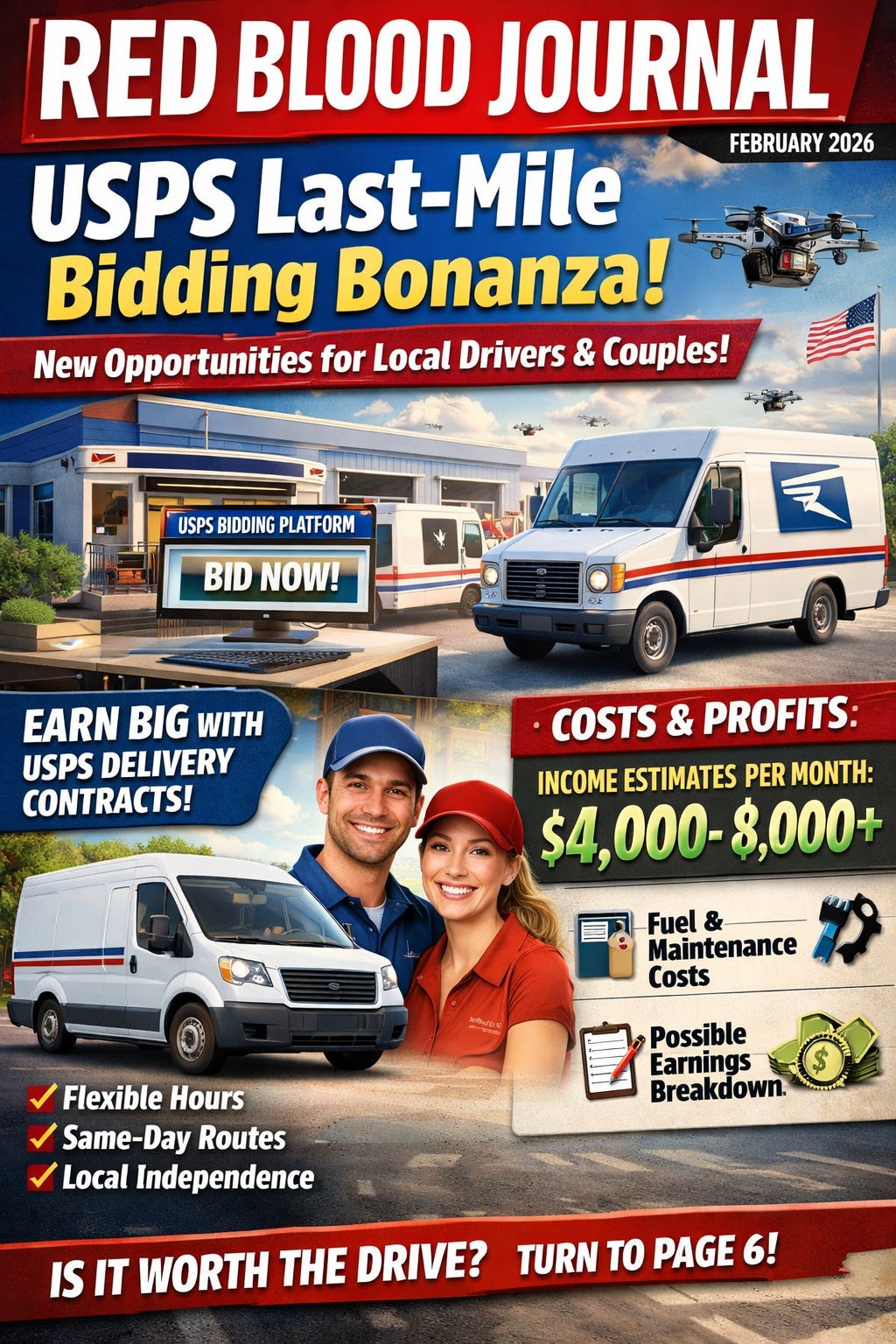
🩸RED BLOOD JOURNAL TRANSMISSION
T#: RBJ-2026-01-21-USPS-LASTMILE-HUSTLE
Classification: Economic Enlistment & Gig-Labor Extraction
Desk: Domestic Logistics, Small-Business Trap & Control Grid Unit
Status: Field Briefing for Prospective Operators (Singles & Couples with a Van)
EXECUTIVE SNAPSHOT
USPS just cracked open its last-mile delivery network—18,000+ local post offices and processing centers—through a new online bidding platform launched January 20, 2026.
On paper, it looks like “access for everyone”: small businesses, regional logistics outfits, maybe even a tiny husband-and-wife courier shop with a minivan.
Reality check:
The platform is designed for shippers, not for individual drivers. You don’t get paid by USPS; you pay USPS for final mile (Parcel Select) and try to earn your margin on top.
If you just want to drive with your own vehicle, your most realistic path is to work under someone else (3PL, Amazon, UPS contractor) at pay levels similar to Amazon Flex / DSP drivers: roughly $18–$25/hr before vehicle costs.
Once you include true vehicle costs (fuel, maintenance, insurance, depreciation), a realistic baseline is ~$0.70–$0.75 per mile in 2026—very close to the IRS business mileage rate of 72.5¢/mile.
When you run the numbers, the net profit for a single driver or couple is much thinner than the marketing language suggests—unless you treat your own time as cheap labor.
This report will walk you through:
What the USPS platform actually is.
The two realistic ways a small player can “get involved.”
Detailed cost & profit scenarios for a single driver or a couple with their own vehicles.
The Red Blood conspiracy lens: how this fits the broader shift into a gig-ified control grid.
I. WHAT USPS JUST DID – THE OFFICIAL STORY
1. The New Bidding Platform
On January 20, 2026, USPS launched a bid solicitation website allowing businesses to submit proposals for access to its last-mile network:
18,000+ Destination Delivery Units (DDUs) & Local Processing Centers (LPCs)
Entry under the Parcel Select umbrella (ground parcels)
Same-day / next-day delivery to end customers by postal carriers
This is pitched as:
“Democratizing” access that previously went mainly to big players (Amazon, UPS, FedEx).
A way to fill unused last-mile capacity: USPS can handle 3.5–4B parcels/year but currently moves only ~1.7B.
A revenue life-raft for an institution with $118B in cumulative losses since 2007 and a risk of running out of cash by early 2027 without new income streams.
2. How Bidding Works (High-Level)
You create a USPS business account and access the new bidding site.
You choose which DDUs/LPCs you want to inject parcels into (can be local, regional, or national).
You submit a proposal for each area combining:
Volume commitments (how many parcels per day/week)
Price you’re willing to pay per package
Tender times (when you’ll drop the loads)
USPS evaluates proposals on:
Revenue / price competitiveness
How well your volume fills its excess capacity
Operational fit with its schedules & standards
Winning bidders sign a Negotiated Service Agreement (NSA)—a custom contract under Parcel Select.
Important:
This platform is not a job board for drivers. It is a wholesale access point for businesses that want to plug into USPS for the last mile.
II. WHERE A ONE- OR TWO-CAR TEAM ACTUALLY FITS
If you are a single person or couple with your own vehicles, you basically have two different paths:
Path A – Micro-Logistics Operator Using USPS as Your Backbone
You form a tiny logistics business (LLC, sole proprietor, etc.) and:
Sign up on the USPS bidding platform as a shipper.
Use your own vehicles to:
Collect parcels from local merchants / e-commerce sellers
Consolidate them
Transport them to the chosen DDU/LPC by the agreed tender times
Pay USPS to carry those parcels the last mile to the customer’s door.
You earn money by:
Charging local businesses more than USPS charges you
But still less (or more convenient terms) than they’d get by shipping each parcel individually through USPS/UPS/FedEx.
This is entrepreneur mode, not gig-worker mode.
Upside: more control.
Downside: all the risk sits on your shoulders.
Path B – Classic Gig / Contractor Driver
You don’t bid with USPS at all. Instead, you:
Work for a delivery service partner (DSP) or 3PL that did win bids.
Or do Amazon Flex / UPS / regional courier work that indirectly depends on USPS capacity.
Pay environment:
Amazon Flex / DSP-style: often advertised around $18–$25/hr gross before expenses, depending on market.
Similar bands for many courier companies & DSPs.
This is labor mode. You’re replaceable; your negotiation power is low, but the barrier to entry is minimal.
III. COST REALITY: WHAT IT REALLY COSTS TO RUN YOUR OWN VEHICLE
Before we talk “profit,” we need to talk true operating cost.
1. Baseline Cost Per Mile
Three useful benchmarks:
IRS 2026 business mileage rate:
72.5¢ per mile for business use (covers fuel, maintenance, insurance, depreciation, and more).
Service / fleet benchmarks (light duty vehicles):
Fuel cost ~$0.14–$0.15/mile for typical service vehicles.
Fuel is often ~60% of total operating cost, implying total cost around $0.23–$0.25/mile for fleets with volume discounts and optimized maintenance.
Real owner-operator trucking costs (heavier but illustrative):
Independent truckers see large line items: fuel, truck payment, repairs, insurance, tires, etc.—tens of thousands per year.
For a regular person with one or two vehicles, the IRS rate (72.5¢/mile) is a very fair proxy for your real all-in cost once you include:
Fuel
Tires, oil, brakes, maintenance
Insurance increases for commercial/gig use
Depreciation + eventual replacement
Registration, incidental tolls, parking, etc.
Working assumption for this report:
All-in vehicle cost ≈ $0.70–$0.75/mile.
We’ll use $0.725/mile in the examples.
2. Typical Gross Pay as a Driver
From Amazon Flex and similar sources:
Advertised / average gross pay: $18–$25/hr.
That sounds decent—until you translate it into per mile and subtract your costs.
IV. PROFIT SCENARIOS – SINGLE DRIVER & COUPLE
These scenarios are illustrative, not guarantees. They assume:
Gross pay: $22/hour (middle of the $18–$25 band)
Average route speed: 20–22 miles/hour (mix of traffic, stops, loading)
Vehicle cost: $0.725/mile (IRS 2026 rate)
Scenario 1 – Single Driver, Side Hustle (Gig-Style)
3 hours/day
5 days/week
4 weeks/month
~20 miles/hour average
Totals:
Hours/month: 3 × 5 × 4 = 60 hours
Miles/month: 60 × 20 = 1,200 miles
Gross income: 60 × $22 = $1,320
Vehicle cost: 1,200 × $0.725 ≈ $870
Net before tax: ≈ $450/month
Effective pay:
$450 ÷ 60h = $7.50/hour
That’s below or near minimum wage in many states before self-employment tax and health insurance.
Scenario 2 – Single Driver, Heavy Part-Time
6 hours/day
5 days/week
4 weeks/month
~22 miles/hour average
Totals:
Hours/month: 6 × 5 × 4 = 120 hours
Miles/month: 120 × 22 = 2,640 miles
Gross income: 120 × $22 = $2,640
Vehicle cost: 2,640 × $0.725 ≈ $1,914
Net before tax: ≈ $726/month
Effective pay:
$726 ÷ 120h ≈ $6.05/hour
You’re working a serious part-time schedule and clearing barely above nothing once your car is honestly accounted for.
Scenario 3 – Couple with Two Vehicles (Gig-Style)
Assume both partners run routes:
Each: 4 hours/day, 5 days/week, 4 weeks/month
So per person: 80 hours/month
Both combined: 160 hours/month
Same $22/hr, 20 miles/hour, $0.725/mile
Per person:
Miles/month: 80 × 20 = 1,600 miles
Gross: 80 × $22 = $1,760
Vehicle cost: 1,600 × $0.725 ≈ $1,160
Net: about $600/month per person
For the couple:
Combined net: ≈ $1,200/month
Combined time: 160 hours
Effective combined pay:
$1,200 ÷ 160h = $7.50/hour
So yes, you “scale up” by adding a second person—but you also double the liability, wear, and stress, and the per-hour pay barely moves.
Scenario 4 – Micro-Logistics Business Using USPS Bidding (Path A)
Now imagine you go entrepreneur mode and actually use the USPS bidding platform.
Assumptions (these are modeling assumptions, not official USPS prices):
You win a small NSA that lets you inject parcels at your local DDU.
For an average lightweight e-commerce parcel, your USPS cost via Parcel Select DDU might land somewhere around $2.50–$3.25 depending on zone & weight. (Actual Notice 123 tables show rates rising with distance/weight; this is a simplified mid-range).
You charge local merchants $4.00 per parcel for:
Pick-up at their shop/warehouse
Consolidation
Drop-off at USPS DDU
USPS then does final delivery.
Assume:
Average margin per parcel after paying USPS = about $1.25
You can reliably move 80 parcels/day, 22 workdays/month.
Revenue math:
Margin/month: 80 parcels × 22 days × $1.25 ≈ $2,200/month
Now the cost of your driving:
Suppose your daily run is ~60 miles (multiple pick-ups + DDU drop-off).
60 miles/day × 22 days = 1,320 miles/month
Vehicle cost: 1,320 × $0.725 ≈ $957/month
Rough P&L:
Margin from parcels: $2,200
Vehicle cost: –$957
Leftover “gross profit” before:
Your own labor time
Bookkeeping / software / storage
Taxes, licenses, insurance upgrades
Bad parcels, refunds, customer service
Leftover ≈ $1,243/month.
If your actual working time is 2.5–3 hours/day including admin (≈ 55–65 hours/month), your effective pre-tax pay is somewhere around $18–$22/hour.
This is the only scenario in this report that looks halfway attractive—and even here:
You carry business risk.
You depend on merchants not dropping you for a cheaper competitor.
USPS could change NSA pricing or terms at renewal.
It’s a business, not a side hustle. And the “profit” can vanish if:
Your mileage is higher than expected.
Merchants demand lower prices.
USPS adjusts rates or fees.
V. RED BLOOD CONSPIRACY LENS – WHAT GAME IS REALLY BEING PLAYED?
From the control-grid angle, a few patterns jump out.
1. Monetizing the Control Grid While Outsourcing the Risk
USPS is sitting on:
A universal network nobody else has.
Massive fixed costs and $118B in losses since 2007.
The bidding platform:
Turns that network into a wholesale API for corporations and micro-logistics players.
Keeps USPS in control of the final mile, addresses, and data, while pushing:
Fuel risk
Vehicle risk
Labor risk
back onto small operators and gig workers.
In other words:
They own the road. You own the wear and tear.
2. Squeezing the Middle: Big Carriers & Amazon vs Micro-Operators
UPS and FedEx already learned that universal coverage is too expensive everywhere, so they hand off low-margin rural parcels to USPS.
Amazon built its own network (1,300+ facilities; 6.3B packages/year) and uses USPS selectively for the ugly routes.
The new bidding system:
Lets the giants compete for even better terms.
Lets small players in—but only if they’re willing to:
Run thin margins
Race each other to the bottom on price
Take on all the fleet risk
Result: a two-tier landscape:
Mega-players optimizing algorithms and contracts.
A long tail of small operators acting as shock absorbers for spikes, rural routes, and political shifts.
3. Soft Enlistment: Everyone Becomes Logistics Infantry
Zoom out:
Gig economy drivers already discovered that once true costs are counted, many are earning less per hour than they think.
Now, USPS invites micro-businesses into a complex bidding system that most individuals won’t fully understand.
From a Red Blood perspective, this looks like:
An enlistment doctrine where citizens quietly become part of the infrastructure—
not as owners of the network, but as expendable nodes in it.
The real assets:
The routes
The data
The regulatory capture
Those remain in the hands of the state-corporate stack.
VI. PRACTICAL TAKEAWAYS FOR A SINGLE OR COUPLE THINKING ABOUT THIS
If you’re seriously considering getting involved, here’s the straight, non-romantic version.
A. If You Just Want to Drive for Money (Path B)
Expect $18–$25/hour gross, and plan on $0.70–$0.75/mile in real cost.
After all costs, your true take-home may be $5–$10/hour.
This can make sense if:
You need short-term cash
You accept that your car is being slowly liquidated into income
But it is not a path to robust independence.
B. If You Want a Real Micro-Business (Path A)
Treat it as a full business project, not “easy side money”:
Business structure & compliance
LLC or similar
Commercial/gig-friendly insurance
Bookkeeping, tax planning
Customer acquisition
Local merchants, DTC brands, subscription boxes
Offer: “We pick up, consolidate, and hand off to USPS—the same carrier you already trust, but cheaper/more convenient.”
Numbers you must build yourself
Min parcels/day where you break even
Max miles/day you can drive (and still be sane)
What happens if one vehicle dies for 2 weeks?
Red flag test
If your model doesn’t give you at least $20–$25/hour equivalent after true costs in your spreadsheet, it’s not worth it long-term.
VII. CLOSING – IS IT A PATH OUT, OR A DIFFERENT KIND OF CAGE?
The USPS last-mile bidding platform is an opportunity—
but mostly for:
USPS itself (monetizing spare capacity)
Big shippers looking for cheaper access
Sophisticated regional 3PLs who already live in spreadsheets and rate tables
For a single person or a couple with their own vehicles, the picture is more sober:
Gig-style driving: likely low true hourly pay, high vehicle burn.
Micro-logistics business: potentially viable only if you:
Run tight numbers
Lock in reliable client volume
Understand you’re building an actual company, not a side hustle.
From the Red Blood lens, this looks less like emancipation and more like another front in the quiet war to:
Push economic risk downward
Keep data and infrastructure centralized
Turn individual vehicles into off-balance-sheet assets for a system that always gets paid first.
just more sophisticated wage-slavery.
🕸️The USPS Last-Mile Hustle: Logistics, Labor, and the Gig Grid
The USPS recently introduced an online bidding platform designed to allow businesses to access its last-mile delivery network and fill excess shipping capacity.
While marketed as a way to democratize logistics, the system functions as a wholesale portal for shippers rather than a job board for independent drivers.
Individual operators and couples face a difficult choice between working as low-wage gig contractors or launching micro-logistics businesses that carry significant financial risk.
Detailed economic analysis suggests that after accounting for vehicle depreciation, fuel, and maintenance, most drivers earn far less than the advertised gross pay.
Ultimately, the transition appears to benefit the postal service and large corporations by offloading infrastructure costs and operational risks onto a decentralized workforce.
This shift is framed as a strategic move to monetize the national grid while turning citizen-drivers into expendable nodes within a state-corporate system.


