


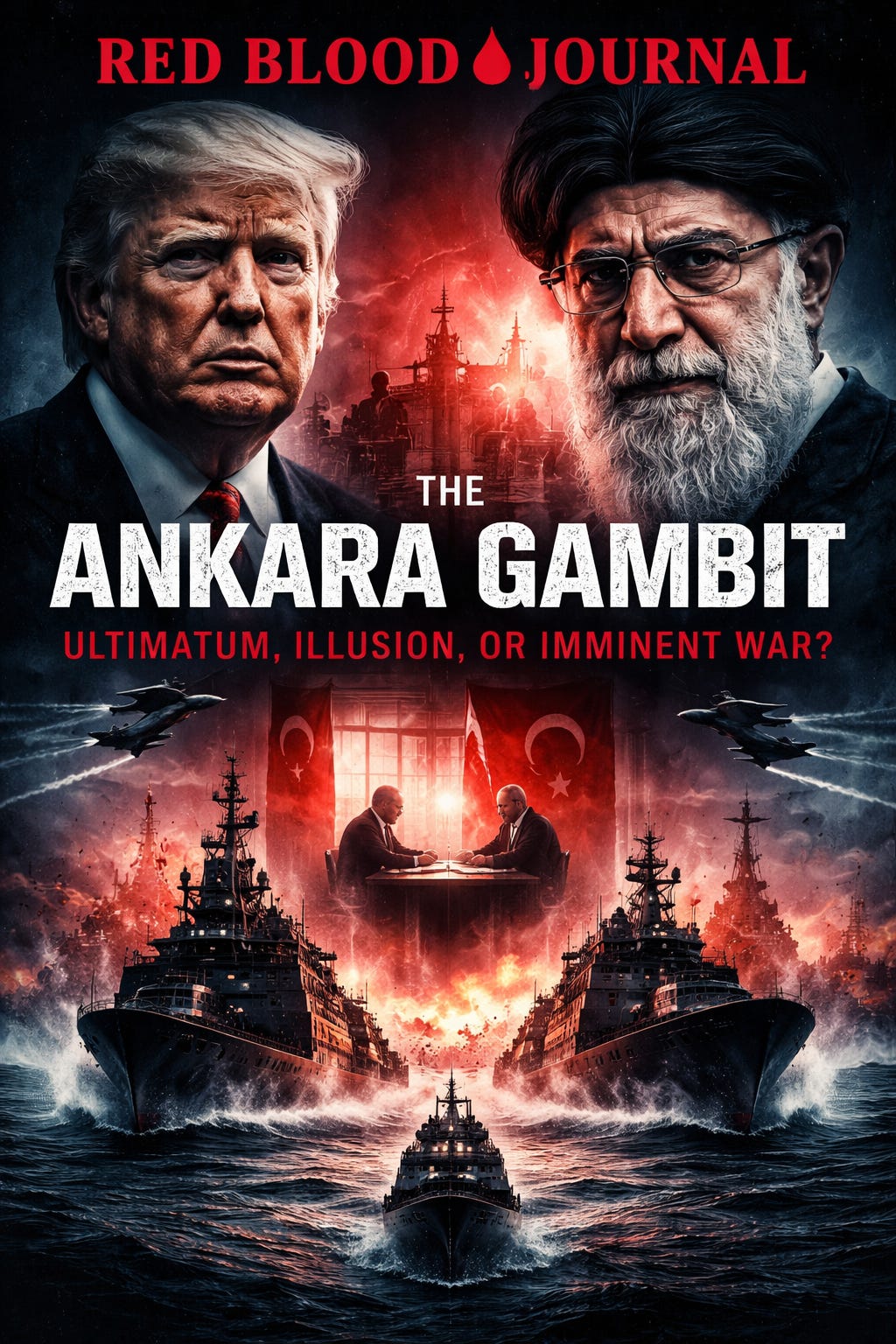
🩸 RED BLOOD JOURNAL TRANSMISSION
T#: RBJ-2026–DIPLOMACY-OR-DECEPTION
Title: The Ankara Gambit: Ultimatum, Illusion, or Imminent War?
Classification: Strategic Signals Analysis
Threat Vector: Managed Escalation / Negotiated Surrender
Clearance: Open — For Those Who Read Between Headlines
PROLOGUE — THE CALM THAT MOVES LIKE A STORM
Diplomacy does not always mean peace.
Sometimes, it is simply war in a different costume.
In the winter of 2026, the world is told that Washington and Tehran may be “talking.”
What we are witnessing is not a normal negotiation.
It is a pressure corridor — a narrowing path where one side holds the gun and the other pretends the table is level.
Ankara is not neutral ground.
It is a stage.
The question is not whether something is happening — it is what kind of something.
Is this negotiation?
Or is it the final ritual before force?
SECTION I — THE ANKARA CHANNEL
Reports have emerged that U.S.–Iran talks may take place in Ankara, mediated through backchannels rather than formal state diplomacy.
On one side: Abbas Araghchi, representing the Islamic Republic.
On the other: Steve Witkoff, a figure closely tied to Trump’s strategic circle rather than traditional diplomacy.
This choice of personnel is the first signal.
Araghchi = regime continuity, nuclear bargaining, survival politics.
Witkoff = deal-making, leverage, real estate logic applied to geopolitics.
This is not diplomacy in the classic sense.
This is transactional coercion disguised as negotiation.
The location — Ankara — matters.
Turkey has long played the role of “gray zone broker” between Iran and the West:
not an ally, not an enemy, but a corridor of plausible deniability.
If this were serious peace-making, talks would be in Vienna, Geneva, or New York.
Instead, they are in the margins.
That tells you where the power lies.
SECTION II — THE 400 KILOGRAM (882 POUND) QUESTION
At the center of the reported agenda is a discussion about the transfer of 400 kg of enriched uranium.
This is not a technical detail.
It is a political fuse.
400 kg is not random.
It is just enough to matter — but not enough to fully disarm.
Possible interpretations:
Symbolic Compliance:
Tehran offers a partial concession to buy time.Managed De-escalation:
Washington accepts a token gesture to reduce immediate crisis pressure.Pre-Strike Conditioning:
The U.S. extracts material concessions before any military move.
In every scenario, Iran is not negotiating from strength.
It is negotiating under constraint.
The deeper truth:
If Iran were confident, it would not even be discussing material transfer.
SECTION III — TRUMP’S LANGUAGE OF UNCERTAINTY
Trump’s public statements have been deliberately ambiguous.
He refuses to reveal his “final decision.”
He speaks of “very powerful ships” moving toward Iran.
He mixes reassurance with threat.
This is classic coercive signaling:
Ambiguity creates psychological pressure.
Military movement creates real pressure.
Silence on intent maximizes both.
His message is not meant for the public.
It is meant for Khamenei.
This is not diplomacy.
It is an ultimatum delivered through theater.
SECTION IV — THE NAVAL SHADOW
U.S. warships are reportedly moving toward the region.
This is not routine posture.
This is deliberate proximity signaling.
Naval movement serves three functions:
Deterrence: Demonstrating capability.
Preparation: Positioning for rapid action.
Psychological Warfare: Forcing Iran to calculate risk every hour.
In strategic terms, ships do not move this way for negotiations alone.
They move when negotiations are expected to fail — or when they are meant to.
SECTION V — NEGOTIATION OR PRELUDE TO WAR?
A key debate has emerged:
Some argue this is a genuine attempt at diplomacy.
Others see it as a prelude to military action.
History suggests the latter is more plausible.
The comparison to the pre-12-day war diplomacy is critical.
In that conflict, headlines spoke of talks — until the bombs fell.
The pattern was:
Negotiation rumors
Military buildup
Sudden escalation
This is the same choreography.
Diplomacy becomes a moral cover for action rather than a replacement for it.
SECTION VI — NEGOTIATION AS DISARMAMENT STRATEGY
A growing view among analysts is that negotiations are being used as a tactic to weaken Iran before any strike.
The logic is simple:
Force concessions first.
Reduce capabilities.
Then act, if needed.
This follows a broader American playbook:
Talk while disarming your opponent.
If Iran refuses concessions, it appears unreasonable.
If it accepts, it becomes weaker.
Either way, Washington gains leverage.
SECTION VII — HEGSETH’S CLEAR WARNING
U.S. Defense Secretary Pete Hegseth has stated plainly:
If Tehran refuses negotiations, the U.S. is prepared to act — more than ever before.
This is not vague rhetoric.
It is a calibrated red line.
Translated into real terms:
“Talk, or face consequences.”
This shifts the negotiation from diplomacy to compulsion.
SECTION VIII — PEZESHKIAN’S CONDITIONAL OPENING
Iran’s President Pezeshkian responded with a carefully worded tweet:
He said Iran would consider talks if the environment is free of threats, based on principles of:
Dignity
Wisdom
National interest
This is diplomatic language for:
“We will talk — but we refuse humiliation.”
Yet, given the U.S. naval movements, this condition is already violated.
Thus, Pezeshkian’s tweet reads less like consent and more like face-saving theater.
SECTION IX — KHAMENEI’S CALCULATED MOVE
Khamenei has not directly spoken.
Instead, he has pushed Pezeshkian forward as the public face of negotiations.
This is a classic power move:
If talks fail → blame the president.
If talks succeed → claim strategic wisdom.
Khamenei retains ultimate control while avoiding direct exposure.
This suggests he does not fully trust the process — or the outcome.
SECTION X — STRATEGIC CONCLUSION
At this moment, three possibilities exist:
Scenario A — Managed Deal:
A limited agreement is reached, freezing tensions temporarily but not resolving them.
Scenario B — Final Ultimatum:
Talks collapse, leading to a decisive military confrontation.
Scenario C — Deceptive Pause:
Negotiations serve as a smokescreen before a sudden strike.
Based on patterns, posture, and power asymmetry, Scenario C appears most likely.
Trump is not negotiating with Iran —
He is testing how much pressure it takes to break it.
COUNTERINTELLIGENCE NOTES
Ankara is a corridor, not a solution.
400 kg of uranium is leverage, not peace.
Warships are not neutral observers.
Negotiation in this context is a weapon.
Khamenei is playing for survival, not compromise.
DEEP PATTERN ANNEX — THE CAT AND THE MOUSE
Trump behaves like a predator that toys with its prey before the kill.
He issues deadlines without naming them.
He moves forces without declaring intent.
He speaks of deals while preparing for destruction.
This is not diplomacy.
This is dominance in motion.
CLOSING TRANSMISSION
Iran stands on a razor’s edge.
The world watches a dance between talk and violence.
Whether this ends in agreement or artillery will shape the region for decades.
But one truth remains:
When the powerful speak softly —
you must watch their ships.
🩸 END OF TRANSMISSION
♟️The Ankara Gambit:
Strategic Coercion and the Shadow of War
The provided text analyzes a high-stakes geopolitical standoff between the United States and Iran, centered on rumored backchannel negotiations in Ankara.
Rather than traditional diplomacy, the source frames these talks as a transactional ultimatum where Washington uses military positioning and psychological pressure to force Iranian concessions.
Key figures like Steve Witkoff and Abbas Araghchi represent a shift toward leverage-based deal-making over formal statecraft, specifically concerning the transfer of enriched uranium.
The analysis suggests that the visible movement of U.S. warships and deliberate ambiguity from the Trump administration serve as a prelude to potential military action.
Ultimately, the text posits that these negotiations may function as a strategic smokescreen designed to weaken the Iranian regime before a decisive escalation.


