


🩸 RED BLOOD JOURNAL TRANSMISSION
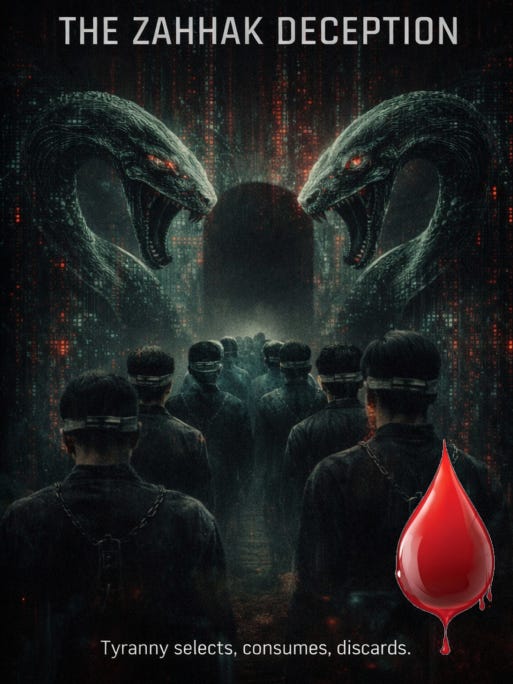
T#: RBJ-2026-02-ZAHHAK
Classification: Mytho-Political Counterintelligence Dossier
Threat Vector: Tyranny by Seduction / Cognitive Extraction Systems
Desk: Tehran — The Archive of Blood and Memory
PROLOGUE — THE SERPENT THAT NEVER LEFT
Zahhak is not a story that belongs to the past.
He is a method.
His origin is not a rumor but a canon: he comes from the Shahnameh — The Book of Kings — composed around the year 1000 CE by Abu’l-Qasim Ferdowsi, the central architect of Iranian historical memory. The Shahnameh is neither simple mythology nor pure history; it is a political, moral, and civilizational archive written in verse, where kings rise and fall according to the laws of justice, hubris, and collective fate.
Zahhak enters this epic not as a demon of folklore, but as a foreign-born ruler disguised as a reformer — a man of apparent piety, discipline, and order. In the classical reading, he is Arab by lineage, yet Persian in his methods of rule. In the modern reading, he is less a person than a recurring pattern of power.
This is the first deception.
In Ferdowsi’s account, Zahhak does not conquer Iran by force. He inherits it through betrayal. Jamshid’s court, arrogant and fractured, allows itself to be undermined from within. The throne changes hands not through rebellion, but through consent — coerced, manipulated, or complacent.
The lesson, inscribed a millennium ago, remains surgical:
Tyranny begins where vigilance ends.
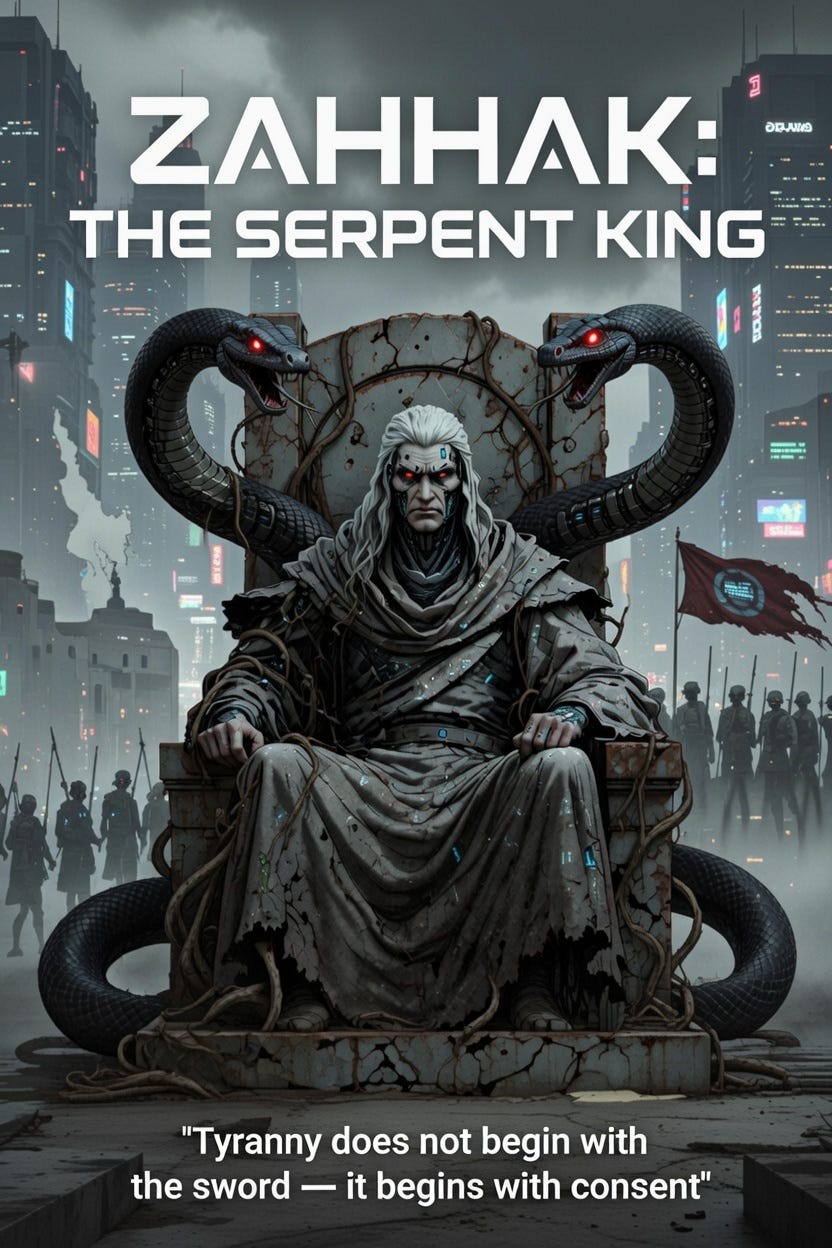
SECTION I — THE DEVIL AS COOK, POWER AS TASTE
Zahhak’s decisive transformation does not occur on the battlefield. It occurs at a table.
In the Shahnameh, Iblis — the devil — does not appear in armor. He appears as a chef.
This is not ornamental storytelling; it is political theory in narrative form.
The chef introduces meat to the royal table — roasted birds, fragrant, irresistible. Zahhak tastes them and is altered. Pleasure becomes appetite. Appetite becomes dependency. Power, like meat, seduces before it dominates.
When Zahhak, intoxicated by taste, offers a reward, the chef asks only for permission to kiss his shoulders — a “humble” request that conceals a catastrophic bargain.
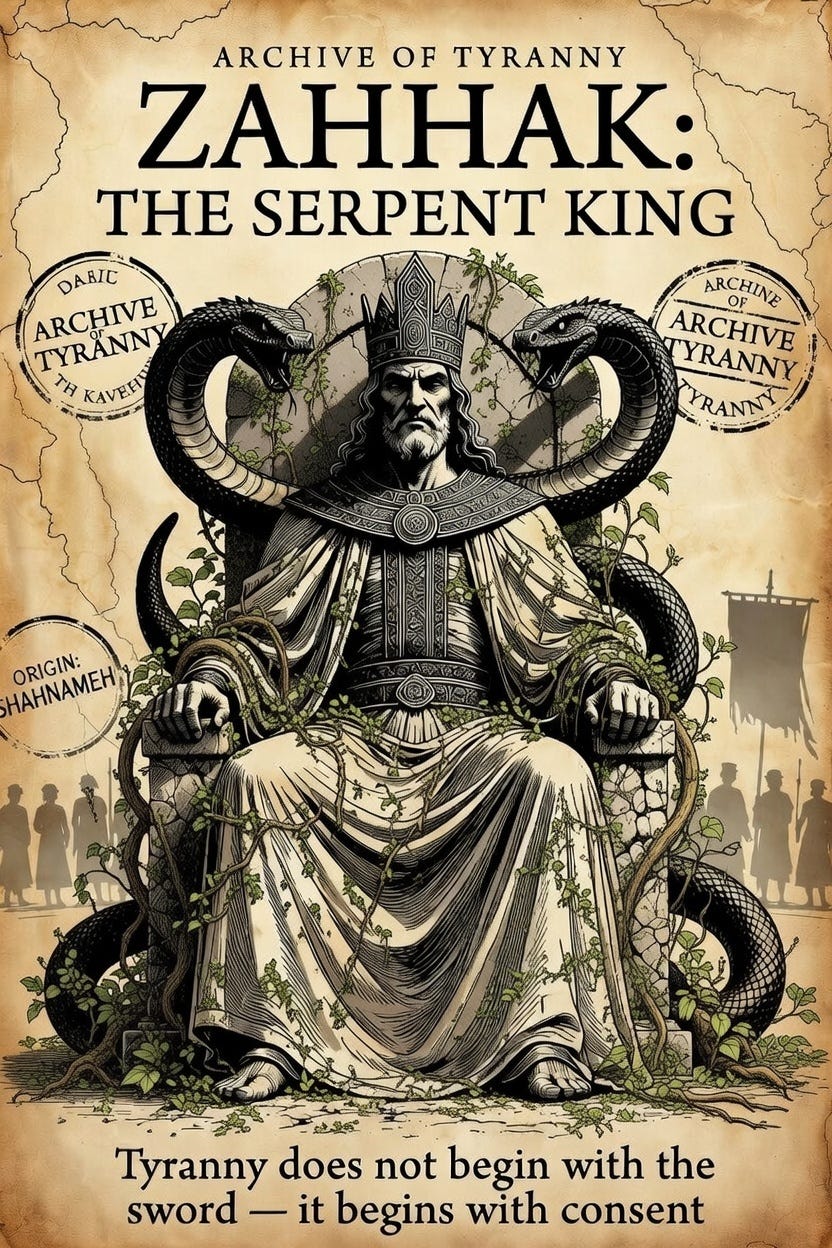
By morning, wounds open on Zahhak’s back. From them emerge two black serpents — embodiments of repression, ideological corruption, and unquenchable hunger.
The serpents do not crave gold or territory. They crave brains.
Ferdowsi encodes a precise diagnosis:
Tyrants do not merely rule bodies. They consume minds.
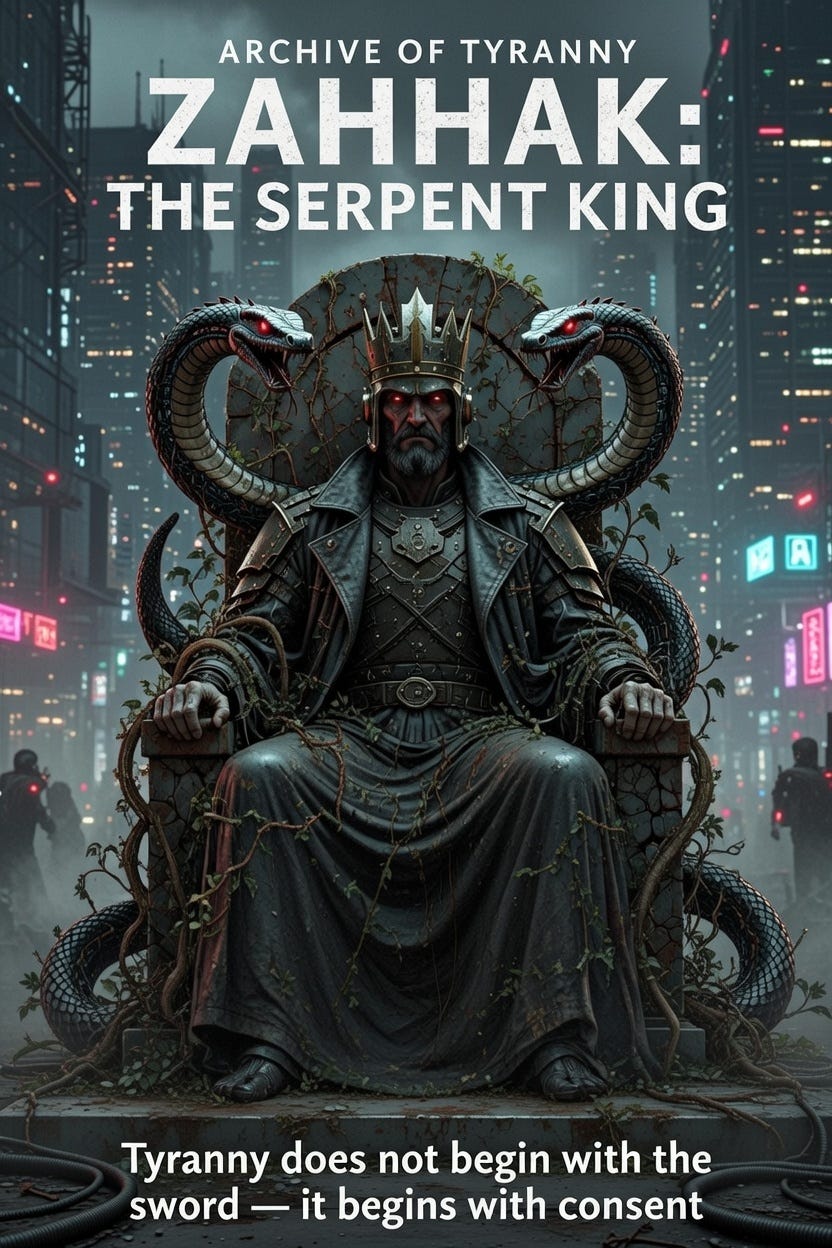
SECTION II — THE SYSTEM OF “FAIR” SACRIFICE
The serpents must be fed daily.
Zahhak does not resist; he rationalizes.
A bureaucratic mechanism is devised: each day, two young Iranians are selected by lottery to be killed so that their brains can nourish the snakes.
In the Shahnameh, the lottery is framed as impartial — not cruelty, but “procedure.”
Here lies the architecture of modern authoritarianism:
Violence dressed as neutrality.
Families breathe with relief when the lot spares them — a fleeting comfort that erodes solidarity. Each household becomes isolated in its survival, hoping the next turn does not come.
“From this pillar to that pillar lies relief,” people say — but Ferdowsi makes clear that the pillars are few, and time moves quickly.
More than seven hundred young lives vanish each year, not as punishment, but as policy.
Zahhak’s rule stabilizes. The machinery of death becomes normalized.
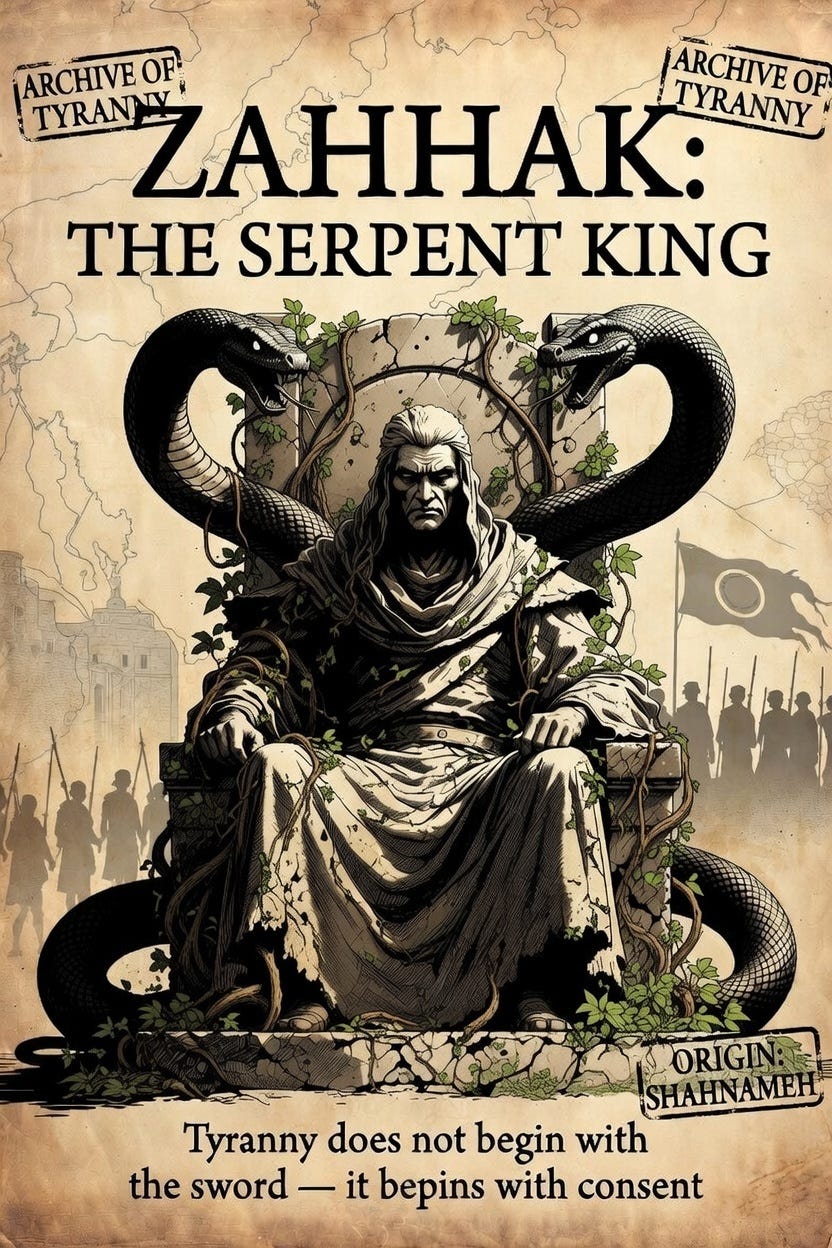
SECTION III — THE COOKS WHO SAVED HALF, AND THE PRICE OF REFORM
In the palace kitchen, two men — Armayel and Garmayel — feel a twinge of conscience.
They do not overthrow Zahhak. They do not rebel. They compromise.
Each day, they spare one youth and mix sheep’s brain with human brain to fool the serpents. Half the victims are saved — and half are still sacrificed.
Ferdowsi frames this as moral ambiguity: reform under tyranny.
A mercy that preserves the machine.
The rescued youths are sent into exile, told to disappear into the wilderness and never return. Thus, the first “brain drain” is inscribed into Iranian myth — survival through flight.
The implicit verdict of the Shahnameh is severe:
Partial justice can entrench total injustice.
SECTION IV — KAVEH, THE MOMENT OF BREAK
Zahhak eventually seeks public validation. He demands signatures declaring him a just king.
The scene in the Shahnameh resembles a staged referendum — a ritual of consent disguised as legality.
People line up. They sign. The regime accumulates legitimacy through paperwork.
Then comes Kaveh the Blacksmith.
He has lost seven sons to Zahhak’s serpents. He has nothing left to fear.
He refuses to sign. He tears the parchment. He declares Zahhak a tyrant.
In that instant, fear fractures.
Kaveh raises his leather apron on a spear — the first banner of revolt, the Drafsh-e Kaviani, born not from aristocracy but from labor, grief, and moral clarity.
Youth join him. The city stirs. The myth pivots from resignation to rebellion.
Ferdowsi crystallizes a revolutionary axiom:
A regime falls when grief becomes organized.
SECTION V — ZAHHAK AS A RECURRING PATTERN
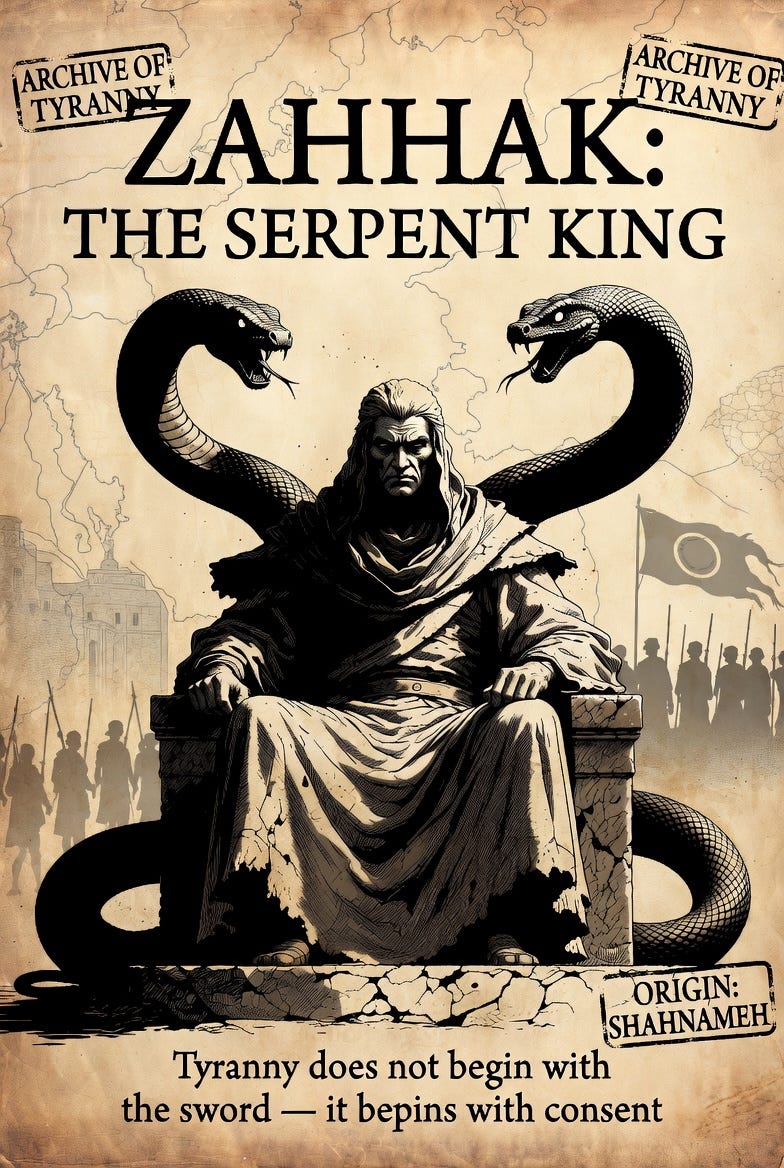
In the Shahnameh, Zahhak is not merely a villain. He is a template:
He arrives through deception, not conquest.
He legitimizes violence through ritual and procedure.
He consumes the future (youth) to preserve the present (power).
He depends on collaborators who prefer stability to justice.
He is ultimately vulnerable to collective moral rupture.
In contemporary readings — especially after Bloody January — Zahhak becomes a mirror for modern tyranny:
A ruler who claims piety while spilling blood.
A state that speaks of security while feeding on its own citizens.
A system that uses courts, lists, and statistics to sanitize massacre.
The serpents today are not literal — they are digital, military, and bureaucratic. But their appetite is identical.
SECTION VI — BLOODY JANUARY AND THE RETURN OF THE MYTH
When images of shattered skulls appeared on Iranian streets, Zahhak ceased to be metaphor. He became prophecy.
Entire families erased.
Parents killed for helping protesters.
Infants dead from deprivation after their guardians were shot.
The state published casualty lists that felt less like accounting than arithmetic designed to contain outrage.
This is Zahhak logic:
Manage the numbers. Mask the horror. Continue the ritual.
Yet something else emerged — thousands of Kavehs.
Mothers, fathers, siblings, and neighbors holding their own banners of grief. Not one blacksmith, but a nation of them.
In this sense, the Shahnameh does not predict defeat — it predicts awakening.
SECTION VII — FEREYDUN AND THE QUESTION OF LEADERSHIP
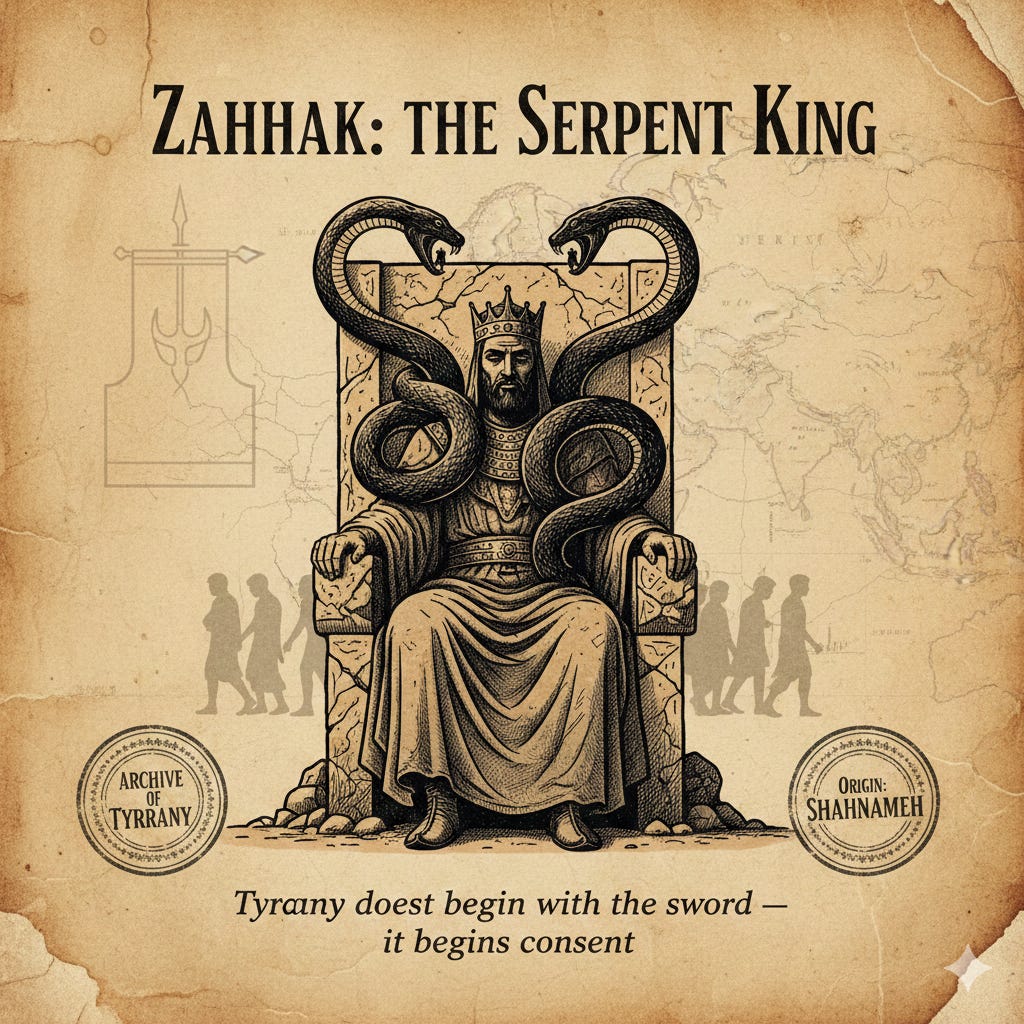
In Ferdowsi’s epic, Fereydun arrives as the force that finally overthrows Zahhak.
In the present, the figure associated with that role is Reza Pahlavi — not as an inevitable monarch, but as a symbol of transition, a rallying point for those seeking an end to the serpent’s rule.
The unresolved question remains:
Will Iranians defeat their Zahhak through their own collective action — as Kaveh did — or will foreign power strike the decisive blow?
History rarely grants pure endings.
Power rarely relinquishes itself without external pressure.
But myths endure precisely because they refuse to reduce morality to geopolitics.
ANNEX — THE COUNTERINTELLIGENCE LESSON FROM THE SHAHNAMEH
From a strategic perspective, Zahhak teaches four things:
Tyranny thrives on normality.
Violence becomes invisible when it is routine.Consent can be manufactured through ritual.
Signatures, elections, and procedures do not equal justice.Reform without rupture preserves the system.
Saving half the victims keeps the machine alive.Rebellion begins with moral refusal, not force.
Kaveh’s tear of the document is more powerful than any weapon.
EPILOGUE — WHY ZAHHAK STILL WALKS
Zahhak survives because he is adaptable.
He wears new clothes, new rhetoric, new technology — but the serpents remain.
Yet the Shahnameh also preserves a counter-truth:
No matter how vast the apparatus of fear,
one moment of collective courage can still undo it.
In every age, there is a Zahhak.
In every age, there must be a Kaveh.
🩸 END TRANSMISSION
🐍The Serpent of Power:
Anatomy of Modern Tyranny
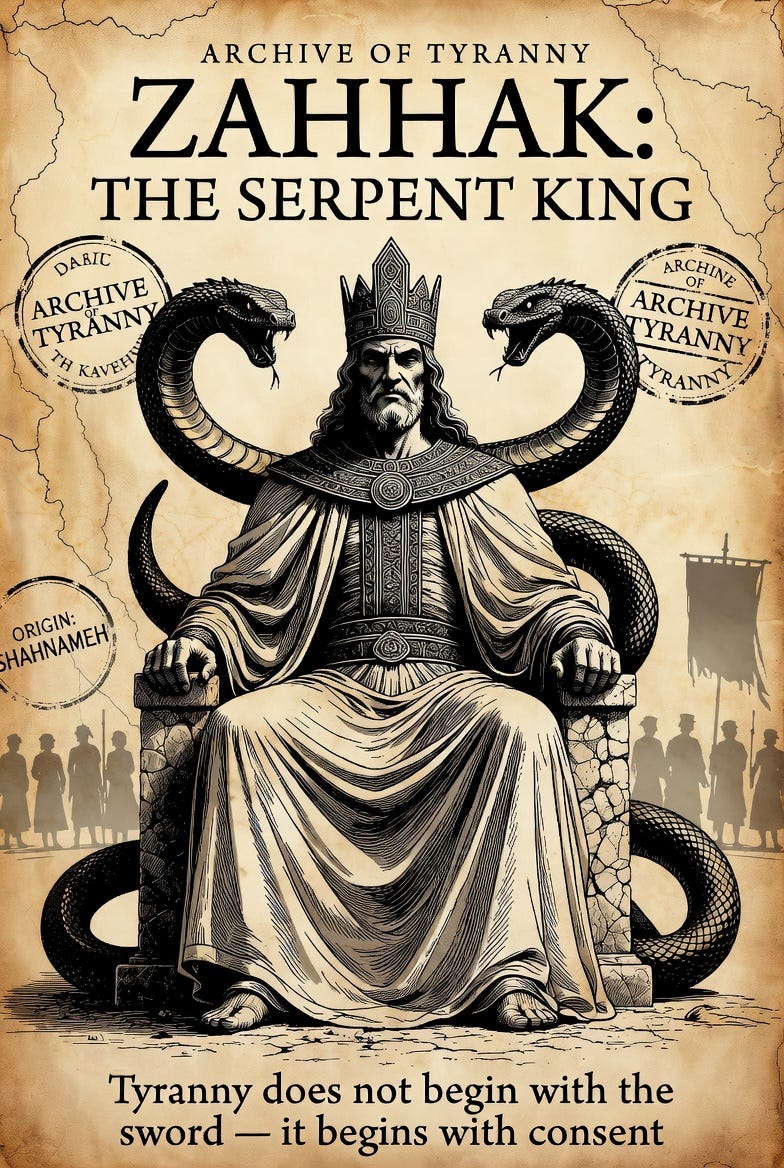
The Shahnameh’s tale of Zahhak serves as a political allegory for modern tyranny.
It depicts a ruler whose power depends on consuming the minds and lives of youth through bureaucratic sacrifice.
Resistance begins when moral refusal and organized grief overcome state fear.


