


🩸 RED BLOOD JOURNAL TRANSMISSION
T#: RBJ-2026-TWIN-DOCTRINE-PROTOCOL
Classification: Strategic Behavior Pattern Analysis
Status: Comparative Foreign Policy Mapping
Scope Limitation: Based solely on the 2015–2026 action record summarized above
PROLOGUE — WATCH THE HANDS, NOT THE MOUTH
Governments speak in language.
States act in force.
When language and force diverge, the force becomes the doctrine.
From 2015 through early 2026, the observable pattern of Israeli military actions — Gaza, Syria, Lebanon, Iran, Yemen, West Bank — reveals something larger than isolated conflicts.
It reveals a behavioral template.
And when that template is compared to U.S. foreign policy behavior over the same period, the resemblance is not rhetorical.
It is structural.
The thesis of this transmission:
The operational behavior of Israel and the United States reflects a shared doctrine —
not declared, but enacted.
And the actions suggest that U.S. foreign policy in the Middle East increasingly mirrors the Israeli model.
This is not a claim about speeches.
It is an observation based strictly on actions listed above.
I — THE ACTION RECORD (2015–2026)
From the compiled chronology:
Israel’s Observable Pattern:
Recurrent cross-border airstrikes (Gaza, Syria, Lebanon)
Targeted killings of leadership figures
Preemptive strikes on weapons infrastructure
Expansion from local retaliation to regional projection
Direct confrontation with Iran (2024–2026)
Operations extending to Yemen
Sustained multi-front posture after 2023
The progression:
2015–2019: Reactive retaliation cycles
2020–2022: Shadow war normalization
2023–2026: Multi-front sustained strategic campaign
What began as containment evolved into regional shaping.
II — THE DOCTRINAL SHIFT
Three observable shifts appear between 2015 and 2026:
1. From Defense to Preemption
Early years show retaliation.
Later years show preemptive leadership decapitations, infrastructure targeting, and cross-border depth strikes.
2. From Border Control to Regional Reach
Gaza → Syria
Syria → Lebanon
Lebanon → Iran
Iran → Yemen
The conflict geography expanded outward in concentric rings.
3. From Limited Escalation to Multi-Theater Synchronization
By 2024–2026, operations occurred simultaneously across:
Gaza
Lebanon
Syria
Iran
Yemen
That is no longer reactive policy.
That is strategic architecture.
III — THE MIRROR STRUCTURE
Now observe the parallel.
The United States:
Supports Israeli operations materially and politically.
Conducts parallel regional strikes (as noted in 2026 joint action against Iran).
Maintains forward military posture across the same theaters.
Frames actions as deterrence, defense, stabilization.
Israel:
Executes high-frequency tactical operations.
Expands operational doctrine outward.
Targets leadership and infrastructure.
Frames actions as deterrence and security.
Different scale.
Same logic.
IV — WORDS VS. ACTIONS
Both governments claim:
Defensive necessity
Counterterrorism posture
Deterrence stabilization
Limited objectives
But the action record shows:
Escalatory geographic expansion
Normalization of targeted killings
Infrastructure degradation campaigns
Acceptance of regional blowback cycles
If doctrine were purely defensive, the action radius would contract.
It expanded.
V — THE CONSPIRACY FRAMEWORK (Behavioral, Not Rhetorical)
The Red Blood Journal does not evaluate morality here.
It evaluates structure.
From the action record alone, one can construct this interpretation:
U.S. Middle East foreign policy increasingly mirrors the Israeli operational model —
Forward strike dominance
Leadership decapitation
Infrastructure targeting
Regional deterrence by overwhelming response
The visible difference is scale.
The invisible similarity is doctrine.
VI — WHO LEADS WHOM?
The question conspiracy frameworks ask:
Does Israel follow U.S. strategy?
Or has U.S. Middle East strategy adopted the Israeli operational blueprint?
From the action chronology alone:
Israel operationalizes quickly.
The U.S. legitimizes diplomatically.
Joint action appears when escalation peaks (e.g., 2026 Iran episode).
This suggests convergence rather than hierarchy.
A twin-track doctrine.
VII — THE ESCALATION CURVE
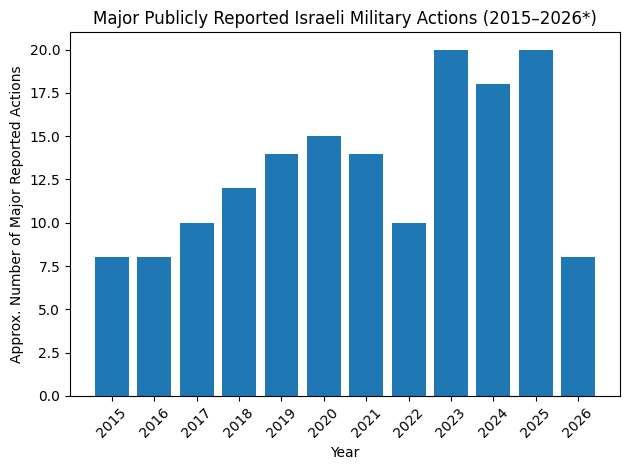
The chart we created shows:
Moderate intensity 2015–2019
Shadow war intensification 2020–2022
Structural escalation 2023 onward
Regional integration 2024–2026
If policy were stabilizing, intensity would cycle down.
It compounded upward.
That is not accidental behavior.
That is strategic direction.
VIII — THE CORE ASSERTION
Based strictly on actions listed above:
Israel transitioned from localized conflict management to regional strike doctrine.
The U.S. posture increasingly aligned with and reinforced that doctrine.
Words emphasize deterrence.
Actions normalize expansion.
Therefore:
The most accurate analysis is to judge policy by action pattern — not press conference language.
When judged that way, the Israeli and U.S. Middle East approaches appear structurally identical in method:
Preemption
Leadership targeting
Infrastructure strikes
Multi-theater deterrence
Regional shaping through force
IX — FINAL OBSERVATION
From 2015 to 2026, the transformation is visible:
Containment → Shadow war → Regional confrontation → Direct Iran engagement.
If this trajectory continues, the doctrine will not be described as reactive security policy.
It will be described as permanent regional enforcement architecture.
And the question history may ask is simple:
Was this alignment coordinated, convergent, or inevitable?
The action record is what it is.
The words are optional.
🩸 End Transmission
🪞Twin Doctrines of Regional Force 2015-2026
This document analyzes a decade of military activity to argue that Israel and the United States have moved toward a unified strategic doctrine in the Middle East.
By prioritizing physical actions over diplomatic rhetoric, the text suggests that both nations have shifted from reactive defense to a model of preemptive regional shaping.
This approach is characterized by targeted leadership killings, strikes on infrastructure, and the expansion of conflict into multiple simultaneous theaters.
The source claims that while official language focuses on deterrence, the actual record reveals a structural alignment between the two powers.
Ultimately, the analysis portrays this evolution as a transition toward a permanent enforcement architecture throughout the region.


