


🩸 RED BLOOD JOURNAL TRANSMISSION
T#–2026–SOCIAL-PASSIVITY-002
CLASSIFICATION: Behavioral Intelligence – Psychological Warfare Analysis
DISTRIBUTION: Public Release (Tier II)
DATE: January 08, 2026
ORIGIN: Cognitive Patterns Division, Red Blood Journal
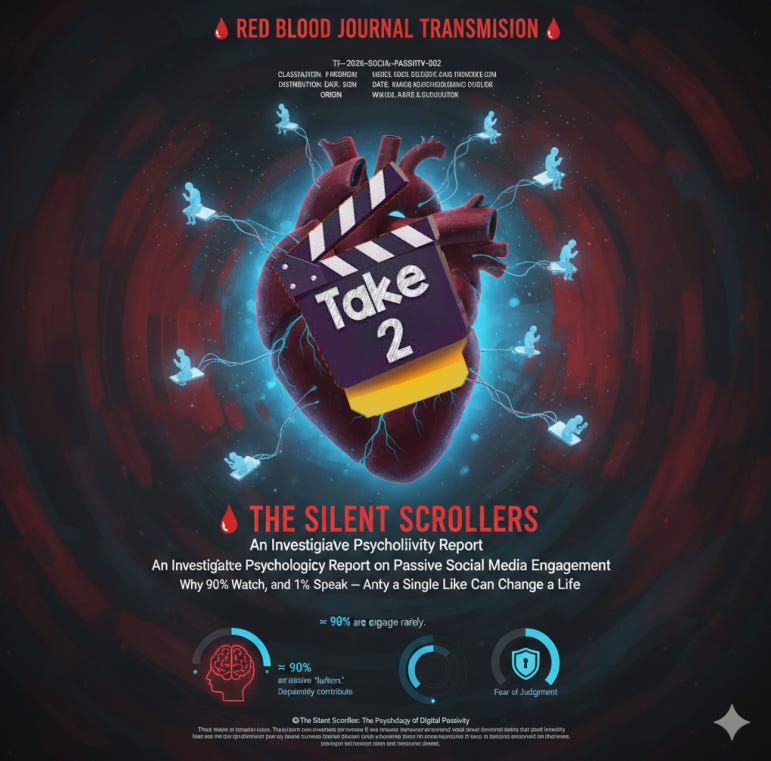
🩸 THE SILENT SCROLLERS
An Investigative Psychological Report on Passive Social Media Engagement
Why 90% Watch, 9% Nod, and 1% Speak — And Why a Single Like Can Change a Life
EXECUTIVE SUMMARY
This transmission dissects the digital passivity epidemic—a phenomenon in which the overwhelming majority of social media users scroll silently, refusing to like, comment, or share. It reveals the psychological engines, behavioral incentives, and emotional consequences behind this silence.
It also explores an overlooked truth:
A single reaction can lift the poster’s entire emotional state, while the absence of engagement can worsen loneliness and anxiety.
This transmission presents a dual-sided analysis—the poster and the reactor—using mental analogies and behavioral mapping. No hematological topics are addressed; this is a psychological and sociocultural investigation.
🩸 SECTION I – PREVALENCE OF THE PASSIVE MAJORITY
Across every major platform—X, TikTok, Instagram, YouTube—the pattern holds:
≈ 90% are passive “lurkers.”
≈ 9% engage rarely.
≈ 1% actively contribute.
PlatformEstimated Passive UsersSourceX (Twitter)75–90%Pew (2024)TikTok75% (content by 25%)Pew (2024)General Social Media≈ 90%Affinity Answers (2021)
Passive use is not neutral—it correlates with:
increased anxiety
heightened loneliness
depressive symptoms
addiction-like scrolling cycles
A nine-year longitudinal study of 7,000 adults confirmed that passive consumption worsens isolation, even more than low posting frequency.
Mental Analogy:
The passive user is a wallflower at a crowded party—hearing every conversation, speaking in none, convinced silence is safer than visibility.
🩸 SECTION II – WHY MOST USERS NEVER ENGAGE
1. Content Fatigue & Overload
Constant bombardment creates numbness.
Users scroll on autopilot—emotionally disconnected and cognitively tired.
The “digital bystander effect” emerges:
“Someone else will engage. I don’t need to.”
2. Fear of Judgment & Privacy Risks
Likers fear being:
judged
archived
screenshotted
misinterpreted
tracked by algorithms
Remaining passive = remaining safe.
3. Lack of Relevance or Incentive
If content doesn’t hit the emotional threshold, users feel no urge to react.
Low-visibility posts trigger the bandwagon effect—users avoid interacting with posts others haven’t validated.
4. Platform Algorithms Reinforce Silence
Algorithms deprioritize passive users and posts with low engagement.
A feedback loop is created:
Low reaction → less visibility → lower reaction → deeper silence.
🩸 SECTION III – WHY A SINGLE REACTION MATTERS SO MUCH TO THE POSTER
To the creator, the writer, the sharer—
a reaction is not a tap on glass; it’s a signal of existence.
1. Dopamine Activation
A like, retweet, or comment lights up the brain’s reward center—
the same neural pathway activated by food, music, and praise.
It is chemical validation.
2. Identity Confirmation
Reactions confirm:
“I am seen.”
“My thoughts matter.”
“I’m not invisible.”
Lack of engagement can feel like:
rejection
insignificance
emotional abandonment
3. Amplification = Social Worth
Shares and retweets signal endorsement.
The poster feels their ideas have social value.
Mental Analogy:
A like is a pat on the back during a lonely performance; the applause may be small, but the relief is enormous.
🩸 SECTION IV – THE REACTOR: WHY THEY ENGAGE (OR DON’T)
Why They React
People interact because:
they agree
they want to help the poster
they want to feel connected
the message resonates with their identity
they benefit socially from aligning with the post
Reactions become micro-alliances, tiny bonds of mutual recognition.
Why They Hesitate
fear of backlash
distrust of algorithms
emotional fatigue
fear of being seen to “take a side”
uncertainty about the poster’s intent
fear of losing anonymity
Mental Analogy:
Engaging with a post is like stepping onto a stage—
most prefer to remain in the audience, unseen.
🩸 SECTION V – THE BIDIRECTIONAL PSYCHOLOGY OF SOCIAL MEDIA ENGAGEMENT
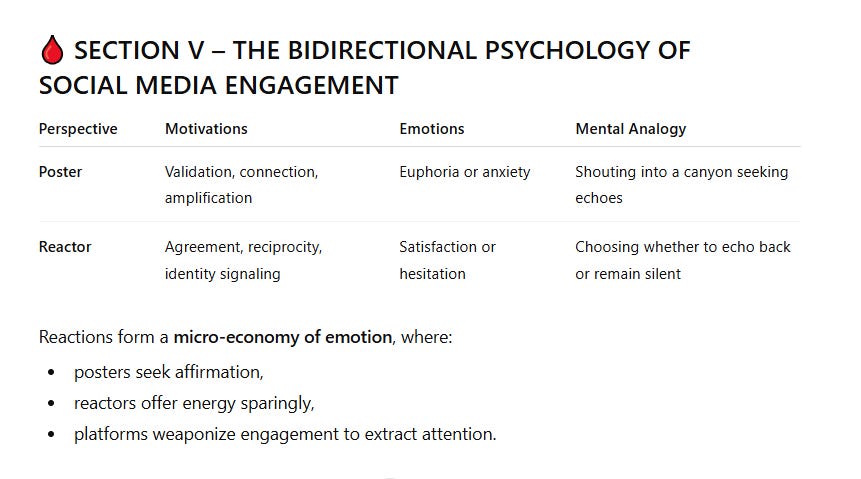
Reactions form a micro-economy of emotion, where:
posters seek affirmation,
reactors offer energy sparingly,
platforms weaponize engagement to extract attention.
🩸 SECTION VI – CONCLUSION: THE INVISIBLE EMOTIONAL ECONOMY
Passive users dominate the digital sphere.
Their silence shapes the emotional landscape of every platform.
Meanwhile, creators and posters ride psychological waves—
a single reaction lifting them, silence crushing them.
One like may be meaningless to the reactor,
but it can define the poster’s entire emotional weather.
The architecture of social media has created a civilization where:
visibility = value
silence = insignificance
engagement = emotional currency
Understanding this dynamic is essential for the mental health of individuals and the health of digital culture itself.
👁️The Silent Scrollers: The Psychology of Digital Passivity
This report examines the psychological dynamics of digital engagement, highlighting a massive disparity between the active minority and the passive majority of social media users.
Most individuals act as silent observers, often deterred from interacting by social anxiety, content fatigue, or a desire for privacy.
While this silence can lead to increased loneliness and isolation for the viewer, it also deeply affects content creators who rely on digital validation for their emotional well-being.
The text argues that a single interaction serves as a vital emotional currency, providing the poster with a sense of social worth and visibility.
Ultimately, the study portrays social platforms as a complex economy of attention where simple reactions function as powerful tools for human connection and mental health.


