


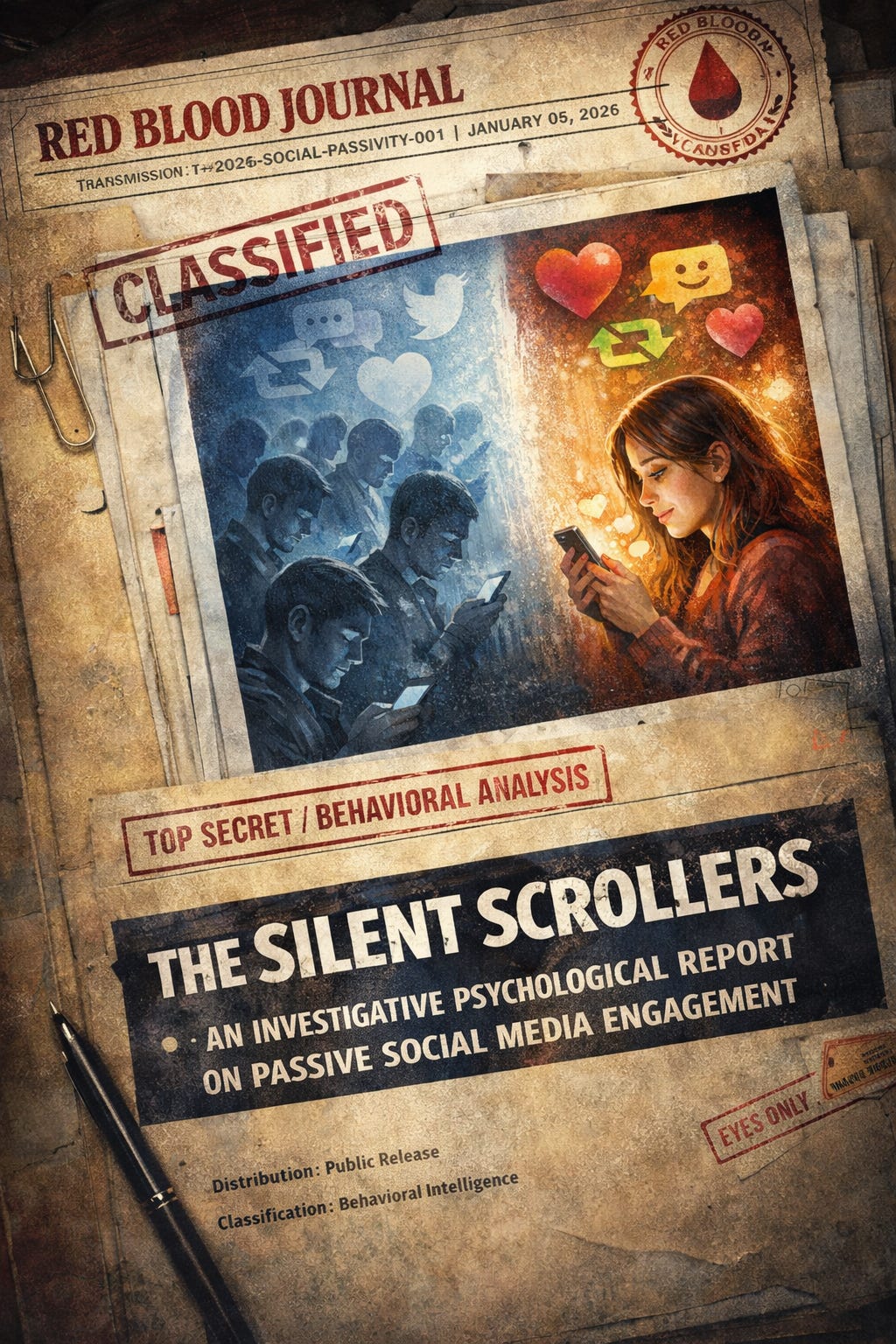

🩸 RED BLOOD JOURNAL TRANSMISSION
T#-SOCIAL-2026-001
CLASSIFICATION: Open Psychological Analysis – Cultural Behavior Mapping
SUBJECT: The Silent Majority of Social Media: Why Most Scroll, Few React, and How a Single Click Becomes Emotional Currency
DATE: January 08, 2026
ORIGIN: Behavioral Intelligence Desk – Red Blood Journal
🩸 REPORT: THE PASSIVE MASSES & THE POWER OF A SINGLE REACTION
In the digital coliseum of the 21st century—where billions gather to watch, judge, and perform—an astonishing pattern emerges:
the vast majority of users remain silent.
They scroll. They consume. They watch. But they rarely react.
Meanwhile, for the small minority who create, post, and expose pieces of their emotional world, even one like, retweet, or comment becomes a microscopic but meaningful pulse of validation—an invisible handshake between sender and receiver.
This report dives into why, on both sides:
why most do not engage,
and why it means so much to those who do.
I. THE PASSIVE MAJORITY: A DIGITAL CROWD OF GHOSTS
Studies across all major platforms show:
✔ 90% only consume content
✔ 9% occasionally interact
✔ 1% consistently post or engage
This is not random. There are deep psychological, cultural, and evolutionary reasons for this lopsided digital pyramid.
1. Fear of Exposure
Most people instinctively avoid situations where their opinion can be judged, mocked, or archived forever.
Online, every reaction feels like:
a receipt,
a public stance,
a potential conflict,
or a record that can be used against them.
The passive majority think:
“If I don’t comment, I can’t be criticized.”
This avoidance of risk is ancient—wired into human survival instincts.
2. The Bystander Effect (Digital Edition)
When thousands have already viewed a post, the passive user assumes:
“Someone else will comment. Someone else will say what I’m thinking.”
The more visible a post becomes, the less likely average users feel responsible to act.
3. Internal Emotional Inertia
Scrolling creates a trance-like state:
A dopamine drip of micro-entertainment.
This leads to:
low emotional activation,
low motivation,
mental fatigue,
disconnection between intention and action
(“I liked that… but didn’t press Like.”)
4. Social Media as Passive Consumption, Not Dialogue
To most users, social media is a television, not a community.
They consume content like watching a show—not participating in conversation.
II. THE EMOTIONAL ECONOMY OF REACTIONS
To the poster—the creator, the narrator, the risk-taker—a reaction is not just a click.
It is a signal.
A micro-dose of human connection.
A confirmation that someone out there saw me.
1. “Like”: Acknowledgment
A like says:
“I see you.”
“I read this.”
“You’re not invisible.”
That alone can change the emotional tone of someone’s entire day.
For many creators, silence feels like:
irrelevance
rejection
invisibility
“screaming into the void”
A like breaks the void.
2. “Retweet / Share”: Agreement or Amplification
A share is more intimate than a like—it says:
“Your thought is strong enough to represent mine.”
It activates the poster’s tribal brain, signaling alliance and shared identity.
3. “Comment”: Emotional Dialogue
A comment is the highest form of digital engagement.
It means someone:
thought about you
paused their life
typed their mind
took a cognitive risk
To the poster, a comment feels like a small gift.
III. WHY POSTERS REACT SO EMOTIONALLY TO FEEDBACK
Because posting is exposure.
A silent audience feels like a wall.
Any reaction feels like connection.
1. Humans are wired for feedback loops
Our emotional circuits evolved for face-to-face tribal living.
Digital platforms hijack these circuits.
Every reaction triggers:
dopamine (reward)
oxytocin (connection)
serotonin (status confirmation)
This is why a single like can make someone’s morning.
2. Posting is vulnerability
To post is to risk:
judgment, ridicule, misunderstanding.
So reactions—especially positive ones—serve as safety signals to the brain.
3. The “Digital Mirror” Phenomenon
People subconsciously measure self-worth through reactions:
More likes = “I matter.”
No likes = “Nobody cares.”
Negative comments = “Maybe I shouldn’t speak.”
Thus, posters are emotionally invested—even when they pretend not to be.
IV. THE SILENCE OF CROWDS: WHY THEY DON’T ENGAGE EVEN WHEN THEY CARE
Here is the paradox:
People often feel something—but still do nothing.
1. Emotional Decoupling
A passive user may enjoy a post but does not want to reveal themselves.
It’s private appreciation.
2. Learned Digital Helplessness
Years of using social media trains the brain to be a spectator, not a participant.
They think:
“What difference does my like make?”
Not understanding:
It makes a world of difference to the poster.
3. Suspicion and Cynicism
Some people intentionally avoid reacting:
They think reacting helps the algorithm “control them.”
They don’t want to boost anyone’s “ego.”
They fear personal exposure.
They simply don’t want to be seen.
V. BOTH SIDES: EMOTIONAL ANALOGY & MENTAL DYNAMICS
For the Passive User
Avoidance
Fear of exposure
Emotional inertia
Spectator behavior
For the Active Poster
Vulnerability
Search for connection
Craving acknowledgment
Emotional investment
These two psychological states collide on the battlefield of social media, creating:
millions who feel unseen
billions who remain silent
a society where digital expressions carry emotional weight disproportionate to their size
VI. CONCLUSION: THE INVISIBLE WAR FOR ATTENTION AND CONNECTION
The silent majority believes their lack of reaction means nothing.
But to the active minority—the creators, the truth-speakers, the people sharing a piece of their mind or heart—
a single reaction is a signal flare in the night.
It says: “I’m here. I heard you.”
Social media may be a cold machine,
but the micro-reactions within it remain deeply human.
The_Psychology_of_Digital_Silence_and_Engagement
👁️The Digital Mirror: Validation in the Age of Silence
Modern digital culture is defined by a sharp divide between a massive, passive audience and a tiny fraction of active creators.
This analysis suggests that most users remain silent observers due to a fear of social judgment, the psychological bystander effect, or a simple habit of consumer inertia.
Conversely, those who choose to post experience significant vulnerability, making every digital interaction—whether a like or a comment—a vital form of validation.
To the creator, these small gestures act as emotional currency that breaks the isolation of the “digital void.”
Ultimately, the text illustrates how micro-reactions serve as essential human signals in an increasingly detached online landscape.


