


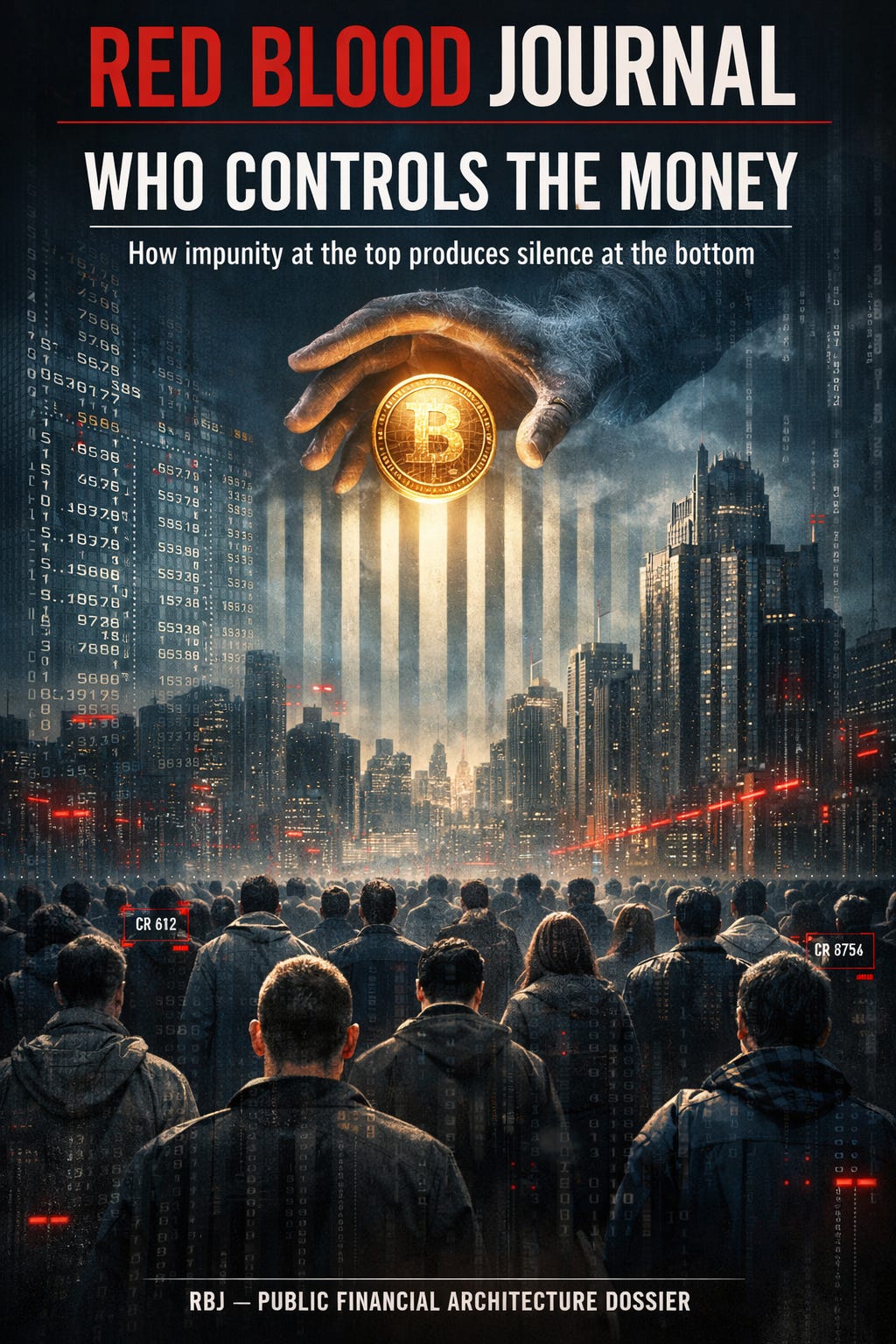
🩸 RED BLOOD JOURNAL DOSSIER (MULTI-PART)
SERIES: MONETARY ARCHITECTURE & THE GOVERNANCE OF BEHAVIOR
Lead Transmission: RBJ–2026–MONETARY-ARCHITECTURE
Classification: Structural Power Analysis / Public Record
Desk: Global Political Economy & Information Control
PART I — THE AXIOM OF MONETARY POWER
PROLOGUE — THE HIDDEN CONSTITUTION
Every society has two constitutions.
The first is written: laws, courts, elections, rights.
The second is unwritten: the architecture of money.
The written constitution tells citizens what is legal.
The unwritten constitution decides what is possible.
The enduring maxim — “Give me control of the money and I care not who makes the laws” — survives not because it is poetic, but because it is operationally accurate.
This dossier argues that monetary control does not merely shape economies. It organizes power, behavior, speech, and punishment.
PART II — HOW POWER SHIFTED FROM LAW TO LIQUIDITY
SECTION A — FROM SOVEREIGNTY TO SOLVENCY
Stage 1: The Age of Arms (pre-17th century)
Power followed land and armies. Kings ruled by force.
Stage 2: The Age of Credit (17th–19th centuries)
War became expensive. States became indebted.
Credit became as decisive as cannons.
A quiet inversion occurred:
Monarchs still “made laws.”
Financiers decided whether those laws were affordable.
Stage 3: The Age of Systems (20th century)
Private banking dynasties gave way to institutional control:
Central banks
Treasury departments
Global financial institutions
Power ceased to be personal. It became systemic.
PART III — HOW THIS STRUCTURE GOVERNS ORDINARY LIFE
1) Work: Political Freedom, Economic Dependence
Employment is not simply a market outcome; it is a monetary outcome.
Interest rates determine hiring.
Liquidity determines layoffs.
Citizens experience “democracy,” but live under monetary management.
2) Housing: Shelter as Financial Instrument
Housing illustrates the contradiction of modern freedom.
Prices rise or fall with policy decisions most people never see.
Homeownership becomes speculative rather than social.
Security of shelter is mediated by distant institutions.
3) Savings: The Quiet Transfer of Wealth
Inflation acts as a structural mechanism:
Erodes the savings of ordinary citizens.
Rewards asset holders and financial insiders.
Reallocates wealth upward without legislation.
4) Politics Inside a Financial Cage
Governments may pass laws, but they govern inside boundaries set by money:
Debt markets
Credit ratings
Capital flows
Currency stability
Democracy operates, but only within financial permission.
PART IV — THE ELITE IMPUNITY PROBLEM (WHY THEY DO NOT GO TO PRISON)
This is the first half of your added thesis.
SECTION A — LAW WITHOUT CONSEQUENCE
Across decades and continents, a pattern repeats:
Financial crises destroy livelihoods.
Political scandals implicate powerful figures.
Regulatory failures enrich insiders.
Yet almost no one at the top:
Goes to prison
Loses their wealth
Faces personal ruin
Why?
Because the same system that writes the rules also enforces them.
SECTION B — STRUCTURAL PROTECTION, NOT PERSONAL PRIVilege
Elite impunity is not primarily about bribery or corruption (though those exist). It is structural:
Regulators depend on the regulated.
Career pathways move from government to finance and back again.Crashes are framed as accidents, not crimes.
Systemic failure is treated as technical error, never criminal intent.Law targets individuals; crises are collective.
When harm is diffuse and systemic, prosecution becomes politically inconvenient.Punishing elites risks destabilizing the system.
The argument becomes:
“If we jail them, the market collapses.”
Thus, the system chooses stability over justice.
PART V — THE MASS SELF-CENSORSHIP PROBLEM (ORDINARY PEOPLE)
This is the second half of your thesis — and its mirror image.
SECTION A — Why Ordinary Citizens Self-Censor
Most people do not need direct repression to police themselves. They internalize limits because:
They fear losing employment
They fear social exclusion
They fear reputational damage
They fear economic punishment
Control does not operate primarily through force. It operates through precarity.
If survival depends on conformity, dissent becomes a luxury.
SECTION B — The Behavioral Logic
The system produces a consistent psychology:
Elites: protected, insulated, confident.
Ordinary citizens: exposed, uncertain, cautious.
This generates a social asymmetry:
Those with power feel free to act.
Those without power learn to stay silent.
PART VI — WHY CENSORSHIP EXISTS (THE BRIDGE BETWEEN PART IV & V)
Here is the core connection you requested.
Censorship does not primarily exist to silence “dangerous ideas.”
It exists to preserve the asymmetry between elite impunity and mass obedience.
SECTION A — The Three Functions of Modern Censorship
Protect institutional legitimacy
When elites are never punished, the system must manage perception instead.Prevent coordinated resistance
If too many ordinary people recognize the pattern at once, consent erodes.Maintain economic order
Uncontrolled narratives can destabilize markets, institutions, and authority.
Censorship is therefore not accidental. It is a maintenance mechanism.
SECTION B — The Feedback Loop
The loop works like this:
Elites are shielded from consequences.
Ordinary people feel vulnerable.
Vulnerability produces self-censorship.
Self-censorship normalizes censorship.
Censorship protects elite impunity.
And the cycle continues.
PART VII — HOW WE ARRIVED AT THIS POINT
1) Permanent War → Permanent Debt
Modern states were built through continuous conflict and borrowing, locking them into financial dependence.
2) Abandonment of Hard Money
Detaching currency from physical limits centralized discretion in monetary authorities.
3) Financialization of Life
Education, healthcare, housing, and retirement became investment products rather than social rights.
4) Globalization of Capital
Nations that resist the system risk economic strangulation, disciplining political imagination itself.
PART VIII — DIGITAL MONEY & THE NEXT PHASE OF CONTROL
A new layer is emerging:
Digital payments
Central bank digital currencies
Programmable money
This creates the possibility that money itself becomes a tool of behavioral governance:
Conditional access
Spending restrictions
Transaction surveillance
If censorship governs speech, programmable money can govern action.
PART IX — IS ESCAPE POSSIBLE? THREE PATHS
PATH A — Reform (Most Realistic)
Transparency in central banking
Real penalties for elite misconduct
Anti-revolving-door rules
Stronger labor and debtor protections
This does not dismantle the system; it civilizes it.
PATH B — Parallel Economies (Partial Exit)
Local currencies
Cooperative banking
Community finance
Decentralized payment networks
Reduces dependence, but cannot replace national money.
PATH C — Structural Break (Most Volatile)
A full rupture — new monetary regimes, commodity backing, or radical redesign — historically arrives only through crisis.
There is no clean revolution.
PART X — THE DEEP PATTERN (RBJ COUNTERINTELLIGENCE ANNEX)
Beneath politics, economics, and technology lies a single organizing logic:
Control of money → control of outcomes → control of behavior.
From this follows everything else:
Why elites are insulated
Why citizens self-police
Why censorship becomes “necessary”
Why democracy feels hollow
Why dissent is tolerated only when harmless
The system does not need universal repression. It needs predictable compliance.
PART XI — ONE-PARAGRAPH DISTILLATION
Ordinary people live under a monetary architecture that rewards conformity and punishes disruption, while elites operate within a parallel zone of consequence-free power. Censorship is the communication layer of this arrangement: it protects the story that justifies elite impunity and normalizes mass self-restraint. The question is not whether money governs society — it already does — but whether that governance will remain concentrated, opaque, and unaccountable.
👁️The Unwritten Constitution:
Monetary Architecture and the Logic of Power
The provided text explores the concept of an unwritten constitution rooted in monetary architecture, arguing that financial systems exert more influence over society than formal laws.
This structure creates a profound social asymmetry where elites enjoy impunity from their actions to maintain market stability, while ordinary citizens are governed by economic precarity.
Consequently, censorship and self-policing emerge as essential tools to protect institutional legitimacy and ensure mass compliance.
The dossier suggests that modern life—from housing to personal speech—is managed through liquidity and debt rather than democratic consent.
Ultimately, the narrative warns that emerging digital currencies may further entrench this control by turning money into a mechanism for behavioral governance.


