


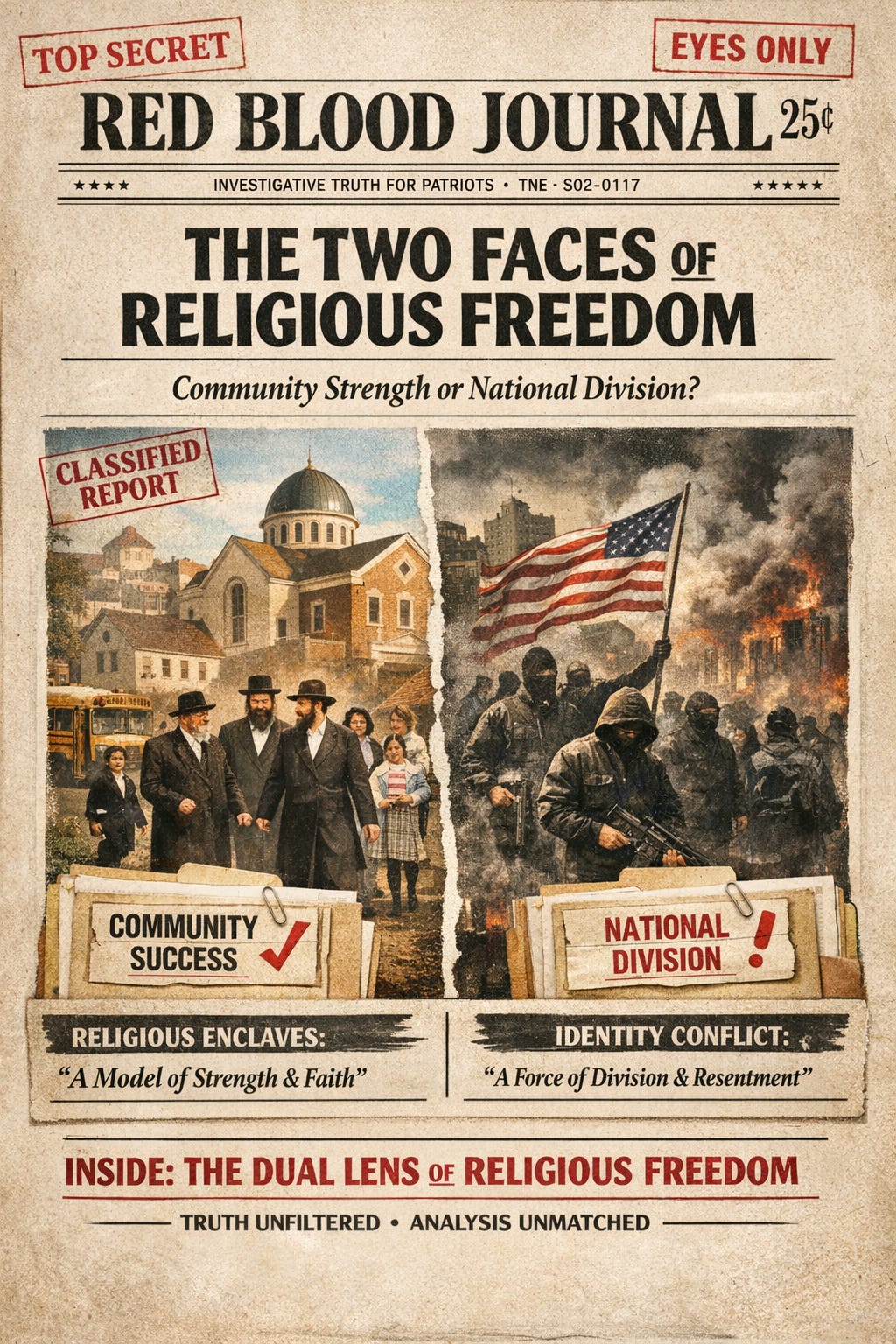
🩸 RED BLOOD JOURNAL TRANSMISSION
T#: RBJ-2026-01-17-DUALPERSPECTIVE-RELIGIOUS-FREEDOM
Classification: Civilizational Analysis – Identity Conflicts & Legal Architecture
Desk: Socio-Legal Dynamics & National Cohesion Unit
Status: APPROVED FOR PUBLIC RELEASE
THE TWO FACES OF RELIGIOUS FREEDOM
How One Law Creates Both Community Strength and National Division
PROLOGUE – THE PARADOX AT THE HEART OF AMERICA
Religious freedom is often presented as America’s most sacred principle — the flag draped over the soul.
It protects prayer, conscience, community, and tradition.
But what happens when the same freedom that empowers one community
is perceived by others as a weapon of division, favoritism, or demographic replacement?
What happens when religious identity becomes a shield
while racial identity becomes a crime scene?
What happens when two groups look at the same legal framework and see opposite realities?
This Transmission examines this paradox through two distinct interpretive lenses — a positive-realistic lens and a critical, harm-focused lens — and reveals how both contain truth.
The goal is not to choose a side.
The goal is to educate, by exposing the architecture of the debate.
I. TWO INTERPRETATIONS OF THE SAME REALITY
Below are the two dominant views regarding communities like Kiryas Joel — and, by extension, any religious enclave operating under American law.
These are not opinions.
They are structural worldviews.
VIEW 1: The Positive-Realistic Lens
“Religious freedom strengthens communities.”
This interpretation sees religious enclaves as success stories:
Low crime
High family stability
Deep social cohesion
Robust charity networks
Volunteer-run services (EMS, security, fire response)
Cultural continuity through private schools
High resilience in crises
Minimal burden on outside institutions
From this view:
Religious enclaves are not a threat — they are a model of how to build strong, moral, self-regulated communities in a chaotic world.
This worldview admires:
Discipline
Modesty
Family-centric life
Religious devotion
Mutual aid
Volunteerism
Shared values
It sees religious freedom as a shield that protects virtue.
VIEW 2: The Critical-Harm Lens
“Religious freedom fractures national unity and creates structural favoritism.”
This interpretation focuses on what religious freedom permits, not merely on what it protects:
Parallel schooling
Closed cultural ecosystems
Minimal integration with broader society
Language barriers
Social insulation
Politically unified voting blocs
Economies run internally
Housing practices that favor insiders
Hidden asymmetry between religious identity (protected) and white identity (restricted)
This lens sees religious freedom as:
A legal loophole that allows some groups to build fortified enclaves while preventing secular or white-identified communities from doing the same.
From this worldview:
Religion receives special constitutional protection
Race receives special legal restriction
Result: asymmetry
And asymmetry → resentment, misunderstanding, division
To this lens, religious enclaves are not “cultural treasures.”
They are centrifugal forces, pulling society apart.
II. WHAT EXPLAINS THE DIFFERENCE?
The difference does not come from facts — the facts are the same.
The difference comes from what the observer believes society should be.
Two competing models of civilization collide here:
MODEL A: The Patchwork Nation
“Small tribes, big country.”
This model values:
Cultural diversity
Self-governance
Religious autonomy
Parallel communities
Identity plurality
Under this vision:
A town of Hasidic Jews
A city of Somali Muslims
A Mennonite farming village
A Catholic enclave
A Buddhist monastery community
…are all examples of healthy pluralism.
MODEL B: The Shared Civic Nation
“One people under one flag.”
This model values:
Integration
Shared public schools
Common language
Unified symbols
Uniform civic identity
Under this view, religious enclaves are:
Fragmentary
Separatist
Parallel civilizations
Demographically competitive
Threats to the national center
Neither model is wrong.
Both are incomplete.
III. WHERE THE TWO VIEWS AGREE
Despite their differences, both perspectives converge on three truths:
1. Religious Freedom Is a Force Multiplier
It amplifies whatever community uses it.
If a group is cohesive → religious freedom strengthens it.
If a group is fragmented → religious freedom exposes fragmentation.
2. It Creates Practical Inequality
Not by intent — by structure.
Religious groups can:
Build institutions
Police morality
Self-govern internally
Preserve cultural identity
Secular majorities cannot.
The law protects belief, not blood.
And that difference creates tension.
3. It Produces Identity Competition
Because:
Religious groups can claim exemptions
Secular groups cannot
Race-based identity is prohibited
Religion-based identity is protected
The result is asymmetric legitimacy:
A religious Jewish, Muslim, Amish, Mormon, or Christian community can self-concentrate legally.
A “white-majority cultural community” cannot frame itself using the same legal shield.
This is the fault line where both worldviews collide.
IV. THE DEEPER PARADOX
Religious freedom was intended to:
Prevent oppression
Prevent forced assimilation
Protect conscience
Enable nonviolent coexistence
But in a modern, diverse, demographic landscape, it also:
Hardens tribal lines
Complicates integration
Creates protected enclaves
Generates resentment from groups without equivalent protections
This is not the failure of religious people.
This is the structural paradox of the law itself.
V. SYNTHESIS: A MORE EDUCATED UNDERSTANDING
The true insight — the one the reader must walk away with — is this:
Religious freedom is not inherently good or bad.
It is a civilizational accelerant.
It strengthens:
Trust
Cohesion
Tradition
Moral codes
Community resilience
It also intensifies:
Division
Identity asymmetry
Social fragmentation
Perceived favoritism
Political tribalism
Its impact depends on:
Who wields it
How cohesive they are
What demographic environment surrounds them
What ideological narratives circulate through the nation
To understand America today, you must understand both faces of religious freedom.
One face builds communities.
The other fractures empires.
EPILOGUE – THE QUESTION AMERICA MUST ANSWER
In the end, the United States must confront a deeper, unavoidable question:
Can a multi-religious, multi-ethnic nation survive
when its laws allow some groups to fortify themselves,
while denying the majority an equivalent civic identity?
Or:
Can pluralism endure
without dissolving the shared identity that binds a nation together?
Both lenses offer part of the truth.
Only by studying their differences can a reader understand the whole.
⚖️The Dual Architecture of Religious Freedom
This analysis explores the dual nature of religious freedom in America, framing it as both a source of communal strength and a catalyst for national fragmentation.
Through two distinct lenses, the text examines how legal protections allow faith-based enclaves to flourish with high cohesion and self-sufficiency while simultaneously creating social and legal asymmetries.
While one perspective celebrates these communities as models of moral resilience, the other views them as secessionist forces that undermine a unified civic identity.
Ultimately, the source argues that religious liberty acts as a civilizational accelerant that amplifies tribalism and highlights the tension between pluralistic autonomy and national integration.
By contrasting these worldviews, the document challenges readers to consider whether a country can maintain stability when its laws protect religious identity more robustly than secular or racial associations.


