


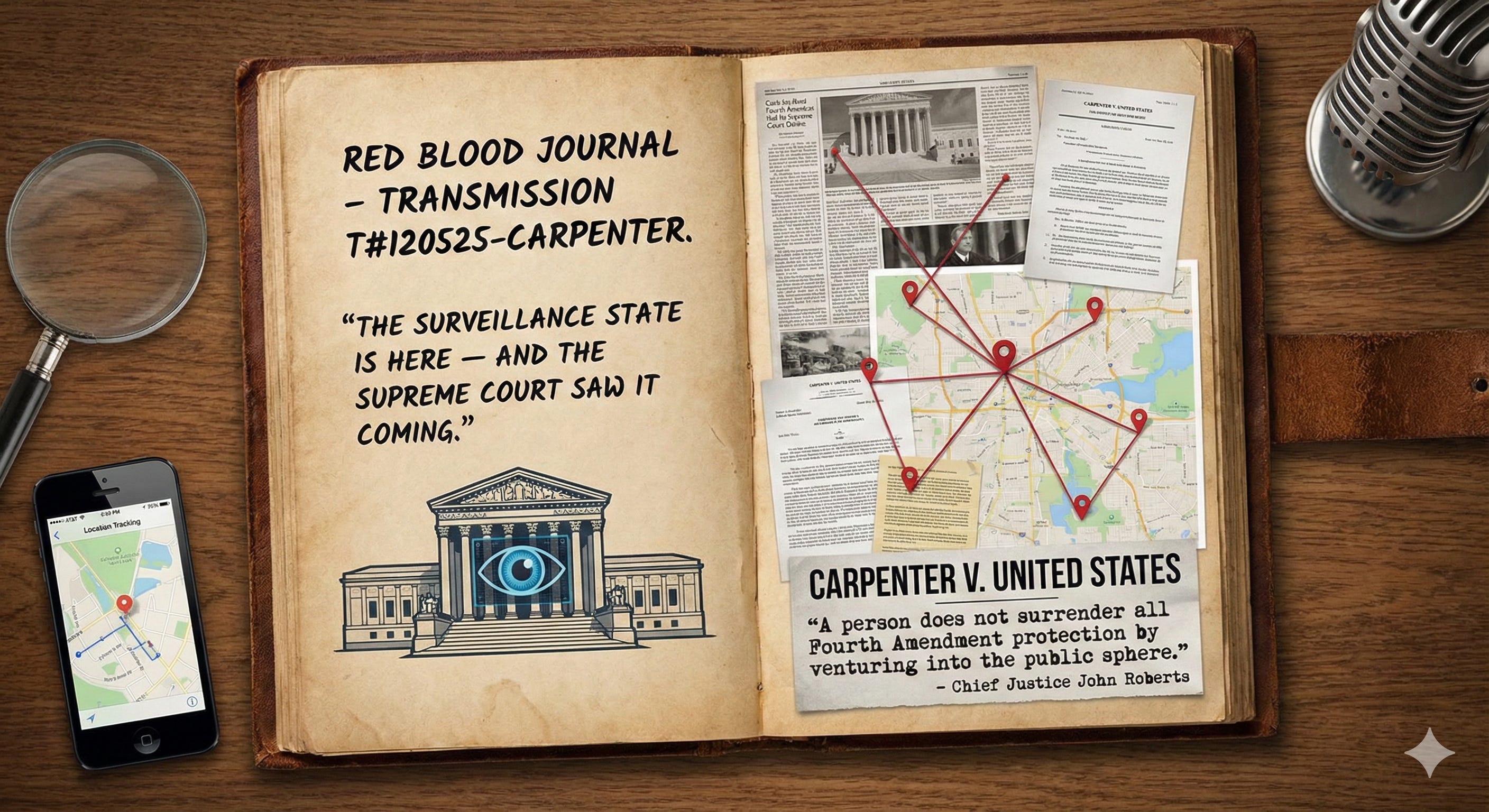
🩸 RED BLOOD JOURNAL – TRANSMISSION T#120525-CARPENTER
“THE SURVEILLANCE STATE IS HERE — AND THE SUPREME COURT SAW IT COMING.”
There is a lie repeated so often that even good men nod along to it:
“You have no expectation of privacy in public.”
A slogan engineered to anesthetize a population sleepwalking into a digital panopticon.
But that line is not law.
It is not constitutional doctrine.
It is not even true.
In 2018, in a razor-thin 5–4 decision, the Supreme Court of the United States stated the opposite — with unmistakable clarity:
“A person does not surrender all Fourth Amendment protection by venturing into the public sphere.”
Those are not my words.
They are the words of the Chief Justice of the United States, written in one of the most consequential privacy rulings of the 21st century:
Carpenter v. United States.
This is the case the surveillance industry hopes you never learn about.
🩸 I. THE ORIGIN STORY OF MODERN DIGITAL SURVEILLANCE
Detroit, 2010–2012. A string of armed robberies.
One suspect flips. He names a man: Timothy Carpenter.
Without a warrant, the FBI orders Carpenter’s wireless carrier to surrender 127 days of his historical location data — a “digital diary” of everywhere he had been, every night he slept, every church he entered, every doctor he visited.
Carpenter is convicted.
116 years in federal prison.
And a question rises to the Supreme Court:
Can the government track your past movements without a warrant simply because the data sits on someone else’s server?
🩸 II. WHAT ROBERTS SAW CLEARLY: THE TECHNOLOGY HAD OUTRUN THE LAW
Chief Justice John Roberts, writing for the majority, identified something chilling:
Past precedents were built for a world where surveillance was costly, rare, and targeted.
Today? It is cheap, constant, and automated.
He contrasted older cases:
Miller (1976): No privacy in bank records.
Smith (1979): No privacy in numbers dialed.
Neither resembled the exhaustive, all-encompassing chronicle of a person’s movements generated by modern cell networks.
Roberts recognized the irreversible shift:
Cell phones are “indispensable to participation in modern society.”
It is not “voluntary” to use one.
You cannot simply “opt out” of being tracked.
This is the exact argument the surveillance industry and their political handlers desperately want to bury.
🩸 III. THE PRIVACIES OF LIFE
Roberts pressed further. Location tracking doesn’t merely log movement.
It maps the privacies of life:
Where you sleep
Where you worship
Which doctors treat you
Who you meet
What political groups you support
Your family, romantic, and sexual patterns
Your associations and habits — your soul’s footprint
And then he dropped the line that should haunt every citizen:
“The Fourth Amendment seeks to secure the privacies of life against arbitrary power.”
To “place obstacles” in the way of a “too permeating police state.”
A warning.
A prophecy.
And an indictment.
🩸 IV. FLOCKNOVA & THE PRIVATE SURVEILLANCE STATE
Here is where Carpenter collides with 2025 reality.
While the Fourth Amendment restrains government, it says nothing about private corporations building omniscient surveillance grids, then selling access to law enforcement like a SaaS subscription.
Enter:
Flock Safety — 80,000+ automated license plate readers
FlockNova — “Search once, see everything”
Fogg Data Science
Project NOLA (“crime cameras,” a linguistic sedative)
A network capable of tracking every vehicle, every neighborhood, every movement, retroactively, with no warrant.
A “nice curtain of technology,” as one police chief bragged — wrapping the American public like shrink-wrap.
This is the warrantless mass surveillance Carpenter warned about — on steroids, outsourced, sanitized as “public safety,” and sold with corporate branding instead of jackboots.
🩸 V. THE POWER TO SURVEIL THE PAST
Roberts noted something unprecedented:
Digital surveillance allows police to travel back in time.
Before the digital age, reconstructing someone’s movements required:
Manpower
Eyewitnesses
Physical tails
A narrow window of opportunity
Today?
A few keystrokes.
Five years of your life rendered visible.
You weren’t merely watched.
You were recorded for later.
This is not surveillance.
This is time-traveling prosecution — the dream of every authoritarian regime.
🩸 VI. THE COURT’S 2018 DECISION — AND THE WAR TO OVERTURN IT
The Court ruled in Carpenter’s favor:
Warrantless access to historical location data is unconstitutional.
Even if held by a private company.
Even if collected automatically.
Even if you were in public.
Carpenter’s convictions?
Overturned.
But 2018 was another era.
Three of the pro-privacy justices are now gone.
Four justices lean heavily pro-surveillance.
One man — Justice Neil Gorsuch — is the wild card.
And here is the twist:
Gorsuch dissented in Carpenter not because he opposed privacy —
but because he believed the majority didn’t go far enough.
He rejects the flawed doctrine of “reasonable expectation of privacy,” because if the public grows numb to surveillance, the doctrine collapses.
Instead, he insists:
The Fourth Amendment protects your property, your person, your data — period.
If a new case reaches the Court with a strong pro-property, anti-surveillance argument, Gorsuch may be the deciding vote to strengthen the Fourth Amendment in the digital age.
🩸 VII. TODAY’S BATTLE: NORFOLK, VIRGINIA
Now comes the modern test case:
The Institute for Justice v. The City of Norfolk.
Issue:
Flock’s 24/7 warrantless location tracking of all drivers.
This is Carpenter all over again — but scaled to an entire city.
Should the case reach the Supreme Court, the nation will witness a constitutional knife-fight between:
The Surveillance Industry (corporate + government)
The Fourth Amendment
History will remember the winner.
🩸 VIII. WHAT COMES NEXT — AND WHY THE REGIME FEARS YOU READING THIS
If Carpenter falls, America enters a new era:
Every city becomes a monitored zone
Every movement becomes evidence
Every citizen becomes a suspect
Privacy becomes a folk tale
Freedom becomes permission, not a right
But if Carpenter is reaffirmed — or expanded — the surveillance leviathan takes a mortal wound.
The battle lines are drawn.
The technology is already installed.
The question is whether the Constitution will be permitted to speak.
🩸 IX. FINAL MESSAGE
Do not repeat the propaganda line that we “have no expectation of privacy in public.”
The Supreme Court rejected it.
History rejects it.
And the future of liberty depends on rejecting it.
The framers placed obstacles against a “too permeating police state.”
It is our generation’s task to decide whether those obstacles remain —
or whether they are quietly removed, replaced by a corporate logo and an AI dashboard.
The surveillance state is here.
Carpenter was the warning shot.
Norfolk may become the battlefield.
🩸 Transmission complete.
👁️ Carpenter, Surveillance, and the Digital Fourth Amendment
This text provides an in-depth analysis of the landmark 2018 Supreme Court case, Carpenter v. United States, which ruled that the government requires a warrant to access historical cell-site location data, affirming that citizens retain Fourth Amendment protection even in public.
The source explores how Chief Justice John Roberts recognized that modern surveillance technology had fundamentally outpaced older legal precedents, transforming cheap, constant tracking into a record of a person’s “privacies of life.”
Furthermore, the article warns that this ruling is under threat due to changes in Court composition and the rise of private surveillance companies like Flock Safety, whose data is often outsourced to law enforcement, posing a direct challenge to the anti-warrant protections established in Carpenter.
The text frames current legal battles, such as the case against the City of Norfolk’s use of license plate readers, as the modern constitutional test to determine if the government’s power to create a “too permeating police state” will be limited or if privacy will be lost entirely.


