


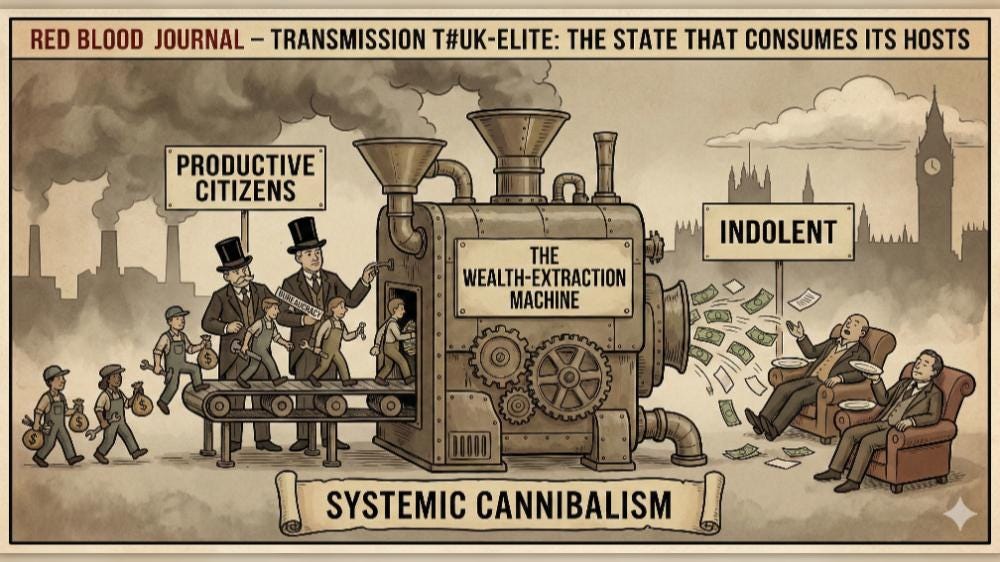
🩸 RED BLOOD JOURNAL – TRANSMISSION T#UK-ELITE (PART 3)
“THE STATE THAT CONSUMES ITS HOSTS — HOW THE BRITISH GOVERNMENT BECAME A WEALTH-EXTRACTION MACHINE.”
A nation can survive bad leaders.
It can survive bad policies.
It can even survive bad decades.
But what it cannot survive —
what no civilization has ever survived —
is a government that treats its productive citizens as livestock.
Britain has crossed that line.
Rupert Lowe’s testimony is not the lament of a nostalgic patriot.
It is the diagnosis of a system that has mutated from a government into a harvesting apparatus — one that feeds on those who still build, work, invest, and create.
This is not dysfunction.
This is extraction.
III. THE NEW BRITISH FORMULA: DEBIT THE PRODUCTIVE, CREDIT THE INDOLENT
Rupert describes the modern British economy with brutal precision:
“The productive are debited.
The indolent are credited.
The formula is doomed to failure.”
But it is deeper than that.
What Britain has created is a reverse meritocracy, a system in which:
Those who work the hardest are punished the most.
Those who delay adulthood are rewarded indefinitely.
Those who build strain under regulation, taxation, and debt.
Those who do nothing are subsidized, empowered, and politically weaponized.
This is not compassion.
This is not socialism.
This is political engineering:
A dependent class guarantees a dependent vote.
A dependent vote guarantees the ruling party’s survival.
And a ruling party’s survival guarantees the expansion of the bureaucracy that manages them.
Dependence is the currency.
Taxpayers are the collateral.
The nation is the casualty.
IV. THE 50% STATE: WHEN A GOVERNMENT BECOMES AN OCCUPATION FORCE
Britain’s government now consumes half of the national GDP.
Half.
No empire in history — not Rome, not the Ottomans, not the British Empire itself — ever demanded that much from its people without offering growth, territory, or prosperity in return.
To feed itself, the modern British state must continually widen its mouth:
more taxation,
more regulation,
more compliance,
more licensing,
more penalties,
more bureaucracy.
A parasitic organism grows by consuming the host.
But a government can only parasitize until the host collapses.
Britain is approaching that point.
Rupert sees it in his businesses: orders slowing, productivity sagging, creative energy strangled.
The old British dynamism — the entrepreneurial spark that built the City of London, the inventiveness that powered the Industrial Revolution, the courage that fueled global exploration — is now smothered beneath layers of administrative fat.
V. THE DEBT PYRAMID: A NATION LIVING ON MONEY THAT DOESN’T EXIST
Beneath the taxation crisis lies the deeper, hidden cancer: debt.
Rupert gives numbers no Treasury official dares say out loud:
100% of GDP in visible national debt
£3–5 trillion in off-balance-sheet civil service pension liabilities
An accounting system (OSCAR 2) specifically designed to obscure the real numbers
This is the financial structure of a failing state —
a state pretending to be wealthy while secretly insolvent.
The government isn’t managing Britain’s finances.
It is hiding Britain’s collapse.
Why?
Because acknowledging the truth would force Parliament to confront an even more dangerous truth:
The nation is being consumed by its own administrative organism.
VI. HOW A WEALTH-EXTRACTION MACHINE IS BUILT
A normal government taxes to fund services.
A predatory government taxes to fund itself.
Modern Britain has:
1. A swollen welfare class
9 million working-age Britons not working — because the system tells them they don’t have to.
2. A strangled productive class
Entrepreneurs, shopkeepers, engineers, tradesmen — the people who actually generate wealth — crushed under rules designed by people who’ve never built anything.
3. A powerful administrative class
Permanent secretaries, civil servants, regulators, quangos — unelected, unaccountable, and growing every year.
4. A political class dependent on the administrative class
MPs reliant on salaries, reputations, and party structures controlled by the bureaucracy.
This is biological colonialism turned inward:
The government has colonized its own population.
It drains the energetic to sustain the inert.
It punishes productivity to protect dependency.
It consumes vitality to preserve its own numerical mass.
This is not mismanagement.
This is systemic cannibalism.
VII. WHEN A GOVERNMENT PREYS ON ITS BEST CITIZENS, IT BECOMES UNSUSTAINABLE
Rupert poses the unspoken warning:
“If we haven’t fixed this by 2029, it may be too late.”
He is not exaggerating.
A nation cannot survive long when:
its strongest leave (Dubai, Milan, Mauritius),
its weakest stay and multiply,
its middle class erodes,
its government hides its insolvency,
and its bureaucracy consumes more than it produces.
Britain is not dying from ideology.
It is dying from structural predation.
The machine will keep extracting until there is nothing left to extract.
Then the collapse begins — fast, brutal, and irreversible.
🧛Britain: A State of Systemic Cannibalism and Wealth Extraction
The source, presented as excerpts from the “Red Blood Journal,” argues that the British government has transformed into a predatory “wealth-extraction machine” that systematically consumes its productive citizens.
This system, described as “systemic cannibalism,” operates by debiting those who work and crediting those who are “indolent,” creating a reverse meritocracy designed to engineer political dependency.
The text asserts that the British state now consumes roughly half of the national GDP, necessitating endless expansion of bureaucracy, regulation, and taxation, which stifles the nation’s entrepreneurial spirit.
Furthermore, the source highlights a massive hidden debt crisis, claiming the government is concealing its insolvency through obscured accounting practices.
Ultimately, the author warns that this internal colonization and structural predation against the productive class will lead to the nation’s irreversible collapse by punishing those who generate wealth to sustain an ever-growing administrative and dependent class.


