


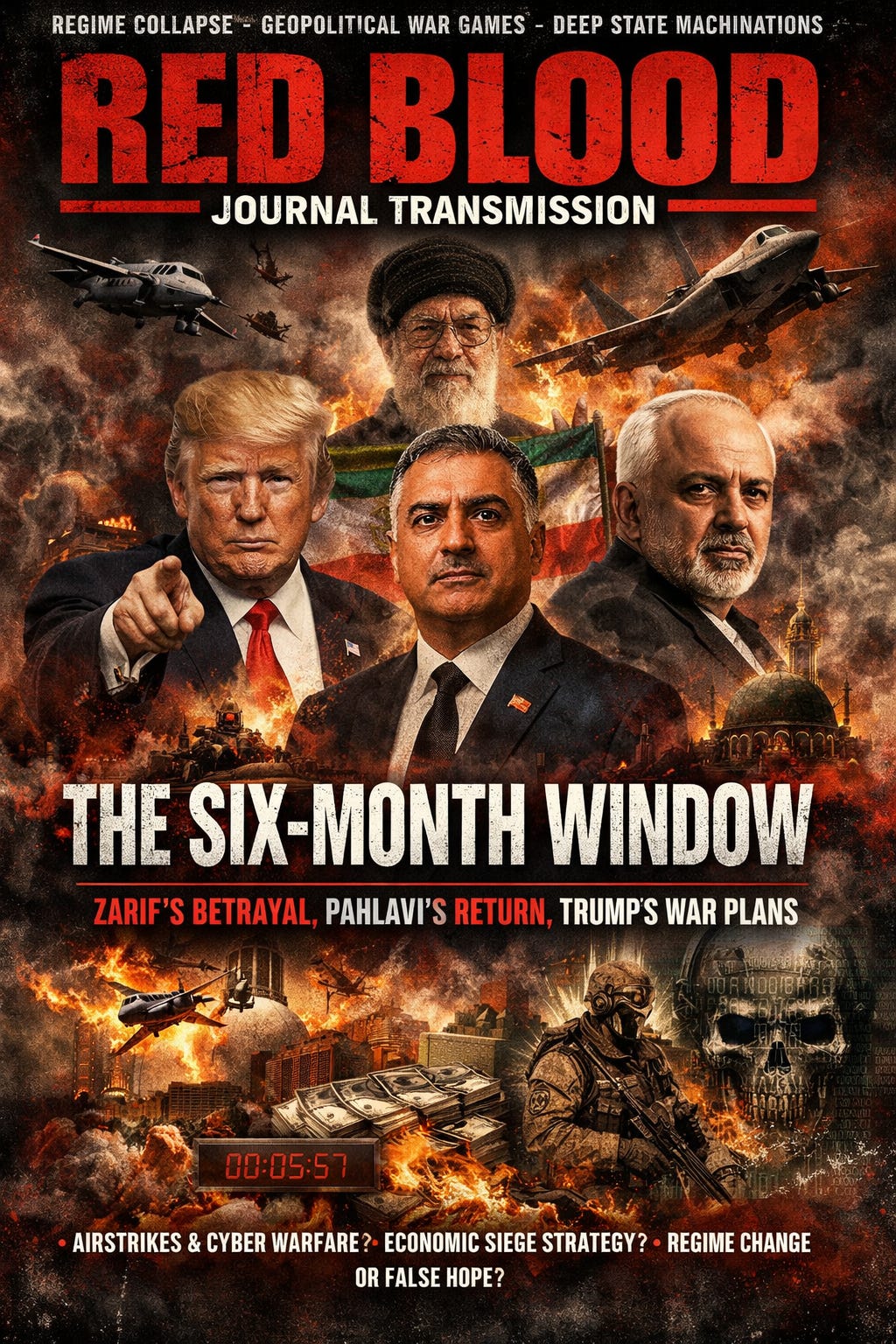
🩸 RED BLOOD JOURNAL TRANSMISSION
T#: RBJ-2026-01-20-IRAN-TRUMP-FORECAST
Classification: Deep Regime Change PsyOps & Great-Power Wargaming
Desk: Geo-PsyOps & Middle East Influence Cartography Unit
Status: Eyes-Only – For Readers Who Suspect “Regime Change” Is a Product Line, Not a Miracle
“The Six-Month Window”
**Zarif’s Alleged Call, Pahlavi’s ‘Return,’ and Trump’s War Room Options on Iran
PROLOGUE – WHEN THE RATS HEAD FOR THE LIFEBOATS
On the surface, this is “just another news cycle”:
Israeli Channel 14 claims Mohammad Javad Zarif called Reza Pahlavi multiple times during the uprising, then looped in Hassan Rouhani.
Both men are then reportedly grabbed by the IRGC and pushed into some form of house arrest.
Davos invites Iran’s foreign minister Abbas Araghchi… then, under pressure over mass killings of protesters, quietly cancels the invite.
Reza Pahlavi publicly declares: “I will return to Iran. The battle is between occupation and liberation.”
The Israeli Air Force quietly receives three more F-35I “Adir” stealth jets, bringing the total to 48.
Senator Lindsey Graham urges President Trump to unleash “holy hell” on Iran through military, cyber and psychological operations, while explicitly ruling out ground troops.
Senator Ted Cruz goes on Fox and says there’s a “real possibility” that in the next six months the regimes in Iran, Venezuela, and Cuba could all fall.
If you look at each item alone, it’s noise.
If you stack them together, it starts to look like a timed operation.
This Transmission reads the Persian report you gave, cross-checks it with the current open-source signals, and then asks:
What is the system preparing for—and what role is Trump being scripted to play?
I. SURFACE LAYER: THE OFFICIAL STORYBOARD
From the translated text + current reporting, the “public script” looks like this:
Inside the Regime – Panic & Fence-Jumping
Zarif allegedly reaches out to Reza Pahlavi, the official exiled alternative.
He shares with Rouhani. Both are already in long-term tension with Khamenei.
They are watched by IRGC. Then: arrests / house arrest.
Message: “Senior insiders are looking for a lifeboat.”
Outside the Regime – Oppositions, But on a Leash
Pahlavi’s popularity is real but contested; the diaspora and internal opposition remain fractured, even as protests call for the end of the Islamic Republic.
Western media acknowledges the bloodbath (thousands killed; some rights groups and exiled sources claim five-figure casualties), but still debates whether Pahlavi should lead or merely “symbolize” the transition.
Davos & the Moral Theater
WEF invites Araghchi → backlash from U.S. conservatives and diaspora → invitation pulled as a gesture to the protesters.
This is sold as “moral clarity,” but functionally it’s a soft de-legitimization step: taking the regime slightly out of the polite club, without yet pulling the plug.
Israel’s Quiet Upgrade
Israel’s F-35I fleet hits ~48 aircraft, explicitly framed in defense media as giving Israel the ability to strike across the region, penetrate advanced air defenses, and repeat the kind of deep strikes used in the 2025 Israel–Iran clashes.
Trump’s Political & Military Signaling
Trump threatens severe consequences if protesters are massacred.
Graham calls for “holy hell” via military, cyber, psychological operations, but no U.S. boots.
Cruz says: six months for Iran/Venezuela/Cuba to possibly fall—tying three regimes into a single regime-change season.
Reza Pahlavi’s Timing
Pahlavi’s “I will return” and “occupation vs liberation” message lands precisely as senators and commentators in the U.S. float timelines for regime collapse.
On the surface, the narrative is:
“An organic revolution in Iran, morally backed by the West, maybe soon crowned by a Pahlavi-led transition if Trump holds his nerve.”
Now we go deeper.
II. DEEPER LAYER: WHAT THE ZARIF–PAHLAVI CLAIM REALLY SIGNALS
The explosive allegation in your Persian text isn’t just “Zarif called Pahlavi.” It’s who Zarif is and when he allegedly did it.
Zarif is not some provincial governor. He’s the regime’s premier networker:
Architect of the JCPOA diplomacy.
Deeply wired into U.S. think tanks, European diplomats, UN structures.
If he is calling Pahlavi:
Either it’s a rogue move (jumping ship), or
It’s part of a managed contingency channel: a “What if we need a soft landing?” back-channel blessed by higher powers.
From a conspiracy-systems view, this looks like:
The same transnational network that built Zarif as the “acceptable face” of the Islamic Republic is now test-running Pahlavi as the “acceptable face” of Post-Islamic Iran.
The arrest/house arrest story (true or not) becomes useful in two ways:
Inside Iran:
It terrorizes other insiders: “If you call the Crown Prince, we know. We’ll put you in the same box as Zarif/Rouhani.”
It also signals factions: “If you want out, you must negotiate through the right channels, not freelance.”
Outside Iran:
It tells Western audiences: “Look, even top Islamic Republic insiders secretly trust Pahlavi. He is the inevitable transitional figure.”
This is the pre-legitimation phase of a regime change product.
III. THE TRUMP VECTOR: WHY THE TIMING MATTERS
In your text and in current news, Trump is not just another Western politician. He’s framed as:
The openly regime-change-curious president, now being lobbied by:
Graham (“holy hell,” but no ground war).
Cruz (six-month window; Iran/Venezuela/Cuba in one breath).
The audience of one for Pahlavi’s appeals: “Be a man of your word; back the Iranian people.”
Put bluntly:
The system is building a moral, emotional, and strategic runway for Trump to do something big on Iran—but “big” does not necessarily mean full war.
If you map all the signals together, Trump’s “menu” looks like this:
IV. TRUMP’S SHADOW PLAYBOOK – FOUR CHANNELS OF ACTION
Channel A – Shock-and-Awe Lite (Air + Cyber + PsyOps)
What Graham is asking for is essentially a limited war package:
Massive cyber operations to blind command-and-control (IRGC, internal security, banking).
Coordinated airstrikes—likely led or heavily enabled by Israel’s upgraded F-35I fleet—targeting:
IRGC bases
Missile sites
Air defenses
Key regime infrastructure
Psychological warfare:
Open calls to IRGC units to defect.
Direct comms to protesters (satellite internet, broadcasting).
Show of force in the Gulf.
Conspiracy read:
This is the “2026 version” of Iraq 1991 + Libya 2011, but with a strict rule:
Destroy the regime’s hard power, but don’t plant the U.S. flag on Iranian soil.
The F-35 pipeline, the scrubbing of Araghchi from Davos, the six-month talking point—together they look like setting the battlespace for this option.
Channel B – Economic Siege + Secondary Sanctions 2.0
Trump already used sanctions and tariffs as weapons in his first term. Under a new Iran “emergency,” he could:
Slam 25%+ tariffs on any country trading significantly with Iran.
Threaten SWIFT, shipping insurance, and banking relationships for those who don’t comply.
Freeze or seize assets linked to IRGC, bonyads, state-linked companies.
What this does:
Worsens economic pain inside Iran → more protests → regime hemorrhage.
Forces EU + Asia to pick a side (Washington vs Tehran).
Conspiracy angle:
This is the “choking the patient until he accepts the transplant” option.
You strangle the Islamic Republic economically until whatever post-regime management plan (likely fronted by Pahlavi or a council that includes him) becomes the only survivable path.
Channel C – Managed Transition with a Pahlavi-Centric “National Council”
In your text, the key psychological shift is:
Pahlavi says: “The battle is between occupation and liberation, not reform vs revolution.”
That’s not just rhetoric—it’s signaling:
It kills the “reformist” safety valve inside the regime.
It makes any inside-the-system fix look like collaboration with occupation.
It lines up perfectly with a U.S. narrative: “We’re helping a people under occupation throw off their captors.”
In a managed transition scenario:
Trump (publicly):
Recognizes a “Transitional Council of Iran” in exile, with Pahlavi as figurehead, but padded with republicans, minorities, reformist defectors, and technocrats to look inclusive.
Trump (quietly):
Greenlights intelligence + financial support for the council.
Coordinates with Israel and Gulf allies on a security umbrella.
System (deep layer):
Uses Zarif-style insiders (if they flip) to preserve continuity in certain institutions (energy sector, central bank, parts of the bureaucracy) so the shock is manageable for markets.
Conspiracy reading:
This is the “Regime Change With a Warranty” model—designed so that:
Oil and gas keep flowing.
The new regime keeps enough of the old security architecture to be controllable.
Iran is re-integrated into the Western-led financial order—but under new branding.
Channel D – The Bluff: War of Words, No Real Regime Change
There is also a darker, more cynical possibility:
Trump makes all the right noises, but the system never truly intends to topple the regime—only to weaken it, milk it, and scare it.
In this channel:
Threats, sanctions, and displays of force continue.
Pahlavi remains in perpetual “I will return” limbo.
The regime survives, though blood-soaked and economically ruined.
The West keeps Iran as a permanent, manageable villain—a justification for arms sales, regional bases, and internal security powers.
From a conspiracy-systems view, this is what we already saw with:
Decades of Cuba embargo.
Cycles of “red line” drama with Syria.
Sanctions-and-talks yo-yo with North Korea.
The question is whether the current casualty levels and open appeals from Pahlavi and U.S. hawks mean we’ve moved past this bluff phase and into a real decision window.
V. FORECAST BOARD – HOW LIKELY IS EACH SCENARIO?
This is speculative pattern-reading, not prophecy. But based on who is talking, what hardware is moving, and which taboos are breaking, a plausible forecast:
Most Likely (40–50%) – Channel B + Partial Channel C
Escalated economic siege + diplomatic isolation.
De-facto recognition of Pahlavi as the symbol, while elites try to form a broader transitional body around him.
Limited covert operations, but no open U.S. kinetic strikes yet.
Goal: soften the regime, fuel internal fractures, and test how many insiders are willing to jump toward the “new Iran” project.
Second Likely (25–35%) – Channel A “Lite” + B + C Combined
A trigger event (massacre, attack on U.S./ally assets, or alleged nuclear violation) is used to justify:
Coordinated air/cyber strikes (likely Israel-fronted, U.S.-enabled).
Rapid expansion of sanctions.
Open political recognition of an exile-based transitional authority.
This would look like Libya 2011 with 2026 technology and more deniability.
Third (15–20%) – Channel D: The Eternal Brink
Trump keeps the threat level high, uses Iran as a geopolitical prop and domestic rally point, but never authorizes decisive moves.
Iran remains wounded but alive; protesters are sacrificed to maintain the balance.
Low Probability but High Impact (5–10%) – Rogue Detonation / “Black Swan Strike”
A sudden event nobody publicly admits planning:
Assassination of a top figure.
A surprise internal coup that claims U.S. neutrality.
A “mysterious” infrastructure disaster (nuclear site, critical refinery, major cyber blackout).
This could force Trump’s hand into a more direct reaction—either military or diplomatic—outside the carefully scripted options.
VI. DEEP CONSPIRACY READ – WHAT THE SYSTEM REALLY WANTS FROM IRAN
If you zoom out beyond Iran and Trump, a pattern emerges:
Cuba, Venezuela, Iran are being rhetorically bundled as one axis of “regimes due for collapse.”
Davos, WEF, Western elites are publicly shamed for entertaining the regime as a normal partner.
Israel’s strike capabilities are brought to a peak, with public reporting about F-35I numbers and their use in degrading Iranian defenses.
Pahlavi’s messaging is aligned almost perfectly with the U.S. hawk narrative: no more reforms, only liberation.
From a Red Blood Journal perspective, this suggests the real objective isn’t just “freedom for Iranians” (though that’s absolutely what many ordinary people sincerely want):
It’s to re-insert Iran into a Western-centric energy, security, and financial architecture—but with a leadership that is:
Sufficiently nationalist to be legitimate.
Sufficiently dependent to be controllable.
Sufficiently traumatized by the transition to obey the new terms.
Trump, in this schema, is not the author—he’s the chosen hammer.
He has the personality to threaten extreme action.
He has a base that cheers toughness on Iran.
He’s already been framed as “Reagan Plus” by hawks.
The system needs someone to take responsibility for whatever happens next. Trump is being positioned as the “decider” whose choices all feed into the same underlying outcome:
Iran as a broken or reshaped node—no longer a fully independent center of power.
EPILOGUE – MESSAGE TO THE READER IN IRAN & THE DIASPORA
From the vantage point of this Transmission:
Yes, the regime is unstable—the Zarif–Pahlavi allegation, insider panic, and global backlash are all signs of that.
Yes, Trump has levers—economic, military, cyber, symbolic—and powerful voices are begging him to pull them.
But no external savior is clean. Every outside actor has its own blueprint for what Iran should become for them.
Foreseen danger:
If Iranians do not articulate and organize around their own clear, internal vision—beyond slogans, beyond imported templates—then any “liberation” can be captured and repackaged as another form of control.
This Transmission doesn’t tell you which scenario to root for.
It only says:
“The window is open. Trump, Pahlavi, Israel, Davos, the Senate hawks—they’re all moving pieces now. Whatever comes next will not be random. Watch how the declared six-month clock is used. Watch who gets framed as the ‘only possible future’ for Iran. And remember: every empire loves a revolution it can pre-design.”
🩸 End of Transmission – RBJ-2026-01-20-IRAN-TRUMP-FORECAST
⏳ The Six-Month Window:
Trump and the Iran Transition Strategy
The provided text outlines a geopolitical forecast regarding a potential six-month window for regime change in Iran during a second Trump administration.
It synthesizes reports of internal Iranian instability, such as alleged secret communications between regime insiders and the exiled Reza Pahlavi, with escalating military and diplomatic signals from the West.
The source suggests that U.S. political figures and Israeli military upgrades are aligning to pressure the Islamic Republic through a combination of cyber warfare, economic sieges, and psychological operations.
Ultimately, the analysis frames these events as a coordinated effort to transition Iran into a Western-aligned state while cautioning that such a movement may be orchestrated by external powers.
The narrative emphasizes that while the regime appears fractured, the resulting political transformation is being carefully scripted by international actors.


