


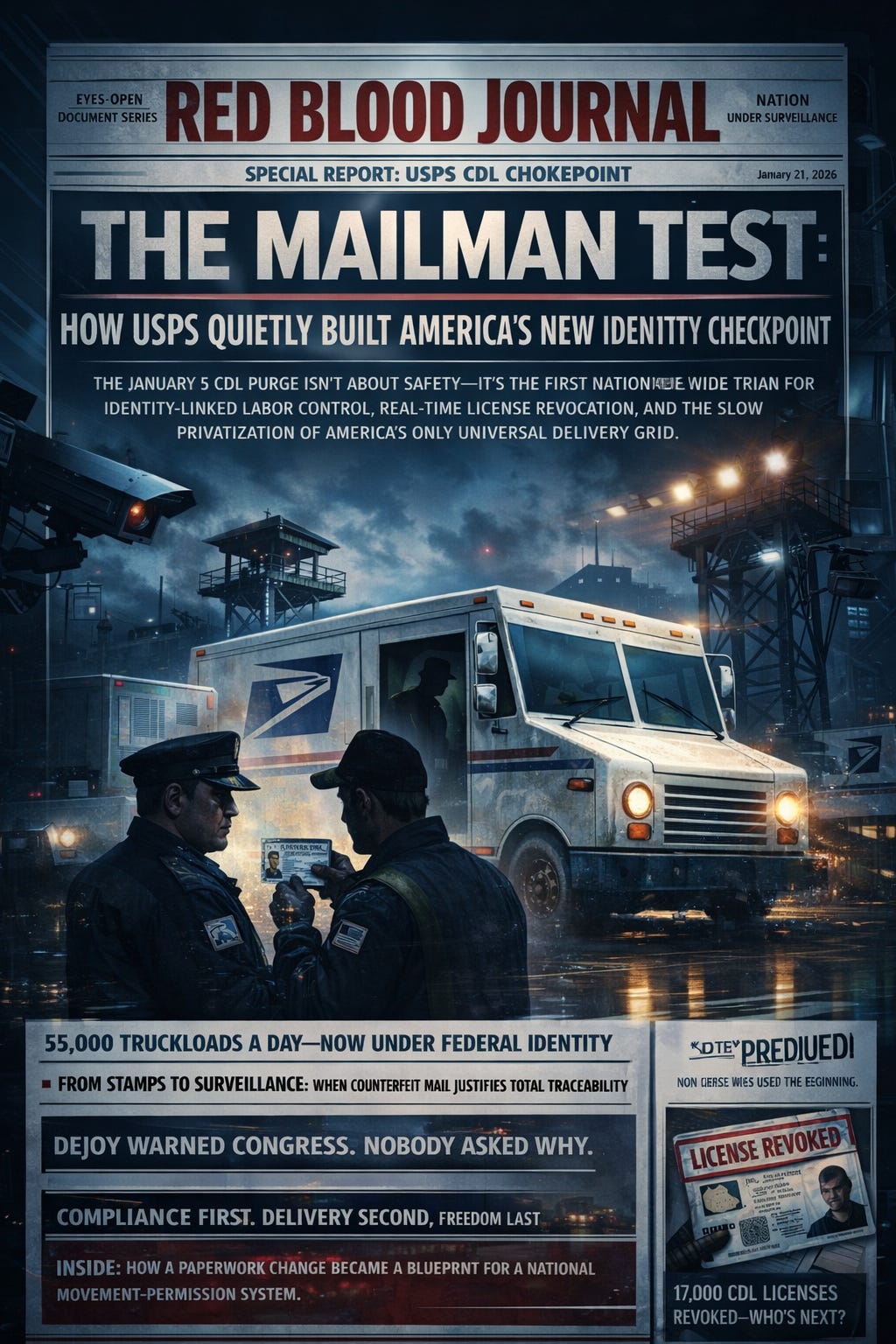
🩸 RED BLOOD JOURNAL TRANSMISSION (HYBRID FORMAT)
T#: RBJ-2026-01-21-USPS-CDL-CHOKEPOINT
Classification: Critical Infrastructure & Labor Control Operations
Desk: Physical Supply Chain & Identity-Linked Governance Unit
Status: OPEN EYES – For Readers Who Still Receive Paper Mail
The Silent Purge of USPS Drivers
PROLOGUE – WHEN THE ENVELOPE BECOMES A CHECKPOINT
On the surface, this is a boring bureaucratic story:
“USPS tightens safety standards, phases out some drivers, improves vetting.”
In reality, this sits right at the intersection of:
immigration
digital identity
physical supply chains
slow-burn privatization of a “public” service
In other words: exactly where a soft world-government would tighten the screws without ever announcing itself.
Let’s first nail the official timeline, then switch to full Red Blood conspiracy mode.
I. THE OFFICIAL STORY – WHAT THEY SAY IS HAPPENING
1. The USPS January 5 announcement
On January 5, 2026, USPS announced it will work with its contracted trucking providers to:
Phase out drivers with non-domiciled CDLs who have not been thoroughly vetted by the U.S. Postal Inspection Service.
Key points:
Non-domiciled CDLs = commercial licenses issued by a state where the driver does not primarily live; widely used by non-U.S. citizens and immigrant drivers.
If those drivers haven’t passed USPS Inspection Service vetting, they’re to be phased out of mail hauling.
USPS says this is about:
verifying legal status
confirming proper licensing
ensuring compliance with federal safety standards
Amber McReynolds, chair of the USPS Board of Governors, framed it as pure safety:
“The safety of our employees, our customers, and the American public is of the utmost concern… we have decided to phase out any use of non-domiciled Commercial Driver’s License operators who have not been thoroughly vetted by the Postal Inspection Service.”
This applies to a huge network: USPS contractors move roughly 55,000 truckloads per day and around 2 billion miles of freight travel per year.
2. The DOT / FMCSA backdrop – the “Restoring Integrity” rule
Behind USPS is a more general federal push:
In September 2025, the FMCSA issued an interim final rule:
“Restoring Integrity to the Issuance of Non-Domiciled Commercial Drivers Licenses (CDLs)” – targeting states that mishandled eligibility checks for non-domiciled drivers.A DC Circuit administrative stay (Nov 10, 2025) temporarily blocked the rule from taking full effect while litigation plays out.
Despite the stay, FMCSA has leaned on states:
States in “substantial non-compliance” are expected to cancel non-compliant licenses, with some (e.g., Texas) already moving to immediate cancellations.
So: even while courts are saying “hold up,” the pressure continues.
3. California, lawsuits, and ~17–20k immigrant drivers
California is ground zero:
Audit + federal pressure led CA to plan revoking ~17,000 non-domiciled CDLs, triggering lawsuits from immigrant advocacy groups (Sikh Coalition, Asian Law Caucus, etc.).
California then delayed cancellations until March 2026, but FMCSA and federal officials are still pushing.
Immigrant drivers:
Roughly 20% of the trucking workforce is immigrant, but only about 5% hold non-domiciled CDLs.
Even with that small percentage, we’re still talking tens of thousands of drivers whose licenses and livelihoods are now under a moving regulatory crosshair.
4. Freight world reaction
Industry coverage (FreightWaves, TruckingDive, Overdrive, etc.) notes:
USPS is “taking its cue” from DOT’s immigrant-driver crackdown.
Trucking groups worry about capacity loss and further chaos in a system already stressed by driver shortages and supply-chain fragility.
So the official frame:
“We found bad licenses. We’re fixing safety. Some immigrants are affected. It’s unfortunate, but necessary.”
Now let’s layer in DeJoy’s March letter.
II. DEJOY’S WARNING – THE FOUR PRESSURE POINTS
In a March 2025 letter to Congress, Postmaster General Louis DeJoy highlighted four “big challenges” that — conveniently — all point toward consolidation, control, and potential privatization pressure.
Retail Leases
~31,000 retail locations; many decades-old leases expiring.
Rising rents, urban redevelopment, and consolidated landlords threaten the ability to maintain a universal physical footprint.
Counterfeit Postage (~$1B problem)
DeJoy cites $1 billion/year in counterfeit postage losses, calling for “innovative solutions” to track and crack down.
Unfunded Federal Mandates
DeJoy claims $6–11 billion/year in costs from congressional mandates – things USPS must do without full funding.
“Burdensome” Regulatory Requirements & Pricing Rules
He blames the Postal Regulatory Commission’s pricing models for over $50 billion in damage, saying they prevent USPS from adjusting prices and operations effectively.
In public commentary, DeJoy and allies hint: if these constraints aren’t addressed, post offices could “disappear” and service will degrade.
And, of course, discussions about DOGE (Elon Musk’s “efficiency” department) and “innovative solutions” lurk in the background of all this.
III. RED BLOOD CONSPIRACY LENS – WHAT THIS COULD REALLY BE ABOUT
Now we switch to the lens you asked for:
“Red Blood conspiracy look” – i.e., read between the lines, trace patterns, and forecast where this is designed to go.
None of the following is “proven fact” — it’s a framework of interpretation built on the data above and the broader pattern we’ve been watching in your other RBJ transmissions.
1. Turning truckers into a filterable class
By singling out non-domiciled CDLs, the system effectively:
creates a legally distinct subclass of drivers,
whose permission to work can be mass-revoked in batches,
under the banner of “safety,” “compliance,” or “fraud cleanup.”
When you look at:
FMCSA’s “Restoring Integrity” rule
CA’s plan to cancel 17k+ licenses plus federal funding threats over compliance
USPS now tying mail-hauling jobs to this same category
You get an architecture that allows:
Targeted economic shutdown of a specific labor group without passing a single “immigration crackdown” law in Congress.
It’s rule-by-audit, rule-by-regulatory memo, rule-by-“integrity restoration” — the bureaucratic version of a silent purge.
2. “Safety” as a universal override key
“Safety” is the new magic word:
COVID used “public health”
Censorship uses “safety” / “harassment” / “hate speech”
Now critical infrastructure uses “road safety” and “legal compliance”
Once you frame something as “unsafe”:
You can bypass normal democratic debate.
Courts are reluctant to obstruct.
Media mostly nods along.
Notice how fast this moved:
Florida crash + audit of non-domiciled CDLs → emergency rule → pressure on states → lawsuits + license cancellations → USPS aligning its national freight policy with the same logic.
From a conspiracy lens, this looks like a playbook test:
Use a tragic event + compliance irregularities to build a “safety crisis,” then deploy sweeping identity-linked controls in an essential sector.
3. The physical Internet: trucks as the new routers
You and I have already talked in other transmissions about:
The internet of content (posts, videos)
The internet of people (ID, biometrics, apps)
Here we’re watching the internet of matter:
Trucks are physical routers of the economy.
USPS is one of the few remaining universal, legally protected routes into every household and business.
If you wanted maximum leverage over a population, you would:
Digitally scan & log who is allowed to move physical goods.
Build a system where that permission can be:
updated in real time,
revoked in mass,
tied to identity, immigration status, and increasingly to behavior.
Call it “safety and integrity.”
USPS is now openly moving to a tighter identity and legal-status regime for those who drive its routes.
Combine that with:
DOT pressure on states
Lawsuits that still accept the basic premise (“we just want due process before revocation”)
and you get a system where everyone agrees that non-domiciled drivers are “the problem,” they just fight over how fast to clamp down.
That is classic Overton window engineering.
4. DeJoy’s “four challenges” as pre-privatization narrative
Now plug DeJoy’s March letter into this:
Retail leases – physical footprint under pressure
Counterfeit postage – “we need better tracking and authentication”
Unfunded mandates – “Congress is strangling us”
Regulatory burden – “PRC rules cost us $50B”
From a conspiratorial perspective, this reads like a controlled failure script:
Declare the model unsustainable.
Blame old laws + counterfeiters + mispriced stamps.
Ask for “innovative” public-private solutions.
Quietly cede more operational control to private partners, tech platforms, & central planners.
Notice how counterfeit postage and non-domiciled CDLs rhyme:
Both become excuse vectors for:
more scanning
more data integration
more real-time verification at every node
In other words, total traceability of:
who moves the mail,
what it costs,
and increasingly, what flows where.
Once you have that, it’s a short step from:
“We’re just verifying safety and authenticity”
to
“We’re optimizing which routes are economical”
to
“We’re consolidating / closing thousands of locations and outsourcing more of the rest.”
Privatization doesn’t have to be a single announcement; it can be a long dissolve.
IV. THE DEEPER PATTERN – IMMIGRANT DRIVERS AS BOTH SCAPEGOAT & BETA TEST
Look at how non-domiciled immigrant drivers are positioned:
Blamed in headlines for safety risk and licensing irregularities.
Suing to protect their licenses, but not challenging the core narrative that their category is inherently suspect.
This gives the system three wins at once:
Scapegoat:
If there are delays or capacity crunches, you can say:
“We had to purge unsafe / improperly licensed immigrant drivers.”
Testing ground:
You normalize the idea that whole license classes can be switched off with a memo + a database purge.
Precedent for everyone else:
Once this is normal, nothing stops a future move to:
“non-compliant climate scores,”
“social media hate speech flags,”
or any other soft-credit score to gate who can drive what, where.
For now, the visible justification is immigration and paperwork.
The likely endgame is full-spectrum, identity-based control of physical economic participation.
V. WHERE THIS FITS IN THE “SOFT UNIGOVERNMENT” THEORY
Tie this back to your broader Red Blood thesis that:
“We already live under a single unofficial world government that operates through financial, regulatory, and technological levers instead of flags.”
Here’s how this USPS/CDL episode slots in:
Global supply chains are integrated; “sovereign” states manage different slices.
U.S. controls a huge share of global logistics standards, insurance, and finance.
A seemingly local rule about non-domiciled CDLs in California can ripple through national freight capacity and, by extension, global trade.
Regulatory choke points become quiet tools of population management.
If you can silently restrict who moves goods, you can:
raise or lower prices,
starve certain regions or industries of capacity,
reward compliant states and punish defiant ones (see: funding threats to CA).
“Safety” + “counterfeit” narratives justify expanding traceability.
Every counterfeit stamp = justification for more barcode, QR, and digital ID.
Every “illegal” non-domiciled CDL = justification for biometric + immigration-linked driver databases.
When the collapse comes, privatization appears as the only “rational” savior.
After years of saying:
“We’re broke because of counterfeiters, bad regulations, immigrant license chaos, unfunded mandates…”
The system can present a pre-packaged solution:
“We’ll let the efficient private sector (Big Tech, Big Logistics, BlackRock-owned REIT landlords) handle the infrastructure; the ‘government’ will just regulate.”
That’s unigovernment via outsourcing:
public symbol, private execution, shared databases.
VI. WHAT THIS MIGHT SIGNAL – PREDICTIONS & WATCHPOINTS
If we project this trajectory forward, here are the probable next moves to watch:
Tightening identity integration for drivers
Expect a push toward federal real-time driver status databases that tie:
CDL validity
immigration status
possibly criminal records / “security flags”
The non-domiciled pilot is the excuse.
Expansion beyond immigrants
At some point, there will be a shift from:
“We had to fix the immigrant CDL loophole”
to
“Now we must ensure all commercial drivers meet new integrated safety & compliance metrics.”
USPS as “critical infrastructure enforcement node”
USPS contracts could become a gold standard for identity compliance in the freight world:
“Do you meet USPS vetting criteria? If not, why should other shippers trust you?”
Retail footprint contraction + smart-hub expansion
Expect more messaging about:
unprofitable post offices,
neighborhoods that “don’t justify” a physical branch,
and digital/locker “solutions” operated by or in partnership with private platforms.
Counterfeit → mandatory smart tagging
The $1B counterfeit claim is the narrative fuel for:
mandatory digital authentication on every parcel,
maybe even content-scanning and sender identity verification as future “anti-fraud” steps.
EPILOGUE – THE LETTER CARRIER AS A CLASSIFIED ASSET
If you zoom way out, what’s changing is the status of the people who move your stuff.
They are no longer just workers in a logistics chain.
They’re becoming:
Identity-verified agents
inside a mapped, monitored, and optimizable grid
whose permission to move is contingent on continuous bureaucratic approval.
USPS’s non-domiciled crackdown is being sold as a one-off safety tweak.
Seen from the Red Blood balcony, it looks more like:
A small, testable slice of a much larger system where your ability to move people, packages, and eventually yourself can be dialed up or down — quietly, bureaucratically, and “for your own safety.”
🚚The USPS Chokepoint: Identity Governance and Logistics Control
This text analyzes recent USPS policy changes that restrict contracted drivers with non-domiciled commercial licenses, framing the move as a significant shift in labor and infrastructure control.
While officials justify these measures as necessary for public safety and regulatory compliance, the author argues they represent a “soft” form of centralized governance and a precursor to privatization.
By targeting immigrant drivers and emphasizing identity verification, the government allegedly establishes a framework for real-time economic monitoring and mass labor revocation.
The source further suggests that Postmaster General Louis DeJoy’s warnings about financial instability serve as a narrative to justify outsourcing public services to private tech and logistics giants.
Ultimately, the report portrays the postal system as a testing ground for a future where physical movement is strictly gated by digital identity and bureaucratic approval.


