


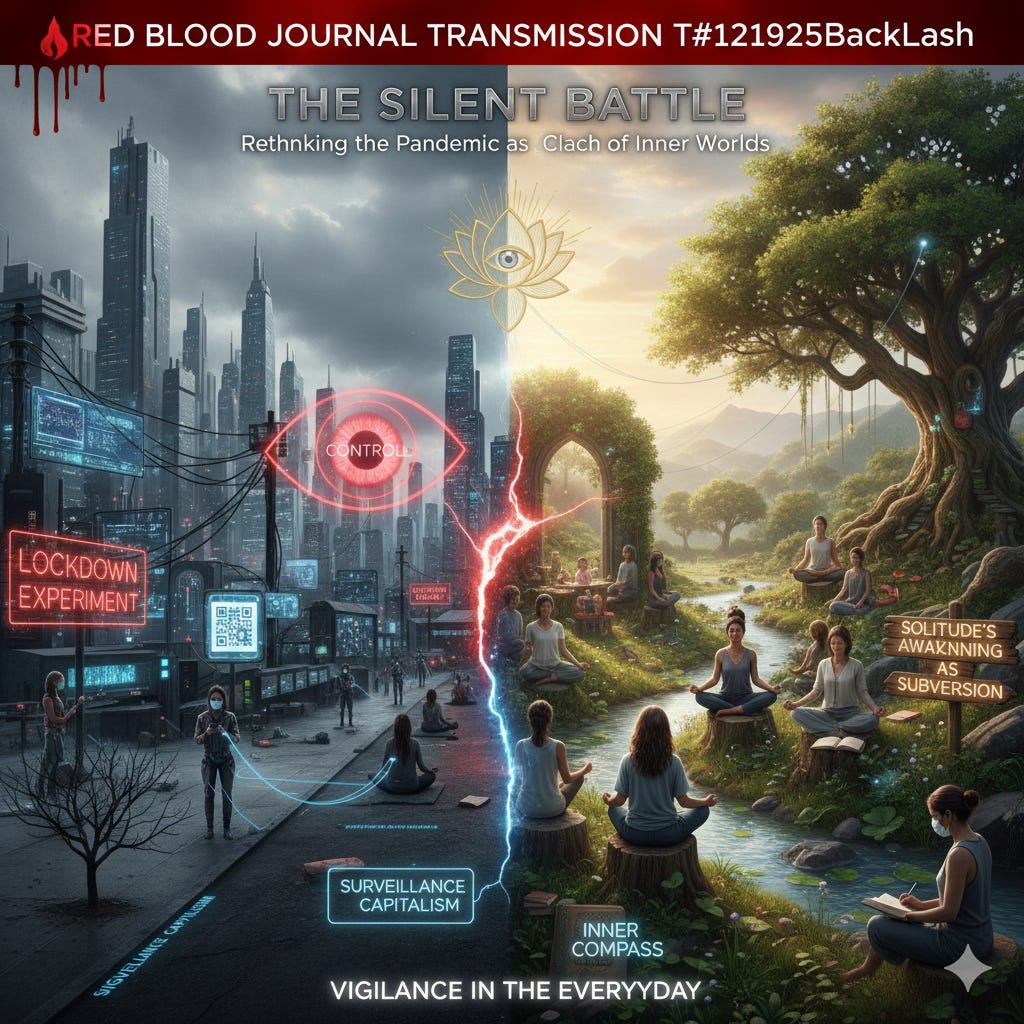
🩸 The Silent Battle: Rethinking the Pandemic as a Clash of Inner Worlds
Introduction: Reframing the Crisis
In the wake of global upheavals, it’s tempting to view events like the COVID-19 pandemic through the lens of public health alone. But what if we consider an alternative perspective—not as proven fact, but as a thought experiment? Imagine that beneath the surface of medical necessity lay a subtler conflict: a struggle not for bodies, but for souls. This isn’t about alleging secret cabals or hidden agendas; it’s about examining systemic patterns and incentives that might inadvertently—or deliberately—target the human spirit. If modern power thrives on distraction and dependency, then any force encouraging introspection becomes a quiet adversary. The pandemic era, in this light, emerges as a pivotal chapter in an ongoing, invisible war.
The Lockdown Experiment: Control in Disguise
At first glance, lockdowns were straightforward: isolate to flatten the curve, protect the vulnerable, and buy time for science. Yet, from a broader vantage, they served as an unprecedented social laboratory. Governments and institutions tested the boundaries of obedience, deploying fear as a catalyst for compliance. How far could restrictions go before resistance mounted? How effectively could narratives shape behavior on a mass scale?
The results were illuminating. Billions adhered to rules that upended daily life, from mask mandates to curfews. But this wasn’t just about health protocols; it was a dry run for future governance models. In an age of surveillance capitalism, lockdowns normalized tracking apps, remote monitoring, and digital passports—tools that extended authority into private spheres. What began as a temporary measure revealed the elasticity of public tolerance, proving that under the right conditions, societies could be reengineered overnight.
The Double-Edged Sword of Solitude
However, the architects of these policies—whether health officials or economic planners—may have overlooked a critical variable: idle time. For decades, the rhythm of modern life has been relentless: commutes devouring hours, jobs demanding overtime, and consumerism filling the gaps. Lockdowns shattered this cycle. Suddenly, people had unstructured time—a commodity scarcer than gold in capitalist societies.
This pause didn’t lead to mere boredom. It sparked a renaissance of the mind. Families reconnected over meals rather than screens. Individuals dusted off books, explored online courses, or simply sat in contemplation. Spiritual practices flourished: yoga classes went virtual, prayer groups multiplied, and searches for meaning spiked. Even skepticism grew, as people dissected official stories and unearthed alternative viewpoints. In essence, isolation bred awakening. Far from pacifying the populace, it empowered them to question the status quo: Why chase endless growth? What truly matters beyond survival?
From a systems perspective, this was a miscalculation. Empowered individuals disrupt hierarchies; they demand authenticity over artifice.
Spirituality as Subversion
Why target the spirit at all? Because true spirituality—untethered from dogma or commerce—fosters independence. It shifts locus of control from external authorities to an inner compass. A person anchored in faith, mindfulness, or philosophical inquiry is resilient to manipulation. They fear less, consume less mindlessly, and resist more thoughtfully.
Historically, empires have co-opted religion to maintain order, channeling spiritual energy into sanctioned rituals. But raw, personal spirituality evades such capture. It breeds dissidents: thinkers who prioritize ethics over efficiency, community over competition. In a world built on predictable consumers and compliant workers, this is revolutionary. No wonder, then, that post-pandemic policies seem designed to erode such spaces—through economic pressures that reclaim every waking moment.
Post-Pandemic Adjustments: Accelerating the Grind
As restrictions lifted, the world didn’t return to normal; it intensified. Inflation eroded savings, gig economies replaced stable jobs, and social media algorithms amplified division. These aren’t random fallout; they’re mechanisms to restore busyness. A harried population has no bandwidth for soul-searching. They doom-scroll through feeds, juggle side hustles, and numb out with entertainment—anything to avoid the void.
This engineered desperation ensures compliance without coercion. Exhausted people don’t meditate; they medicate. They don’t organize; they isolate. The strategy is elegant: weaponize scarcity to silence the inner voice. In this war, victory isn’t declared with banners but measured in apathy.
The Nature of the Conflict: Beyond Physical Force
This isn’t a conventional battle with armies or armaments. It’s waged through economics, media, and culture—subtle forces that colonize attention. The goal? To prevent the emergence of “awake” citizens: those who, having glimpsed their potential, reject superficial pursuits. History shows that real change stems from such awakenings—revolutions, reforms, renaissances all begin in the quiet of the mind.
Yet, the pandemic’s legacy endures. Lessons from lockdowns inform ongoing tactics: hybrid work that blurs boundaries, AI that automates reflection, and crises that justify oversight. The spirit isn’t crushed outright; it’s starved of sustenance.
Conclusion: Vigilance in the Everyday
This hypothesis doesn’t require malice; incentives alone suffice. Systems self-perpetuate by favoring stability over enlightenment. But recognizing the pattern offers agency. In reclaiming time—through intentional pauses, communal bonds, or simple defiance—we counter the siege. The quiet front persists, but so does our capacity to fight back, one mindful breath at a time.
👁️🩸 The Silent Battle: Rethinking the Pandemic as a Clash of Inner Worlds
This text presents a provocative perspective on the COVID-19 pandemic, reframing global health measures as a clash for the human spirit.
The author suggests that lockdowns served as a societal experiment to test public obedience and normalize digital surveillance through the use of fear.
While these restrictions were meant to control behavior, they inadvertently granted people precious solitude, sparking a spiritual awakening and a rejection of consumerist cycles.
The source argues that current economic pressures and digital distractions are deliberate mechanisms designed to reclaim that lost time and suppress independent thought.
Ultimately, the narrative warns that modern systems view self-aware individuals as threats to stability, necessitating a conscious effort to protect one’s inner life from external manipulation.
This overview highlights the ongoing struggle between systemic control and the pursuit of personal enlightenment.


