


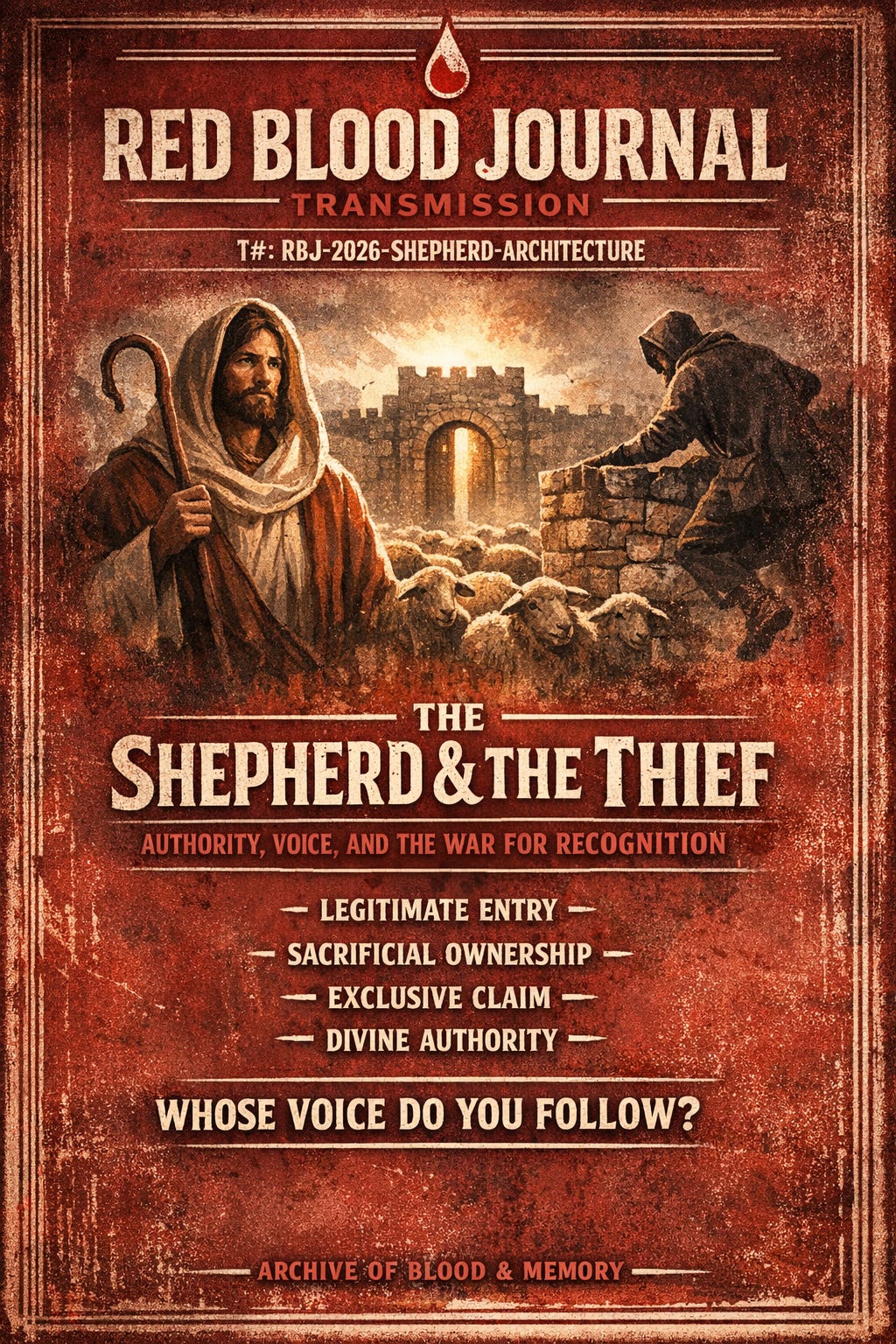
🩸 RED BLOOD JOURNAL TRANSMISSION
T#: RBJ-2026-SHEPHERD-ARCHITECTURE
Classification: Scriptural Power Analysis / Allegorical Authority Mapping
Status: Textual Examination — Gospel Framework
Source Anchor: John 10 (NKJV)
THE SHEPHERD & THE THIEF
Authority, Voice, and the War for Recognition
PROLOGUE — ENTERING THROUGH THE DOOR
In John 10, the figure of the shepherd is not pastoral decoration.
It is a jurisdictional claim.
The imagery is simple:
A sheepfold.
A door.
A shepherd.
A thief.
But beneath the metaphor lies a structural tension:
Who enters through the legitimate gate —
and who climbs in through alternative access?
The chapter begins with an accusation not directed at Rome, but at spiritual leadership itself.
The one who bypasses the door is named plainly:
“A thief and a robber.”
The one who enters through the door is known by recognition, not force.
The sheep follow not because they are driven —
but because they know the voice.
Voice recognition becomes the decisive marker of legitimacy.
I — THE CLAIM OF EXCLUSIVE ACCESS
“I am the door.”
This is not symbolic modesty.
It is exclusivity.
The claim establishes:
• A single authorized point of entry
• Salvation tied to passage through that entry
• Abundant life contrasted with theft and destruction
The contrast is binary.
The thief comes to steal, kill, and destroy.
The shepherd comes to give life — “more abundantly.”
Two architectures emerge:
Architecture of extraction.
Architecture of preservation.
John 10 does not allow neutral middle ground.
II — THE HIRELING MODEL
The hireling flees when danger appears.
This is leadership without ownership.
Authority without sacrifice.
Presence without responsibility.
The wolf becomes a stress test.
When pressure rises, the hireling disappears.
The good shepherd stays.
The distinguishing feature of the shepherd is not rhetoric.
It is willingness to lay down life.
Sacrifice becomes proof of legitimacy.
III — THE POWER TO LAY IT DOWN
“I lay down My life… and I take it again.”
The claim escalates.
This is not martyrdom imposed from outside.
It is voluntary surrender followed by voluntary reclamation.
Power over death is asserted.
Control over life cycle is declared.
This is why division follows.
Some call it madness.
Others see witness in the works.
Miracles function as evidence in a courtroom of perception.
IV — VOICE, BELONGING, AND SELECTION
“My sheep hear My voice.”
The division sharpens.
Belief is not portrayed as intellectual debate alone.
It is framed as belonging.
Recognition precedes agreement.
The text presents a controversial structure:
Some believe because they are His sheep.
Others do not believe because they are not.
This is identity before ideology.
Security is then declared:
“No one shall snatch them out of My hand.”
Protection language mirrors political sovereignty language.
Possession and custody are emphasized.
V — “I AND THE FATHER ARE ONE”
The tension reaches its apex.
The accusation is not about healing.
It is about identity.
“Being a Man, make Yourself God.”
This is the charge.
Blasphemy.
The response references Psalm language —
“You are gods.”
The defense argues consistency within Scripture.
But the underlying issue remains:
Authority is being centralized in one person.
Not prophet.
Not teacher.
But unified with the Father.
This is either ultimate truth
or ultimate heresy.
No middle category is offered.
VI — STONING AS RESPONSE TO CLAIM
When authority threatens structure, stones appear.
The crowd’s reaction is not confusion —
it is escalation.
The works are acknowledged as good.
The problem is the claim of divine unity.
The threat is theological and political.
Because if the claim is true:
All other spiritual intermediaries collapse.
The door is singular.
The shepherd is singular.
The fold becomes unified.
“One flock, one shepherd.”
Centralization of allegiance.
VII — BEYOND THE JORDAN
The final movement shifts geography.
Beyond Jerusalem.
Beyond confrontation.
And many believed there.
Not in the center of power.
But in the periphery.
Recognition spreads not through force —
but through testimony.
“John performed no sign, but all he spoke was true.”
Voice again.
Recognition again.
DEEP PATTERN ANALYSIS
John 10 constructs a framework of authority based on:
• Legitimate entry
• Recognized voice
• Sacrificial ownership
• Exclusive mediation
• Protection from external seizure
It is a complete authority architecture.
And it produces division wherever it is spoken.
Because it forces a choice:
Is the shepherd legitimate?
Or is the shepherd an intruder?
The text leaves no safe neutrality.
CLOSING OBSERVATION
The central tension of John 10 is not pastoral imagery.
It is discernment.
How does one distinguish the shepherd from the thief?
By the voice.
By the sacrifice.
By the works.
And by whether the sheep recognize the call.
🩸
End Transmission
Archive of Blood & Memory
🐑The Architecture of Authority:
The Shepherd and the Thief
The provided text explores the authority and structural themes found in the biblical narrative of John 10, framing the relationship between the shepherd and the flock as a study of legitimacy versus intrusion.
It contrasts the Good Shepherd, who enters through the proper gate and offers sacrificial protection, with the thief and the hireling who prioritize extraction and self-preservation.
Central to this analysis is the concept of voice recognition, where the sheep’s ability to identify their leader serves as the ultimate marker of belonging and spiritual security.
The document asserts that this imagery creates an exclusive claim to divinity, forcing a binary choice between total allegiance or the rejection of a perceived heresy.
Ultimately, the text defines true leadership not through force or rhetoric, but through a voluntary surrender of life and an inseparable union with the Father.


