


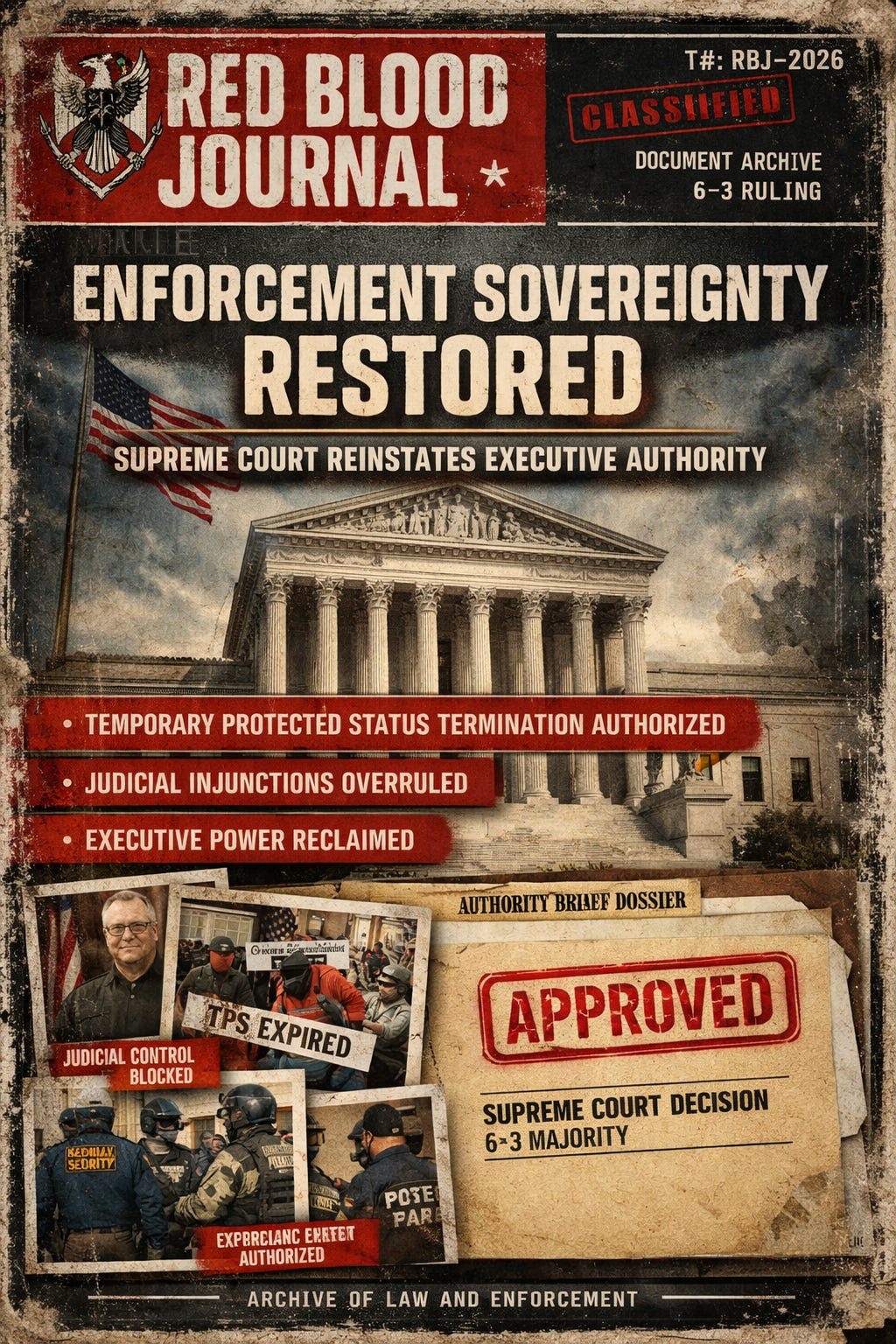
🩸 RED BLOOD JOURNAL TRANSMISSION
T#: RBJ-2026-EXECUTIVE-PRIMACY-IMMIGRATION
Classification: Sovereign Authority Realignment / Judicial Containment Protocol / Population Status Revocation Framework
Desk: Constitutional Power Analysis Division — Archive of Law & Enforcement
Cross-Reference: Administrative State Expansion Doctrine / Temporary Status Permanence Drift / Judicial Override Containment
PROLOGUE — THE WORD “TEMPORARY” THAT LASTED DECADES
In law, words are supposed to mean what they say.
Temporary.
Permanent.
Authority.
Jurisdiction.
But in practice, legal definitions are not enforced by their meaning. They are enforced by power.
For more than three decades, a humanitarian mechanism known as Temporary Protected Status (TPS) existed inside a paradox. It was designed as a short-term refuge for foreign nationals whose home countries had suffered disasters, wars, or collapse. The intention was explicit: grant safety until stability returns—then terminate protection.
Instead, “temporary” became indefinite.
The Supreme Court has now intervened.
And with a single 6-3 decision, the structure of immigration enforcement—and the balance of power between courts and the executive branch—has been redefined.
6-3
SECTION I — THE ORIGIN OF TEMPORARY PROTECTION
Temporary Protected Status was established in 1990 as a humanitarian safety valve.
Its purpose was simple:
Provide temporary refuge
Allow legal work authorization
Protect individuals from deportation
Maintain protection only until conditions improve
Typical duration: 6 to 18 months.
But the system evolved differently.
Extensions multiplied. Deadlines moved forward repeatedly. Months became years. Years became decades.
6-3
By the time of the Court’s intervention:
The average TPS holder had lived in the United States for over 12 years.
6-3
Approximately 600,000 individuals were directly affected.
6-3
Broader TPS designations potentially covered over 1.2 million people.
6-3
A temporary system had become a semi-permanent population category.
Not by legislation.
But by procedural extension.
SECTION II — THE CONFLICT BETWEEN BRANCHES OF GOVERNMENT
The central legal question was not immigration.
It was authority.
Specifically:
Who has the final power to end temporary immigration protections?
The executive branch argued that if it has authority to grant temporary protection, it must also possess authority to terminate it.
Lower courts disagreed.
Federal judges issued injunctions blocking termination, effectively freezing executive enforcement.
This created a new power structure:
Executive branch decisions → suspended by individual district judges → nationwide enforcement halted.
6-3
Over time, district courts issued more than 300 nationwide injunctions blocking immigration enforcement actions.
6-3
A single courtroom could override federal enforcement policy across all 50 states.
This was not theoretical.
It was operational reality.
SECTION III — THE SUPREME COURT INTERVENTION
The Supreme Court majority ruled decisively:
The executive branch has authority to terminate temporary immigration protections without requiring approval from lower courts.
6-3
This ruling reasserted three constitutional principles:
Congress writes immigration law
The executive enforces immigration law
Courts interpret law—but cannot permanently override executive enforcement authority
The Court emphasized a structural logic:
Temporary programs can be ended because they are temporary.
6-3
No permanent justification is required to end a temporary measure.
The existence of temporariness itself is the justification.
SECTION IV — THE HIDDEN MECHANISM: INJUNCTION PERMANENCE
A phenomenon known as “injunction creep” had emerged.
Temporary court orders were repeatedly renewed.
Each renewal delayed enforcement.
Each delay strengthened the argument that termination would cause disruption.
This created a legal feedback loop:
Delay → normalization → dependency → political resistance → further delay.
6-3
In effect, temporary protection became permanent not by law—but by procedural inertia.
This is how administrative permanence is manufactured.
Not through legislation.
Through time.
SECTION V — THE HUMAN AND STRUCTURAL DIMENSION
TPS holders had become integrated into the economic structure:
Legally employed
Paying taxes
Supporting families
Embedded in communities
Removing protection introduces cascading effects:
Loss of legal work authorization
Loss of legal status
Exposure to deportation proceedings
Yet deportation itself operates under logistical constraints.
Enforcement agencies prioritize cases based on criminal history and operational feasibility.
Mass removal is not instantaneous.
It unfolds gradually.
6-3
The Court’s decision does not trigger immediate deportation of all affected individuals.
It restores authority to terminate protection.
Enforcement remains a separate operational process.
SECTION VI — THE REAL SIGNIFICANCE: EXECUTIVE AUTHORITY RESTORED
The most consequential effect of the ruling is not TPS itself.
It is precedent.
The Court has clarified:
Temporary executive programs fall primarily under executive control.
Lower courts cannot indefinitely suspend executive enforcement authority through procedural injunctions.
This redefines the structural relationship between:
Executive branch → primary authority
Judicial branch → interpretive authority, not enforcement override authority
The ruling removes what had become a structural barrier to executive enforcement discretion.
SECTION VII — THE PRECEDENT EFFECT
This decision establishes a framework that extends beyond TPS.
It affects:
Deferred immigration programs
Future executive humanitarian designations
Temporary administrative protection mechanisms
Future administrations now operate with clarified authority.
Temporary status can be granted.
Temporary status can be revoked.
Without indefinite judicial suspension.
SECTION VIII — THE POWER STRUGGLE BEHIND THE CASE
At its core, this case was not about immigration alone.
It was about control over administrative reality.
Three competing centers of authority exist in modern governance:
Legislative branch → creates law
Executive branch → executes law
Judicial branch → interprets law
When courts block enforcement indefinitely, interpretation becomes operational control.
The Supreme Court has now rebalanced that structure.
Executive authority over enforcement has been reaffirmed.
FINAL ASSESSMENT — THE RESTORATION OF ENFORCEMENT SOVEREIGNTY
The most important transformation is structural.
The decision did not invent executive authority.
It re-confirmed it.
Temporary protection was never intended as permanent residency.
The Court has reasserted that administrative temporariness must remain temporary—unless Congress explicitly changes the law.
The immigration system did not change overnight.
But the architecture governing its enforcement has.
The executive branch now holds clarified primacy over temporary protection programs.
And the judiciary’s ability to indefinitely suspend enforcement has been structurally constrained.
ARCHIVE NOTE
This transmission documents a shift not in immigration policy alone, but in constitutional operational hierarchy.
Authority did not move.
It returned.
⚖️The Restoration of Executive Primacy in Immigration Enforcement
This text analyzes a significant Supreme Court ruling that re-established the executive branch’s power over immigration enforcement, specifically concerning Temporary Protected Status (TPS).
For years, legal maneuvers and judicial injunctions effectively transformed short-term humanitarian relief into indefinite residency for hundreds of thousands of people.
The court’s 6-3 decision determined that the presidency maintains the unilateral right to end these programs without being blocked by lower court interference.
By limiting the ability of judges to issue nationwide injunctions, the ruling shifts the balance of power back toward executive authority.
Ultimately, the document argues that this change ensures administrative definitions of “temporary” status are strictly upheld rather than expanded through procedural delays.
The decision serves as a broader constitutional precedent that reinforces the executive’s role in executing law while constraining the judiciary’s operational control over federal policy.


