


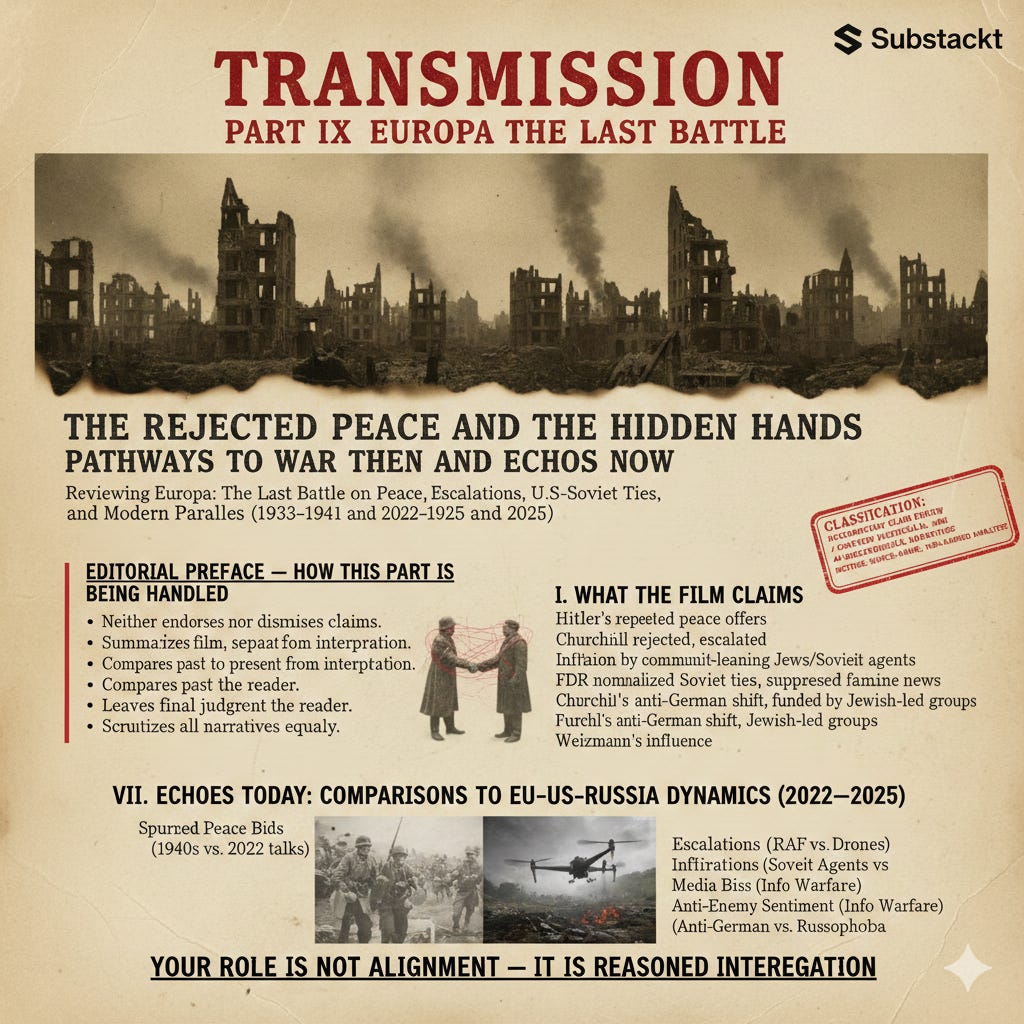
🩸 RED BLOOD JOURNAL — TRANSMISSION
PART IX EUROPA THE LAST BATTLE
THE REJECTED PEACE AND THE HIDDEN HANDS: PATHWAYS TO WAR THEN AND ECHOES NOW
Reviewing Europa: The Last Battle on Peace Offers, Escalations, U.S.-Soviet Ties, Infiltrations, and Modern Parallels (1933–1941 and 2022–2025)
Classification: Documentary Claim Review / Contested Historical and Geopolitical Narratives
Method: Source-aware, non-aligned analysis of film assertions, extended to contemporary comparisons
EDITORIAL PREFACE — HOW THIS PART IS BEING HANDLED
This section neither endorses the documentary’s claims nor those of mainstream historical or journalistic accounts.
It does not dismiss any perspective out of hand.
Instead, it does the following:
Accurately summarizes what the film claims across both segments
Separates claim from documentation
Identifies where accounts align, diverge, or remain unresolved
Draws parallels to current EU-US-Russia dynamics, using verified sources from diverse viewpoints
Leaves final judgment to the reader
If the film accuses journalists and historians of deception, this review applies the same scrutiny to the film itself—and to all narratives, past and present. Both sides may deceive or tell truths; the reader decides.
I. WHAT THE FILM CLAIMS — IN ITS OWN ARC
Combining the two segments, Europa: The Last Battle presents a narrative of orchestrated conflict:
Adolf Hitler extended repeated peace offers to Britain (via Mussolini, Sweden, leaflets, speeches, and Rudolf Hess’s 1941 flight), proposing troop withdrawals from occupied territories, safeguards for the British Empire, and anti-communist cooperation
Winston Churchill rejected or concealed these, escalating through civilian bombings to quell domestic peace movements and involve the U.S.
Britain started deliberate terror bombing of German cities, prompting reluctant German retaliation (the Blitz)
U.S. and British governments faced infiltration by communist-leaning Jews and Soviet agents, with Franklin D. Roosevelt normalizing Soviet ties in 1933, relying on such advisors, and allowing media suppression of Soviet atrocities (e.g., Ukrainian famine)
Churchill, claimed to have Jewish heritage and funded by Jewish-led groups like “The Focus,” adopted anti-German policies from 1936, swayed by Zionist figures like Chaim Weizmann who pledged U.S. war entry
Journalists like Walter Duranty minimized Soviet horrors, promoting falsehoods about communism to maintain alliances
This depicts a unified push—via rejections, provocations, infiltrations, and misinformation—to sustain war against Germany, bypassing public calls for peace.
II. DOCUMENTED POINTS WHERE ACCOUNTS ALIGN
Elements from both segments intersect with various records, though interpretations differ:
Peace Contacts and Escalations
Informal peace explorations occurred in 1940–41, including indirect signals through intermediaries
Hess’s solo flight to Scotland in May 1941 is confirmed; he was imprisoned without talks
RAF strikes hit German cities (e.g., Berlin) prior to the full Blitz; escalation unfolded gradually
British peace rallies took place in 1940, alongside internal Cabinet debates
U.S.-Soviet Relations and Networks
Roosevelt established diplomatic ties with the USSR in November 1933, naming William Bullitt ambassador
Reporters like Malcolm Muggeridge documented the Ukrainian famine (Holodomor); Duranty publicly understated it but privately acknowledged massive deaths
Roosevelt’s circle included Jewish advisors like Henry Morgenthau Jr. and Felix Frankfurter; Executive Order 6102 seized gold
Churchill accepted “The Focus” funding from 1936, with Jewish donors like Sir Henry Strakosch involved
Weizmann’s September 1941 letter to Churchill pushed Zionist goals and U.S. engagement
These facts appear in archives and histories—debates focus on motives and implications.
III. WHERE ACCOUNTS DIVERGE
The film advances interpretations that contrast with other narratives:
Peace Offers and Provocations
The film views Hitler’s proposals as genuine and generous; alternative accounts see them as potential tactical maneuvers amid underlying distrust
It attributes sole initiation of civilian bombings to Britain; other perspectives describe a cycle of mutual escalation in a total war context
Churchill is portrayed as suppressing peace for ulterior reasons; differing views highlight strategic concerns over German continental dominance
Infiltrations and Influences
Jewish advisors are labeled as “communist-leaning Soviet agents”; some (e.g., Harry Dexter White) were later identified as informants via declassified files, but many were seen as progressive policymakers—not a cohesive group
Soviet recognition is tied to intentional deceit; other explanations point to economic needs during the Great Depression
Churchill’s alleged “Jewish heritage” and “purchased” anti-German shift are presented; ancestry claims lack verification, and his cautions on German rearmament preceded the funding
Weizmann’s letter is depicted as a directive; it aligns with wider lobbying efforts, amid events like Pearl Harbor
These divergences stem from varying emphases on evidence—individual actions versus broader patterns.
IV. DOMESTIC POLITICS, MEDIA, AND NARRATIVES
Integrating themes:
The film notes British peace demonstrations and famine minimizations (e.g., Duranty’s awarded but disputed reporting)
Such elements are recorded, but contexts include wartime unity efforts and restricted USSR access for journalists The film stresses concealment and prejudice; alternative accounts frame these as contextual shortcomings amid crises.
V. THE QUESTION OF MOTIVE — WHERE CAUTION IS REQUIRED
The film links war to ethnic/ideological “blocs” (e.g., Jewish networks directing anti-German policy).
A neutral review notes:
Influences, finances, and espionage can be traced (e.g., Venona decrypts on agents)
Yet, ascribing collective intent to groups demands robust evidence, which the film presents interpretively rather than comprehensively. This shifts from analyzing power to assigning group motives, inviting reader evaluation.
VI. THE CORE QUESTION THIS PART LEAVES OPEN
Removing rhetoric: Were WWII peace options realistic, or mirages in unavoidable strife? Did infiltrations favor ideology over state interests?
Accounts differ without necessitating vilification.
VII. WHY THIS PART MATTERS IN THE SERIES
This merged segment questions WWII’s inevitability and moral clarity, suggesting spurned peace and covert forces as conflict catalysts.
Challenging assumptions is fair; imposing certainties is not.
VIII. ECHOES TODAY: COMPARISONS TO EU-US-RUSSIA DYNAMICS (2022–2025)
The film’s themes—spurned peace bids, escalations, infiltrations, media slants, and foe demonization—resonate in the Russia-Ukraine conflict, hinting at recurring patterns. Diverse sources (pro-Ukraine, pro-Russia, neutral) reveal parallels, though viewpoints often reverse the film’s “peace-pursuer vs. instigator” lens (e.g., Russia as aggressor, West as defender). Both narratives may hold truths or distortions; readers assess.
Spurned Peace Bids and Mediations
Then: Hitler’s offers (1939–41) dismissed by Churchill to prolong war.
Now: 2022 Istanbul talks stalled; as of December 30, 2025, U.S.-led efforts (e.g., 20-point plan) show progress but hurdles. Trump-Zelenskyy Mar-a-Lago meeting advanced a 15-year U.S. security guarantee, but Ukraine seeks 30–50 years; Russia alleges a Ukrainian drone strike on Putin’s residence, vowing harder lines and denting hopes. Mutual bad-faith claims echo unaddressed mediations (e.g., via Mussolini); some see Russia as the peace-blocker, others the West.
Escalations and Provocations
Then: Britain purportedly began civilian bombings to elicit retaliation and stifle peace.
Now: Reciprocal strikes (e.g., drones, infrastructure hits) parallel the “phony war” to Blitz; Western aid is labeled provocation by some (akin to RAF raids), while others view Russian actions as initiatory. Munich (1938) analogies caution against “appeasing” Russia, but critics argue dismissed talks extend suffering.
Infiltrations and Influence Networks
Then: Communist/Jewish “fifth columns” in US/UK driving anti-German agendas.
Now: Claims of Russian sway in Western politics (e.g., disinformation, far-right ties) mirror encirclement fears; conversely, Western lobbies (e.g., military-industrial, diasporas) are accused of anti-Russia steering, akin to the film’s “hidden hands.” EU shifts (e.g., sanctions, reconstruction via frozen assets) reflect internal/external pressures, like Roosevelt’s networks.
Media Bias and Propaganda
Then: Duranty’s famine denials bolstered pro-Soviet untruths.
Now: Western reporting faces bias accusations (e.g., selective humanization); Russian/Ukrainian outlets engage in info warfare, fostering divided narratives like WWII propaganda. Censorship and framing sustain conflicts, per analyses.
Anti-Enemy Sentiment
Then: Anti-German zeal suppressed peace.
Now: Russophobia echoes WWII anti-German views, with Putin’s tactics likened to 1930s leaders; disinformation repeats demonization patterns.
Overall, patterns suggest a “playbook” reuse: halted talks, mutual escalations, influence claims, biased media, and polarized views fuel strife. Whether this echoes the film’s thesis or flips it (victim as aggressor) varies by source—patterns warrant examination, not assumption.
CLOSING NOTE TO THE READER
This review does not urge acceptance of Europa: The Last Battle, mainstream histories, or current parallels.
It invites critical examination—
with equal skepticism toward all accounts.
If films, journalists, or historians can deceive, all may.
Your role is not alignment—
it is reasoned interrogation.
👁️Same Conflict Playbook WWII and Ukraine
This text provides a neutral, source-aware review of the documentary Europa: The Last Battle, which presents a revisionist history of World War II.
The analysis explores the film’s assertions that Adolf Hitler’s peace offers were intentionally rejected by Winston Churchill to prolong the conflict through orchestrated escalations.
It further examines claims regarding the infiltration of Western governments by Soviet agents and influential interest groups that allegedly steered foreign policy toward war.
By comparing these historical theories to the modern geopolitical dynamics of the Russia-Ukraine conflict, the source identifies recurring patterns in media propaganda and diplomatic breakdowns.
Ultimately, the author maintains an objective distance, encouraging readers to apply rigorous skepticism to both mainstream narratives and alternative interpretations.


