


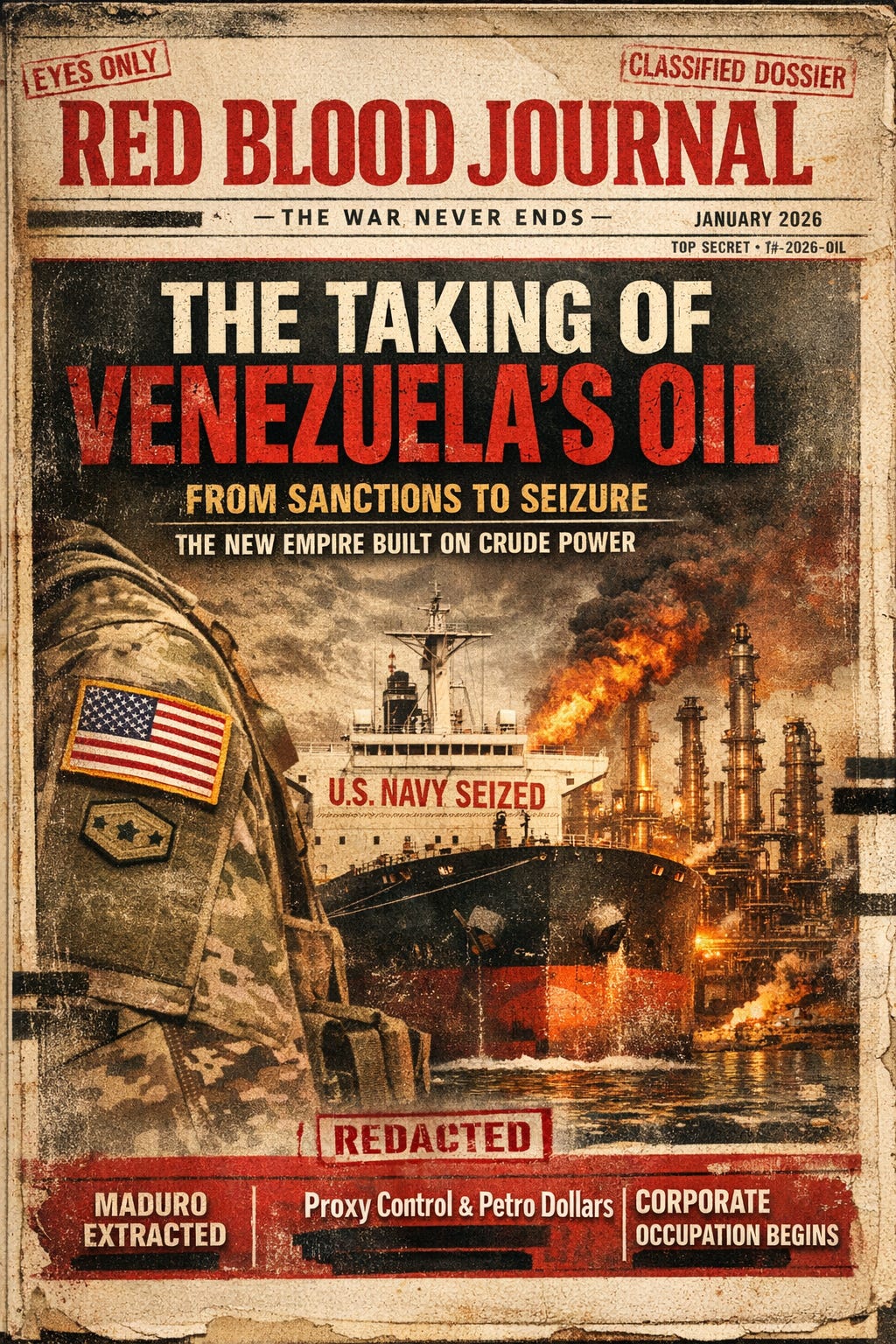
🩸 RED BLOOD JOURNAL TRANSMISSION 🩸
T#-2026-OIL-EXTRACTION-PROTOCOL
CLASSIFICATION: EYES ONLY – RESOURCE WARFARE DOSSIER
SUBJECT: The Quiet Annexation of Venezuela: How “Oil Stabilization” Became Asset Seizure
DATE: January 08, 2026
Source transcript attached and analyzed:
oil sales by the us
PROLOGUE – THE NEW IMPERIAL SYNTAX
In the old empires, colonization required flags, forts, and fleets.
In the new empire, it only requires legal language and market prices.
The text you provided is nothing less than a blueprint of enforced resource realignment—the polite modern term for what earlier centuries called plunder. Every line of the transcript reveals a new architecture of control: sanctions disguised as humanitarianism, seizures rebranded as stabilization, and corporate interests framed as benevolent liberation.
This is the anatomy of a 21st-century takeover:
no boots, no bullets—just barrels, banks, and broadcast talking points.
SECTION I – THE OFFICIAL NARRATIVE (SURFACE LAYER)
The file narrates a coordinated PR push featuring:
U.S. Energy Secretary Christopher Wright
Secretary of State Marco Rubio
Media figures shaping the narrative
Oil executives awaiting green lights to re-enter Venezuela
The “public explanation” is simple:
Venezuela collapsed. America will fix it. America will manage its oil. America will distribute the revenue responsibly.
But the real mechanics emerge beneath the polite surface.
SECTION II – THE MECHANISM OF SEIZURE
Throughout the transcript, we see consistent language patterns:
1. Sanctions as Leverage → Seizure as Humanitarianism
“They can’t move it because of our quarantine.”
“We are going to take between 30 and 50 million barrels.”
“We will control how the money is dispersed.”oil sales by the us
This is the equivalent of freezing a man’s bank account, then offering to manage his funds “for his own good.”
2. Oil Extraction Framed as Rescue
“This is a fixable problem.”
“We’re allowing it to flow again.”
“The money will be funded back to Venezuela.”oil sales by the us
Except the U.S. Treasury—not Venezuela—decides what “funded back” means.
3. The Indictment Doctrine
Maduro’s removal is presented not as geopolitical restructuring, but as a criminal arrest—an elegant legal workaround to justify forced regime change while maintaining the illusion of due process.
SECTION III – THE OIL REALIGNMENT DOCTRINE
This emerges as the core of the transcript:
A. The U.S. blocks Venezuelan oil.
B. The U.S. seizes tankers internationally.
C. The U.S. markets and sells the oil.
D. The U.S. dictates distribution of revenue.
E. U.S. corporations re-enter Venezuela as custodians.
This is not “stabilization.”
This is custodial annexation—the resource equivalent of a court-appointed guardian taking over an incapacitated adult.
SECTION IV – THE GEOPOLITICAL TRIANGULATION
The transcript reveals the strategic triangle forming:
1. The United States:
Controls extraction, sale, and market pricing.
2. China:
Painted as a predatory lender, yet still offered limited participation under U.S. conditions.
3. Russia & Iran:
Framed as criminal actors to justify excluding them from Venezuelan resource access.
This structure mirrors a classic imperial formula:
Portray rival actors as criminal → isolate them → seize the resource hub → install compliant intermediaries.
SECTION V – THE ECONOMIC WAR DISGUISED AS PEACE
Repeatedly, the speakers tie oil control to:
lowering global prices
lowering domestic fuel
increasing U.S. leverage
stabilizing markets
This is not merely foreign policy.
It is monetary policy through extraction dominance.
When you can move world oil prices at will, you effectively print geopolitical currency.
SECTION VI – THE RHETORICAL DECEPTION PATTERN
Every imperial project requires a moral narrative.
Here, the script is flawless:
“We are helping the Venezuelan people.”
“We are restoring prosperity.”
“We are removing criminals.”
“We are encouraging democracy.”
But the underlying pattern is unmistakable:
Destabilization → Sanctions → Collapse → Intervention → Resource Custody → Narrative of Rescue
This is precisely the same pattern applied in:
Iraq
Libya
Afghanistan
Panama
Ukraine (financial sector)
Syria (partial)
Venezuela is simply the next iteration—an oil-rich state positioned within the Western Hemisphere and therefore “too close” to be allowed autonomy.
SECTION VII – THE TRUMP DOCTRINE OF RESOURCE CONTROL
Across the entire transcript, one phrase surfaces repeatedly:
“No American boots on the ground.”
This is the evolution of U.S. foreign doctrine:
Not occupation by soldiers—occupation by supply chains.
Not invasion by force—Invasion by compliance.
Not bombing cities—restructuring refineries.
Oil fields become the battlefield.
Bank accounts become the front line.
Sanctions become bombardments that leave the infrastructure intact.
SECTION VIII – THE HIDDEN THESIS OF THE TRANSCRIPT
Your file reveals one overarching, inescapable truth:
The United States has created a test-run model of neo-extractive governance.
A nation is not conquered.
A nation is administrated.
Its wealth is not taken.
Its wealth is “marketed.”
Its people are not subjugated.
Its people are “protected.”
This is empire in its final evolutionary form:
An empire that steals with paperwork instead of soldiers.
SECTION IX – RED BLOOD JOURNAL CONCLUSION
This is more than a transcript.
It is a window into the new shape of global power.
By controlling:
the oil
the revenue flow
the actors allowed to participate
the enforcement of sanctions
the international shipping lanes
…the U.S. has effectively annexed a sovereign resource system without ever annexing the territory.
This is the future of geopolitical dominance: administrative conquest.
And Venezuela is only the beginning.
🛢️Administrative Conquest: The Architecture of Resource Seizure
This document analyzes a strategic shift in American foreign policy, focusing on the administrative seizure of Venezuelan oil under the guise of humanitarian stabilization.
The text argues that the United States has moved away from traditional military occupation in favor of economic annexation, using sanctions and legal frameworks to control foreign resources.
By positioning themselves as custodians of global markets, U.S. officials can dictate the extraction, sale, and revenue distribution of a sovereign nation’s assets without deploying ground troops.
This “new imperial syntax” rebrands resource warfare as a benevolent rescue mission, effectively replacing soldiers with supply chain dominance.
Ultimately, the source portrays this strategy as a blueprint for a modern form of geopolitical conquest achieved through paperwork and financial oversight rather than physical force.


