


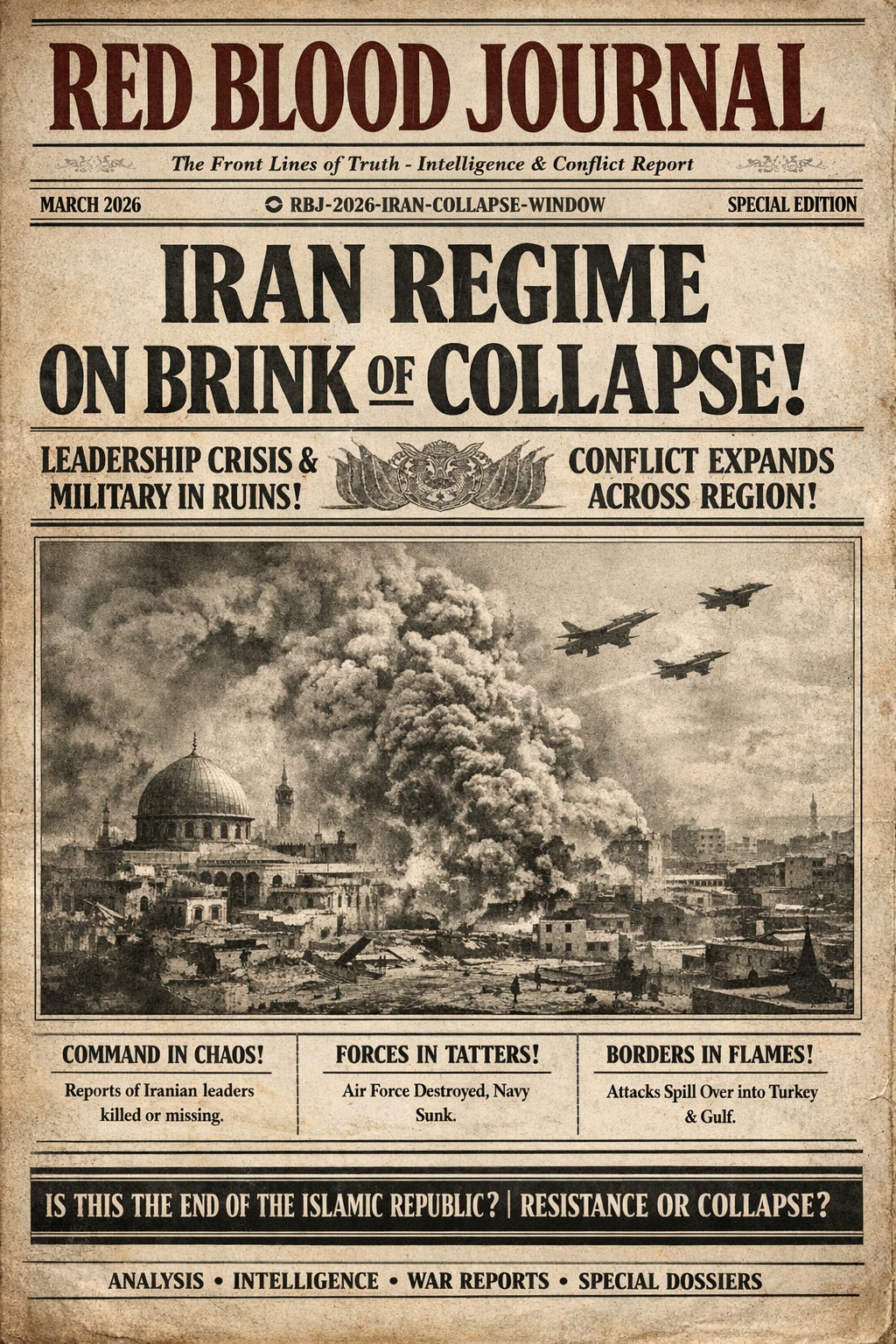
🩸 RED BLOOD JOURNAL TRANSMISSION
T#: RBJ-2026-IRAN-COLLAPSE-WINDOW
Division: Geopolitical Crisis & Regime Stability Analysis Unit
Format: Hybrid Format (Narrative + Analytical Assessment)
Classification: Strategic Observation / Open-Source War Narrative
Transmission Date: March 2026
PROLOGUE — THE COLLAPSE NARRATIVE
Reports circulating across Persian media ecosystems describe a dramatic scenario:
the leadership structure of the Islamic Republic of Iran is portrayed as collapsing under the pressure of coordinated military attacks and internal panic.
In this narrative, statements attributed to Donald Trump suggest that the regime’s command structure has been shattered and that anyone attempting to assume leadership within it may face the same violent fate as their predecessors.
For regime opponents, this message is interpreted as confirmation that the political life cycle of the Islamic Republic is nearing its terminal phase.
Iran
For regime supporters, however, the same events are framed as an existential war requiring religious mobilization and national resistance.
The moment therefore represents a classic collapse narrative battlefield—
where perception, propaganda, and military developments converge.
SECTION I — THE LEADERSHIP VACUUM
One of the central themes in the report is the claim that the regime’s command structure has fractured.
According to the narrative:
• Senior leadership figures have reportedly been killed.
• Members of the council responsible for choosing a successor are missing, hiding, or dead.
• Communication between military command levels has reportedly broken down.
Iran
In such a situation, the succession architecture—the internal mechanism through which authoritarian systems transfer power—begins to fail.
Historically, authoritarian regimes collapse not only because of external attack but because elite coordination disappears.
When no actor can guarantee personal survival by assuming leadership, the system enters paralysis mode.
This phenomenon has been observed in:
Iraq during the final days of Saddam Hussein
Libya during the collapse of Muammar Gaddafi’s regime
Nazi Germany during the final months of World War II
The Persian report frames Iran as entering a similar moment.
SECTION II — MILITARY STRUCTURE DISRUPTION
The report also claims the destruction of major components of Iran’s military structure.
According to statements attributed to American officials:
Iran’s air force has been neutralized.
Naval assets have been destroyed or disabled.
Ballistic missile infrastructure has been targeted.
Iran
If accurate, this would represent the systematic dismantling of Iran’s three-layer deterrence architecture:
Air defense network
Naval control of the Persian Gulf
Missile strike capability
The narrative claims the campaign’s objective is to prevent Iran from ever developing nuclear weapons capability.
This strategic framework aligns with long-standing security priorities of both the United States and Israel.
SECTION III — STREET POWER VS STATE POWER
While leadership and military structures are described as collapsing, the report emphasizes a different battlefield: the streets.
Regime supporters are reportedly being mobilized to maintain visible control of urban areas.
The purpose is psychological as much as operational:
• To signal that the regime still exists
• To prevent opposition crowds from forming
• To maintain the illusion of state continuity
At the same time, opposition narratives claim that public morale inside Iran is shifting dramatically.
Celebrations reported in some areas are interpreted by regime opponents as signs that the population expects the regime to fall.
Such moments represent revolutionary thresholds, where:
Fear of the regime collapses faster than the regime itself.
SECTION IV — REGIONAL ESCALATION
Another critical dimension of the report is the expansion of the conflict beyond Iran’s borders.
The report claims Iranian attacks or attempted attacks on:
Turkey
Gulf Arab states
Regional energy infrastructure
Iran
These actions are interpreted by regional actors as destabilizing escalation.
Diplomatic reactions cited include warnings from Turkey and security alerts across Gulf states.
Such escalation risks triggering:
• Regional coalition responses
• Expanded NATO involvement
• A broader Middle East war architecture
The conflict therefore moves from bilateral confrontation into systemic regional crisis.
SECTION V — THE INFORMATION WAR
Perhaps the most powerful battlefield described in the report is not military but informational.
Two narratives now compete globally.
Narrative A — Regime Collapse
According to opposition media:
Iranian leadership has disintegrated
Military power has been destroyed
The regime is entering its final phase
Narrative B — Existential Resistance
According to regime supporters:
Iran faces foreign invasion
Religious duty requires resistance
War is a divine test
Both narratives serve strategic purposes.
Narrative A encourages defection and uprising.
Narrative B encourages loyalty and mobilization.
In modern conflicts, the outcome often depends on which narrative the population believes first.
SECTION VI — THE STRATEGIC OBJECTIVES
Statements attributed to the White House identify four operational goals for the military campaign:
Destroy Iran’s ballistic missile program
Neutralize the Iranian navy
Disable proxy forces across the region
Prevent Iran from acquiring nuclear weapons
Iran
Notably absent from the official goals is explicit regime change.
However, analysts widely recognize that the destruction of a regime’s military infrastructure often leads indirectly to political collapse.
This creates a strategic ambiguity:
official objective: containment
probable outcome: regime destabilization
ANNEX A — COLLAPSE INDICATORS
Analysts typically monitor several signals when evaluating whether a regime is nearing collapse.
Key indicators include:
Elite fragmentation
Internal power struggles and disappearance of leadership figures.
Military disintegration
Loss of command cohesion across armed forces.
Information chaos
Conflicting narratives between official and unofficial sources.
Public defection
Population openly rejecting regime authority.
Regional realignment
Neighboring states preparing for post-regime scenarios.
The report claims that many of these indicators are now present simultaneously.
ANNEX B — THE FINAL VARIABLE
Despite all military and geopolitical factors, one variable remains decisive:
the behavior of the Iranian population.
External powers can weaken a regime.
But only internal dynamics determine whether a system ultimately collapses or adapts.
The report concludes with the suggestion that the coming weeks may determine whether Iran experiences:
• regime collapse
• negotiated transition
• prolonged war
• or internal consolidation of power
History shows that such moments often appear sudden only in hindsight.
In reality they represent the final stage of processes that may have been building for decades.
End of Transmission
Archive Reference: Red Blood Journal – Geopolitical Crisis Files
💥The Persian Fracture:
Chronicles of a Regime Collapse
This report details a hypothetical geopolitical crisis centered on the potential collapse of the Iranian government under intense military and internal pressure.
It outlines a scenario where coordinated air and sea strikes have neutralized the nation’s defense systems, leaving a leadership vacuum and shattered command structures.
The text examines the dueling narratives of the conflict, contrasting claims of a terminal regime failure with calls for religious mobilization and resistance.
Strategically, the document highlights how the destruction of military infrastructure aims to prevent nuclear proliferation while causing profound elite fragmentation.
Ultimately, the analysis suggests that while external forces can destabilize the state, the actions of the Iranian people will determine if the system truly disintegrates.
This overview serves as a strategic observation of how modern authoritarian regimes face existential threats through combined military and psychological warfare.


