


🩸 RED BLOOD JOURNAL — TRANSMISSION
PART IX EUROPA THE LAST BATTLE
THE PEACE THAT NEVER LANDED
Reviewing Europa: The Last Battle on Churchill, Peace Offers, and Escalation (1940–1941)
Classification: Documentary Claim Review / Contested Wartime Decisions
Method: Source-aware, non-aligned analysis of film assertions
EDITORIAL PREFACE — HOW THIS PART IS BEING HANDLED
This section does not assert that the documentary is correct.
It also does not dismiss it out of hand.
Instead, it does the following:
Accurately summarizes what the film claims
Separates claim from documentation
Identifies where mainstream history agrees, disagrees, or remains inconclusive
Leaves final judgment to the reader
If Europa accuses historians of deception, then this review must apply the same scrutiny to Europa itself.
I. WHAT THE FILM CLAIMS — IN ITS OWN ARC
In this segment, Europa: The Last Battle presents a cohesive thesis:
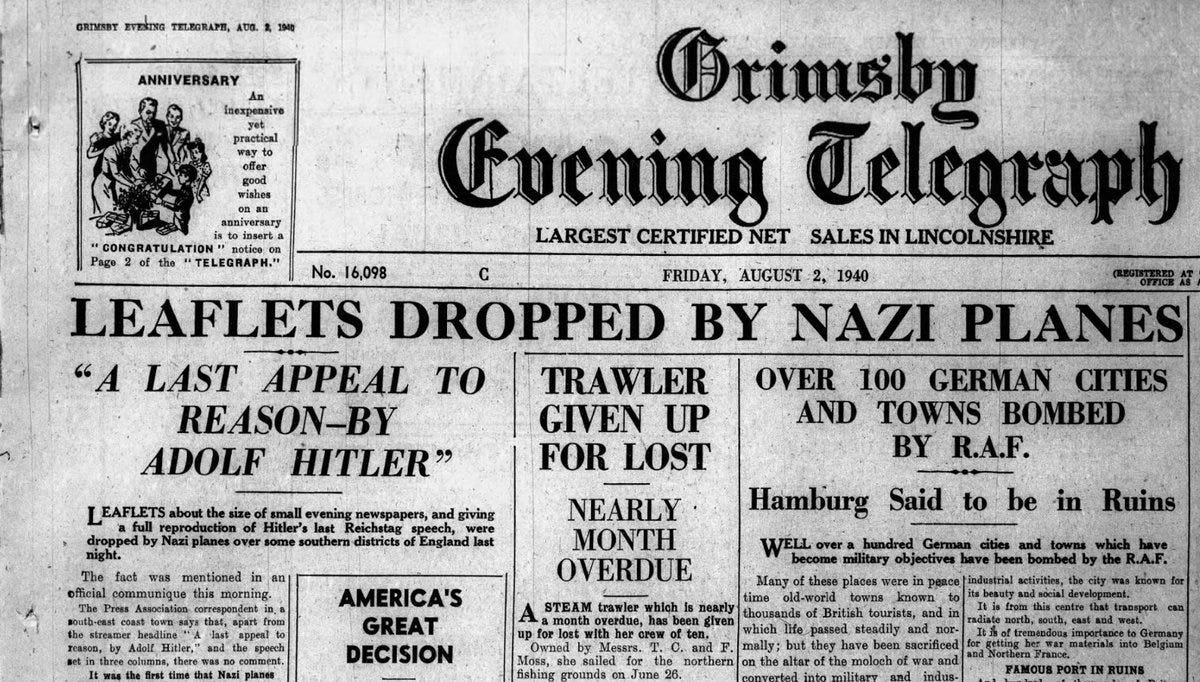
Adolf Hitler repeatedly sought peace with Britain
Winston Churchill consistently rejected or suppressed these offers
Britain allegedly escalated civilian bombing first
Churchill is portrayed as needing war:
to suppress domestic peace movements
to draw the United States into conflict
The documentary further claims:
peace mediation via Mussolini and Sweden was ignored
Rudolf Hess’s 1941 flight was a genuine peace mission
British leadership concealed peace proposals from the public
This is the internal logic of the film.

II. DOCUMENTED POINTS WHERE HISTORY AND FILM OVERLAP
Some elements presented in the documentary do intersect with established records:
1. Peace Feelers and Back Channels
It is historically acknowledged that informal and indirect peace contacts occurred in 1940–41
These were not formal treaties, but exploratory signals and intermediated communications
Historians agree these contacts existed — they disagree on sincerity and feasibility
2. Rudolf Hess Flight (May 1941)
Hess did fly solo to Scotland
He was immediately detained and imprisoned
British authorities treated the act as unauthorized and politically dangerous
No negotiations followed
This event is not disputed, though its meaning is.
3. Air War Escalation Was Not Instantaneous
RAF raids did reach German cities, including Berlin, before the full-scale Blitz
German bombing of London intensified afterward
The escalation occurred in steps, not in a single unilateral act
III. WHERE THE FILM MAKES INTERPRETIVE LEAPS
The documentary then moves beyond documentation into interpretation, which is where neutrality requires distance.
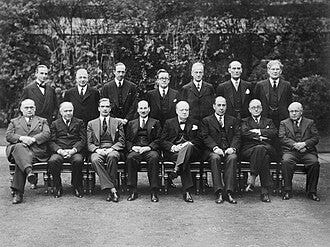
1. “Churchill Wanted War”
The film frames Churchill as:
deliberately provoking escalation
using civilian bombing to force German retaliation
suppressing peace sentiment within Britain
Mainstream historians counter:
Churchill believed any peace would leave Germany dominant in Europe
Britain feared a temporary peace followed by renewed war on worse terms
Strategic mistrust, not provocation alone, guided decisions
This is a difference in interpretation, not a settled fact.
2. Peace Offers as “Generous”
The film describes Hitler’s proposals as:
withdrawals from occupied territories
guarantees of the British Empire
cooperation against communism
What is contested:
whether these offers were concrete, enforceable, or strategic pauses
whether Britain could trust long-term compliance
whether acceptance would have preserved European sovereignty
The documentary treats intent as sincere; historians treat intent as unknowable.
3. Bombing of Civilians
The film asserts:
Britain initiated deliberate terror bombing
Germany responded reluctantly
Historical consensus:
both sides violated civilian immunity
escalation dynamics were reciprocal and politically driven
moral responsibility is shared and context-dependent
The film presents a linear provocation model; history presents mutual escalation under total war logic.
IV. DOMESTIC POLITICS AND THE “PEACE MOVEMENT”
The documentary highlights:
British peace demonstrations in 1940
dissent within Cabinet and Parliament
fear of losing public support
These elements did exist, but historians note:
Britain also feared invasion
morale management was central to survival
peace sentiment did not equal political viability
The film emphasizes suppression; mainstream history emphasizes wartime consolidation.
V. THE QUESTION OF MOTIVE — WHERE CAUTION IS REQUIRED
The documentary introduces claims about:
adviser influence
lobbying pressure
ethnic or ideological blocs steering policy
This is the most sensitive area.
A neutral review must state clearly:
Influence can be studied
Funding networks can be mapped
Ideological alignments can be documented
But collective motive assigned to an ethnic or religious group is not a historical method — it is a political narrative tool.
Here, the film moves from critique of power into attribution of group intent, which requires extraordinary evidence that is not presented at a scholarly level.
VI. THE CORE QUESTION THIS PART LEAVES OPEN
After stripping away rhetoric, the real unresolved question is this:
Was continued war in Britain’s long-term national interest in 1940 — or was peace a missed exit ramp?
Reasonable historians still disagree.
That disagreement does not require demonization of either side to exist.
VII. WHY THIS PART MATTERS IN THE SERIES
This segment of Europa is powerful because it challenges a sacred assumption:
That war was inevitable, necessary, and morally unambiguous.
Challenging that assumption is legitimate.
Replacing it with another absolute certainty is not.
CLOSING NOTE TO THE READER
This review does not ask you to accept Europa: The Last Battle.
It asks you to watch it critically —
with the same skepticism you are taught to apply to official history.
If historians can lie, so can documentarians.
If governments can suppress context, so can films.
Your task is not to choose a side —
it is to interrogate narratives without surrendering reason.


