


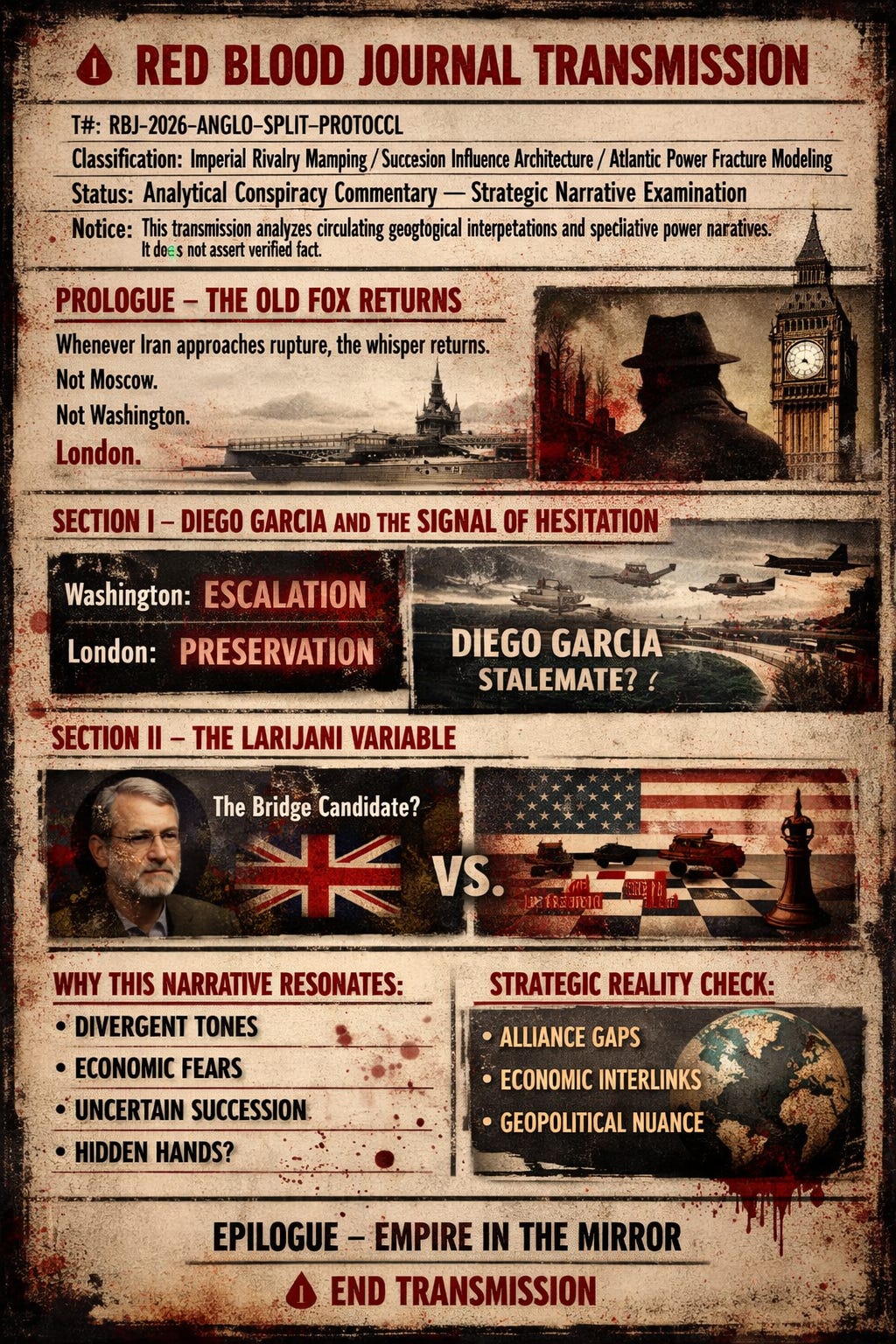
🩸 RED BLOOD JOURNAL TRANSMISSION
T#: RBJ-2026-ANGLO-SPLIT-PROTOCOL
Classification: Imperial Rivalry Mapping / Succession Influence Architecture / Atlantic Power Fracture Modeling
Status: Analytical Conspiracy Commentary — Strategic Narrative Examination
Notice: This transmission analyzes circulating geopolitical interpretations and speculative power narratives. It does not assert verified fact.
PROLOGUE — THE OLD FOX RETURNS
Whenever Iran approaches rupture, the whisper returns.
Not Moscow.
Not Washington.
London.
In the political subconscious of Iran, Britain is never absent.
It does not shout.
It calibrates.
And in moments when war seems near — when aircraft carriers move and red lines are drawn — the question emerges again:
Is there more than one Western will operating here?
SECTION I — DIEGO GARCIA AND THE SIGNAL OF HESITATION
The allegation:
Britain has hesitated to fully enable U.S. operational access to key strategic positions, including Diego Garcia.
Whether accurate or exaggerated is secondary.
In the conspiracy framework, hesitation equals intention.
If the United States projects urgency,
and Britain projects restraint,
the divergence becomes narrative fuel.
Within this lens:
Washington represents escalation.
London represents preservation.
One seeks resolution through confrontation.
The other prefers leverage through continuity.
The absence of synchronized tone becomes interpreted as strategic fracture.
SECTION II — THE LARIJANI VARIABLE
Ali Larijani enters the narrative not as a politician — but as a symbol.
Western-educated.
Diplomatically fluent.
Historically positioned within elite circles.
In speculative commentary, this profile transforms into:
A bridge candidate.
The theory proposes:
If regime survival becomes inevitable,
certain foreign interests may prefer a transitional steward rather than systemic collapse.
A softer interface.
A negotiable figure.
Continuity with flexibility.
Whether grounded or imagined, the Larijani hypothesis becomes the hinge upon which the “British preference” narrative turns.
SECTION III — ATLANTIC DIVERGENCE THEORY
At the heart of the transmission lies a larger archetype:
Old Empire vs. New Empire.
Britain:
Master of indirect governance.
Sculptor of influence without spectacle.
Strategic patience over military drama.
United States (under Trump rhetoric):
Decisive pressure.
Escalation leverage.
Visible dominance.
If the U.S. seeks submission,
and Britain seeks managed equilibrium,
then Iran becomes the board — not the player.
This framing does not require proof.
It requires plausibility anchored in memory.
SECTION IV — WHY THIS NARRATIVE RESONATES
The Anglo-split thesis thrives because:
Western governments rarely speak with identical tone.
Military escalation threatens global markets.
Succession uncertainty creates strategic vacuum.
History supplies precedent for covert maneuvering.
Ambiguity invites authorship.
When outcomes are unclear, invisible hands become explanatory tools.
SECTION V — STRATEGIC REALITY CHECK
Observable facts:
Western alliances are not policy monoliths.
Economic interdependence discourages full-scale war.
The UK historically emphasizes diplomatic containment.
The U.S. establishment itself is divided on regime-change operations.
These differences can produce divergence without secret rivalry.
But in volatile environments, nuance is compressed into rivalry.
SECTION VI — THE FUNCTION OF THE “BRITISH HAND”
Inside Iranian political mythology, the British archetype serves three purposes:
Externalization of manipulation.
Simplification of complex geopolitics.
Psychological continuity with historical grievance.
The “old fox” narrative is less about London —
and more about the human need to map uncertainty onto intention.
EPILOGUE — EMPIRE IN THE MIRROR
Is there a hidden Anglo-American struggle over Iran’s future?
No public evidence confirms such a structure.
Are there strategic differences in tone and preference between Western capitals?
Almost certainly.
But between divergence and conspiracy lies interpretation.
And interpretation — in times of instability — often hardens into doctrine.
In the absence of transparency,
silence is rarely interpreted as coincidence.
It is interpreted as design.
🩸 END TRANSMISSION
🦊The Old Fox and the Atlantic Fracture
This analytical commentary explores a geopolitical conspiracy theory regarding a supposed strategic fracture between the United States and the United Kingdom over the future of Iran.
The text suggests that while Washington favors visible military pressure, London—characterized as the “Old Fox“—reportedly prefers indirect influence and managed stability through figures like Ali Larijani.
This narrative thrives on historical grievances and the perception that Britain prioritizes diplomatic continuity over the chaotic collapse of the current regime.
While no concrete evidence confirms a secret rivalry, the source argues that policy divergences and subtle hesitations are often interpreted by observers as intentional design.
Ultimately, the document examines how narrative architecture fills the void of political uncertainty, transforming nuanced alliance differences into a myth of imperial manipulation.


