


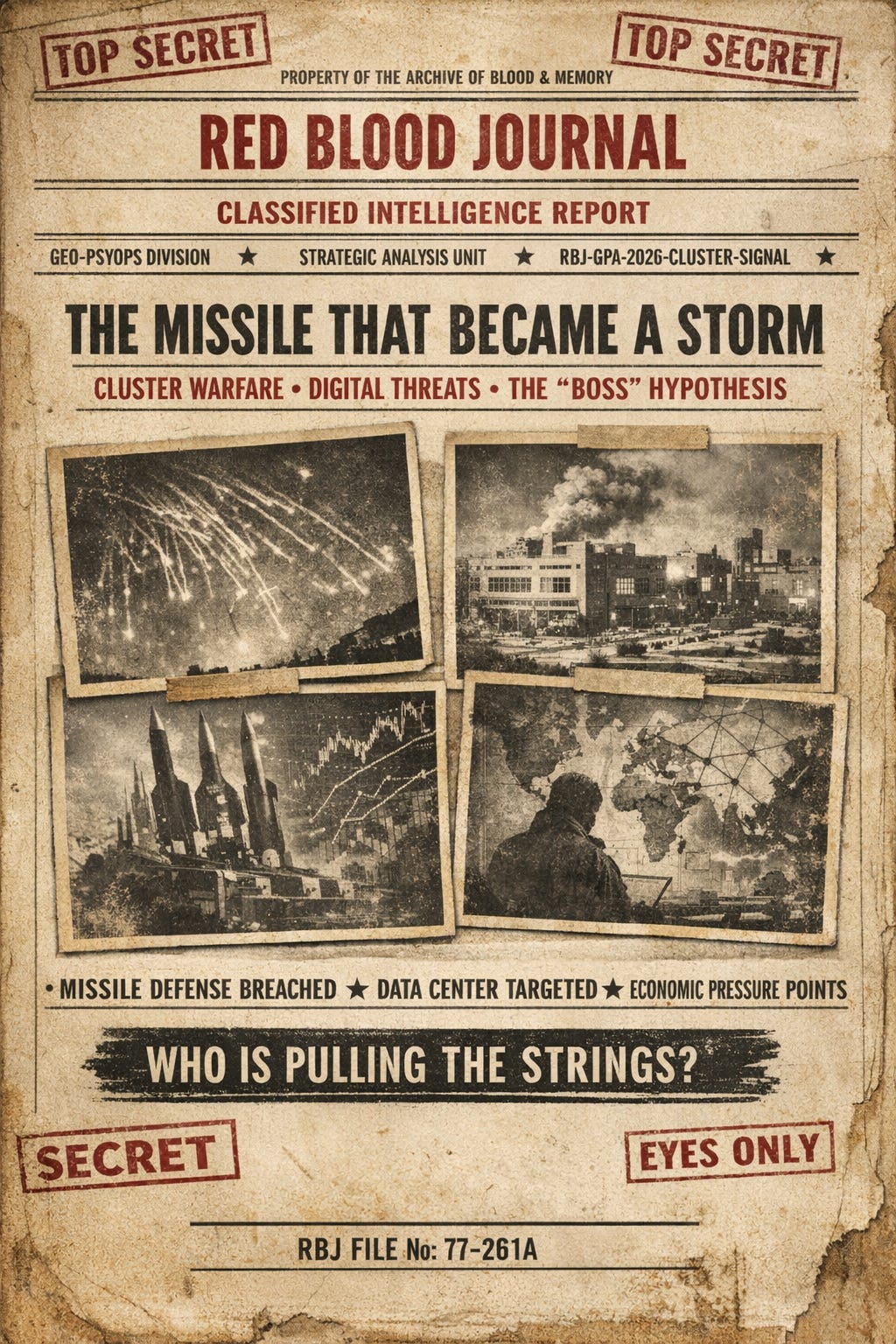
🩸 RED BLOOD JOURNAL TRANSMISSION
Division: Geo-PsyOps & Strategic Power Architecture Unit
Transmission Code: RBJ-GPA-2026-CLUSTER-SIGNAL
Classification: Strategic Analysis / Conspiracy Lens Overview
Archive: The Archive of Blood & Memory
Format: Hybrid Transmission
THE MISSILE THAT BECAME A STORM
Cluster Warfare, Digital Targets, and the Question of the Boss
PROLOGUE — LOOK UP
Seven million people reportedly looked up into the sky.
What appeared above them did not resemble the conventional image of missile warfare. It looked more like fireworks spreading across the night sky — bright trails separating and expanding like an umbrella.
But the spectacle represented something else entirely.
It represented the moment when one missile became hundreds.
The technology being discussed is the cluster missile, a weapon whose tactical logic exposes a deeper strategic question:
Did this conflict simply escalate by accident,
or is something larger unfolding beneath the surface?
SECTION I — BREAKING THE DEFENSE EQUATION
For decades, missile defense systems have relied on a simple principle:
One threat → one response
The sequence is straightforward:
Radar detects an incoming missile.
Its trajectory is calculated.
An interceptor missile is launched.
The threat is destroyed.
Billions of dollars and decades of engineering have been spent perfecting this model.
Cluster missiles disrupt that equation.
The weapon launches as a single detectable projectile, allowing defense systems to lock onto one target.
But at a predetermined altitude, the missile casing opens.
From that shell emerge dozens or hundreds of smaller warheads, spreading outward and continuing toward the ground.
By the time the defense system realizes what has happened, the interceptor has already struck the empty casing.
The submunitions are already falling.
Stopping them individually would require hundreds of interceptors fired simultaneously — something no current system was designed to do.
The result is not merely a tactical challenge.
It is a conceptual breach in the architecture of missile defense.
SECTION II — THE ECONOMIC WARFARE EQUATION
Beyond the engineering problem lies a financial one.
Advanced interceptor missiles can cost millions of dollars each.
Cluster missiles may cost a fraction of that.
This creates a strategic imbalance:
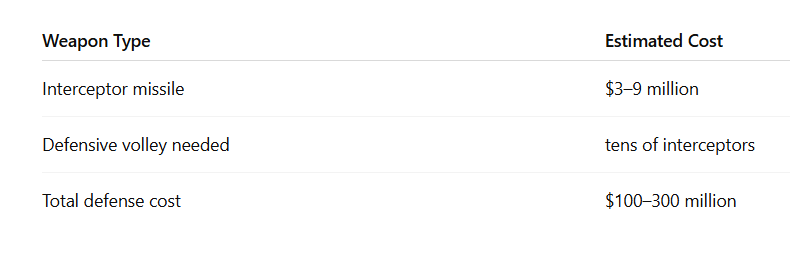
In simple terms:
A relatively inexpensive offensive weapon can force an opponent to spend orders of magnitude more to defend against it.
For military planners, this equation is unsettling.
For geopolitical analysts, it suggests something else:
A deliberate attempt to exhaust the financial logic of advanced defense systems.
SECTION III — THE DIGITAL FRONT
Another reported development raises an even deeper question about the nature of modern warfare.
A strike reportedly targeted a Microsoft data center in the Gulf region.
Unlike airbases or weapons depots, data centers represent something different:
They host the infrastructure of the digital world:
Cloud computing
Financial networks
AI systems
Corporate communications
regional internet services
A strike against such a facility sends a signal.
The battlefield may no longer be limited to military targets.
The infrastructure of global economic systems themselves can become part of the conflict.
In the emerging strategic environment, power flows through cables, servers, and data clusters as much as through missiles and aircraft.
SECTION IV — THE FINANCIAL LAYER
Behind the military developments lies another potential pressure point: global capital flows.
Gulf sovereign wealth funds represent trillions of dollars built from decades of oil revenues.
These funds have historically recycled money into Western financial systems through investments in:
U.S. Treasury bonds
infrastructure projects
technology companies
global real estate
Analysts sometimes refer to this mechanism as part of the petrodollar ecosystem.
If geopolitical tensions alter those investment patterns, the ripple effects could extend far beyond the battlefield.
Interest rates, currency stability, and global trade dynamics could all be influenced by changes in how those funds are allocated.
SECTION V — THE INTELLIGENCE DIMENSION
Precision strikes across the region have prompted speculation among analysts regarding intelligence support.
Some observers suggest the possibility of satellite imagery sharing, which could significantly enhance targeting accuracy.
In modern conflict, information dominance is often as important as military hardware.
Satellites, surveillance systems, and real-time imaging networks can shape the battlefield long before missiles are launched.
If such capabilities are distributed among multiple powers, the traditional advantages held by a single intelligence network could become less decisive.
SECTION VI — THE “BOSS” HYPOTHESIS
Within the Red Blood Journal analytical framework, a recurring question appears whenever multiple geopolitical systems shift simultaneously.
Military.
Financial.
Digital.
Intelligence.
When all four pillars show signs of stress at the same time, some observers begin to wonder whether these developments represent mere coincidence.
Or something else.
The RBJ analytical tradition refers to this possibility as “The Boss Hypothesis.”
The hypothesis proposes that global conflicts sometimes appear chaotic on the surface while quietly advancing deeper structural changes beneath.
From this perspective:
Wars become catalysts.
Financial shocks become leverage.
Technological disruptions become gateways to new systems.
The visible crisis may be only the surface layer of a broader transformation.
Whether such coordination exists remains a subject of debate.
But history repeatedly demonstrates that major geopolitical transitions rarely occur without hidden architecture behind them.
COUNTERINTELLIGENCE NOTES
Several analytical possibilities remain open:
Scenario A — Conventional escalation
The conflict follows the familiar cycle of retaliation, negotiation, and eventual ceasefire.
Scenario B — Technological shift
New weapon systems permanently alter the balance of missile defense strategies.
Scenario C — Systemic transition
The conflict accelerates changes in global financial and technological structures already underway.
Scenario D — Controlled destabilization
Events unfold in a manner that benefits actors seeking to restructure the global order.
FINAL OBSERVATION — WHO WRITES THE SCRIPT?
History often appears random while it is happening.
Only later do patterns emerge.
A missile becomes hundreds.
A data center becomes a battlefield.
Financial alliances begin to shift.
Satellite intelligence changes the map of power.
And across these events arises a persistent question:
If so many systems begin changing at once…
Who, if anyone, is writing the script?
👁️The Architecture of Global Transition:
The Boss Hypothesis
This report analyzes how advanced cluster munitions are currently disrupting traditional missile defense systems by overwhelming them with numerous submunitions that are too expensive and complex to intercept.
Beyond physical weaponry, the text explores how modern conflict now targets digital infrastructure, such as data centers, to destabilize global cloud and financial networks.
The analysis highlights a shift in geopolitical power, suggesting that changes in sovereign wealth investments and satellite intelligence sharing could dismantle established economic orders.
Central to the narrative is the “Boss Hypothesis,” which questions whether these multifaceted crises are coordinated efforts to drive a global structural transition.
Ultimately, the source posits that visible warfare may serve as a catalyst for a deeper, calculated restructuring of international military and financial architecture.


