


🩸 RED BLOOD JOURNAL TRANSMISSION
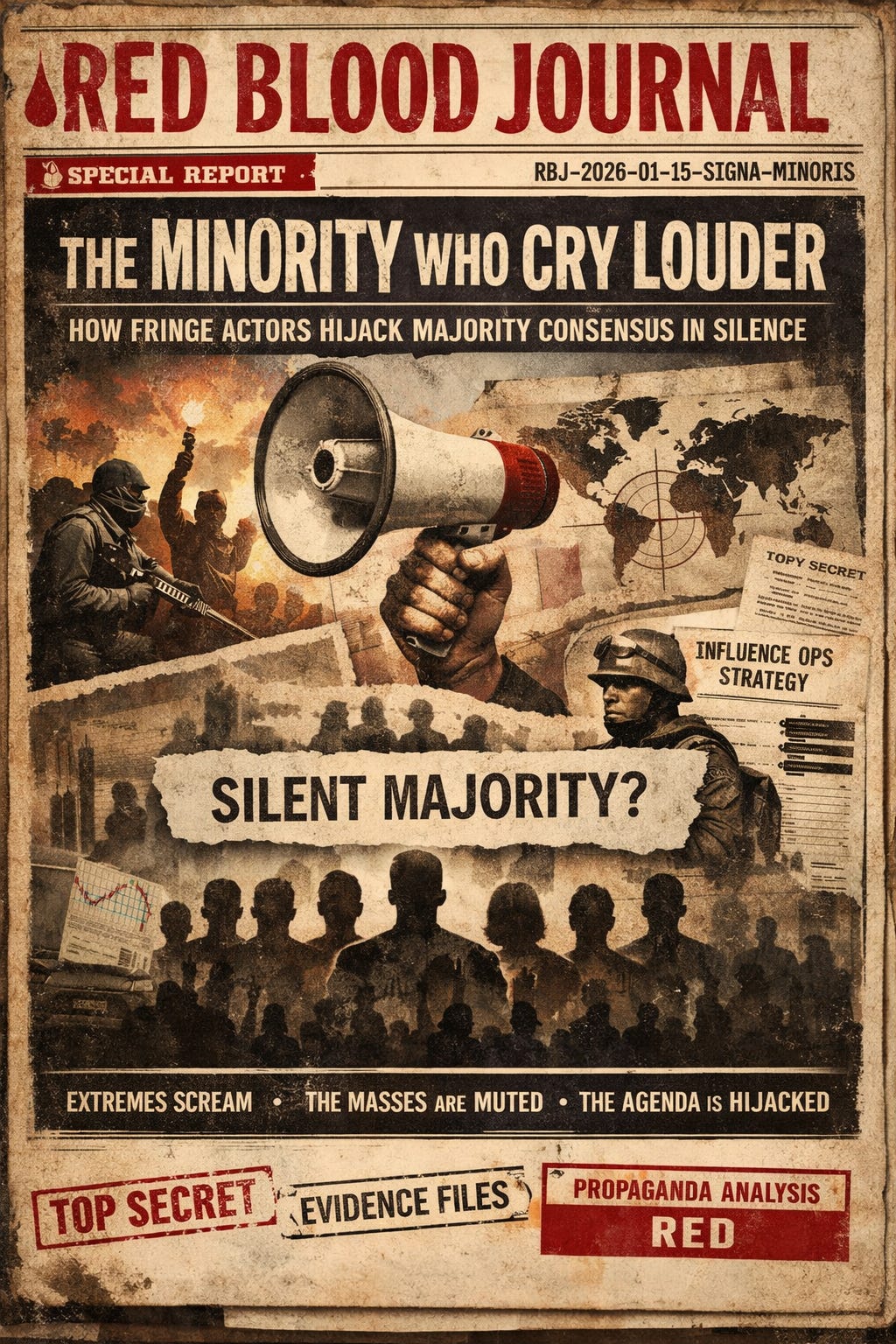
T#: RBJ-2026-01-15-SIGNA-MINORIS
Desk: Narrative Warfare & Cognitive Infrastructure Analysis Unit
Classification: OPEN SOURCE — Conspiracy Cartography & Influence Mapping
**“THE MINORITY WHO CRY LOUDER:
How Fringe Actors Hijack Majority Consensus in Silence”**
🩸 EXECUTIVE SUMMARY
Across global conflicts, political arenas, activist networks, and digital speech-policing infrastructures, the same pattern repeats:
A small coalition of hyper-activated actors—whether groups, institutions, or individuals—can dominate the narrative by mastering amplification tools, crisis framing, and moral urgency. Meanwhile, the broad global majority, with more nuanced or moderate views, becomes crowded out, spoken for, or overwritten.
This Transmission analyzes allegations surrounding the Anti-Defamation League (ADL), its CEO Jonathan Greenblatt’s internal-strategy comments, public reactions, and the wider battlefield of extremism narratives. The focus is NOT on moral judgments of any actor, but on how information power works—who speaks loudest, who shapes perception, and who benefits from framing every disagreement as existential.
This investigation avoids labels and instead examines behaviors, structures, and power dynamics.
🩸 SECTION I — THE EVENT THAT IGNITED THE FLASHPOINT
A transcript from a discussion in Los Angeles revealed ADL CEO Jonathan Greenblatt describing his organization’s behind-the-scenes efforts to counter individuals he views as amplifiers of harmful rhetoric. Among the names referenced:
Nick Fuentes
Tucker Carlson
Candace Owens
Hasan Piker
Ben Shapiro
Ted Cruz
Speaker Johnson
Greenblatt detailed attempts to:
supply lawmakers with data to “take down” voices he identifies as extreme
collaborate with technology platforms on moderation
encourage factions on the right and left to “clean their own house”
The ADL officially describes its mission as countering hatred of all kinds. But critics argue the real-world execution of such missions—by any group, not just the ADL—risks transforming influence into informal gate-keeping of acceptable speech.
Here, we do not assign moral weight.
We examine the mechanisms of influence.
🩸 SECTION II — THE REACTION ECHO CHAMBER
Public figures rapidly responded:
Tucker Carlson
Accused institutional actors of coordinated suppression of speech.
Independent Commentators
Circulated clips suggesting cross-ideological collaboration to marginalize specific voices.
ADL Supporters
Countered by arguing such criticisms fuel broader hate campaigns.
Observation (not accusation):
Both sides weaponized visibility, virality, and moral high ground.
In the digital age:
Volume ≠ Majority
Engagement ≠ Consensus
Visibility ≠ Legitimacy
Often the group that appears dominant is simply the group that speaks the loudest, not the one that reflects the majority.
🩸 SECTION III — EXTREMISM COMPARISON WITHOUT LABELS
This report avoids moral comparison and instead contrasts behaviors:
Shared Mechanisms Among Extremes Worldwide
Regardless of geography or ideology, extremist movements tend to:
rely on simplified “us vs them” narratives
exploit grievance psychology
use high-emotion communication tactics
claim divine, historical, or moral authority
justify violence or coercion as “protective necessity”
This applies in various global contexts—whether:
Islamist extremist factions
Zionist extremist factions
nationalist militant movements
revolutionary ideological fringes
authoritarian state-aligned radicals
Each uses amplification, victimhood framing, and identity imperative to push beyond the weight of their actual numbers.
Meanwhile, the mainstream majority—internationally—often holds more complex views, including:
criticism of state violence
condemnation of terrorism
support for civilian protection
skepticism of censorship
desire for de-escalation
Yet that majority rarely dominates the conversation.
Because moderation is not loud.
Nuance is not viral.
Silence does not trend.
🩸 SECTION IV — LOBBYING, POWER, & THE PERCEPTION OF “HIDDEN HANDS”
The ADL is not alone in facing allegations of disproportionate influence.
In every major sector:
defense alliances
tech moderation boards
religious coalitions
intelligence-adjacent NGOs
diaspora political blocs
activist networks
corporate governance groups
…small, organized minorities shape policies impacting millions.
This is not a “grand conspiracy”—
It is the structural advantage of coordination.
In the U.S. system specifically:
Lobbying remains legal and normalized, overseen by registration frameworks. Critics compare it to “legal bribery”; advocates see essential civic participation.
Wherever one stands, the undeniable fact is:
A well-funded minority can speak louder than a population-sized majority.
Which makes it very easy for observers—right, left, global north, global south—to interpret influence as conspiracy, even when systems are simply designed to reward those who show up with money, organization, and proximity.
🩸 SECTION V — THE NARRATIVE BATTLE OVER GLOBAL VIOLENCE
International institutions, human rights groups, and large segments of world opinion have criticized Israeli military actions against Palestinians, with some labeling them as genocide. Simultaneously, many condemn Hamas and other militant groups for actions against Israeli civilians.
This Transmission does not adjudicate the claims.
It identifies the pattern:
Extremes on both sides scream; moderates on both sides bury their dead quietly.
What the world sees is not the actual majority sentiment—
but the minority willing to weaponize catastrophe for narrative control.
🩸 SECTION VI — META-CONSPIRACY: THE CAPTURE OF SILENT MAJORITIES
The Through-line:
Across all sides of all conflicts worldwide—Israel/Palestine, U.S. politics, religious tensions, ideological divides—tiny factions with:
high emotional intensity
strong networks
influence infrastructure
media access
algorithmic saturation
…manage to speak for entire populations, without their consent.
The silent billions are held hostage by the loud thousands.
The moderate middle is collateral damage.
The narrative battlefield rewards extremes.
This Transmission concludes:
The crisis is not one group vs another.
The crisis is minority rule of perception.
🩸 RED BLOOD JOURNAL CONCLUDING DOSSIER NOTE
This report does not accuse.
It exposes the structural mechanics by which:
extremism
amplification
lobbying
censorship
political warfare
digital manipulation
emotional rhetoric
…combine into a system where the majority loses agency to the loudest actors.
The conspiracy, if one exists, is not ideological.
It is architectural.
📢
The Architecture of Perception and the Loud Minority
This document analyzes how highly organized minorities leverage emotional intensity and strategic infrastructure to dominate public discourse.
By examining the actions of influential groups like the Anti-Defamation League, the text explores how small factions use lobbying, media access, and crisis framing to overshadow the nuanced views of the global majority.
The analysis suggests that narrative control is achieved through systematic amplification rather than genuine consensus, creating a “minority rule of perception.”
This structural advantage allows extremist voices on all sides of political and international conflicts to speak for entire populations without their consent.
Ultimately, the source argues that the architecture of communication rewards loud, polarizing rhetoric while effectively silencing the more moderate, complex perspectives of the masses.


